My motorcycle club brothers laughed when I collapsed trying to lift my fallen Harley. After fifty years on two wheels
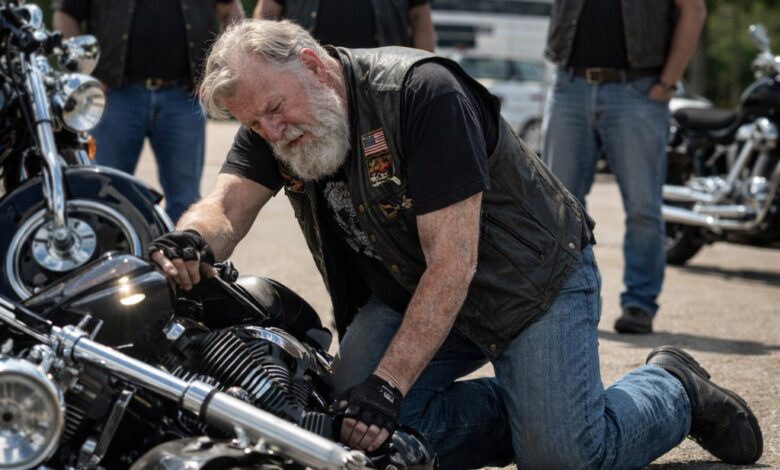
My motorcycle club brothers laughed when I collapsed trying to lift my fallen Harley. After fifty years on two wheels, I’d become what I feared most—a burden they carried out of obligation, not respect.
It happened at Sturgis. Four hundred thousand bikers, and I had to fall in front of my own brothers. My knees gave out as I tried to right my Heritage Softail on uneven gravel. The bike wasn’t even heavy. I’d lifted it thousands of times. But at 72, my body had different ideas.
The laughter cut deeper than the road rash on my hands.
“Easy there, Ghost,” said Razor, our new president. Half my age, twice my strength. He lifted my Harley with one hand while others helped me up. “Maybe time for something lighter? Three wheels?”
The suggestion of a trike felt like a death sentence. In our world, trikes were for men who were finished.
I nodded and mumbled something about thinking about it. But inside, I was bleeding.
That night, I sat alone outside my tent. Younger riders roared past with perfect tattoos and store-bought leather that had never seen real weather. I rubbed my aching knees and traced the patches on my cut. Each one earned through blood and miles these kids couldn’t imagine.
The “Original” patch from 1973. Memorial patches for thirteen brothers who never made it home. Faded colors that had seen rain, snow, and desert sun across all forty-eight states.
I’d started riding when motorcycles were dangerous machines for dangerous men. When breaking down meant you fixed it yourself or you didn’t get home. When brotherhood meant something sacred.
Now I was a relic. A ghost.
The next morning, Razor approached with several younger members.
“Ghost, we had a club meeting last night. We think it’s time you retired your patch.”
The world stopped spinning.
“The road’s changing, old man. The club needs to change too. You’re slowing us down. You’re a liability.”
Each word hammered into me. I looked at the faces around me. Some sympathetic. Others impatient. A few I’d personally brought into the club looking away in shame.
“I earned these colors,” I said. “Earned them when you were still in diapers.”
Razor shrugged. “Nobody’s taking that away. But everything has its season. Yours is over.”
They walked away. Left me alone with my bike and fifty years of memories that suddenly felt hollow.
I had three choices. Beg to stay. Walk away with dignity. Or remind them who I really was.
I called Tommy Banks. My road brother from the 70s. Hadn’t spoken in twenty years. He’d left the life to become a trauma surgeon.
“Tommy? It’s Ghost. I need a favor.”
“Ghost? Jesus, I thought you were dead!”
“Not yet. But the club thinks I should be.”
I explained everything. The humiliation. The dismissal. When I finished, silence.
“So what are you going to do?” Tommy finally asked.
“Something stupid. Something to remind them what this life used to be about.”
Two days later, I pulled up to Tommy’s house in the Black Hills. The man who greeted me looked nothing like the wild-eyed biker I’d known. But his handshake was still iron.
Inside his garage was a medical office. Tommy prepared an injection.
“Stem cell therapy for joint regeneration,” he explained. “I’ve been working with aging athletes. This is legitimate—not back-alley bullshit.”
As he worked on my knees, we caught up. His research. His divorces. His kids. I told him about the brothers we’d lost. The roads I’d traveled. How the club had changed.
“There’s more than one way to ride into the sunset,” Tommy said. “The Medicine Wheel Run is tomorrow. Five hundred miles through the Black Hills in a single day. No stops except gas. Even the young guns respect it.”
“And you think I should enter? With these knees?”
“This treatment won’t make you twenty again. But it’ll help the pain. The rest?” He shrugged. “That’s up to the stubborn bastard I used to ride with.”
I left with less pain than I’d felt in years. And a plan that would either restore my honor or kill me.
The next morning, I rode to the starting line. Five hundred bikers registered. Most half my age. When I pulled up, Razor looked surprised.
“Ghost? What the hell are you doing here?”
I ignored him. Registered. Checked my bike. The Heritage wasn’t the fastest machine there. But it had taken me across this country nine times.
“You’re making a mistake, old man,” Razor said. “This run will break you.”
I looked at him. “Maybe. But I earned these colors on the road. If they’re going to be taken from me, that’s where it’ll happen.”
The run began at dawn. Five hundred bikes thundering through the Black Hills. Younger riders pulled ahead quickly, racing each other. I kept steady, letting my Harley speak to me through the handlebars.
The first hundred miles were easy. The second, less so. By mile three hundred, riders were dropping out. Exhaustion. Mechanical failures. Lack of will.
My knees ached, but Tommy’s treatment held. The challenge wasn’t pain. It was endurance.
I’d been riding since before these men were born. I knew how to become one with the machine. How to let the road hypnotize you into a state where there was only the next mile, the next curve, the next horizon.
At mile four hundred, I passed Razor on the roadside. His bike’s engine smoking. Our eyes met. Neither of us spoke. I didn’t stop. This wasn’t about helping him. This was about finishing what I started.
When I crossed the finish line, only thirty-seven of five hundred remained. I wasn’t first. But I was there. I had finished what men half my age couldn’t.
As I dismounted, my legs nearly buckled. My back felt like fire. But I was standing.
Word spread through Sturgis. The old man who completed the Medicine Wheel Run. By nightfall, riders from clubs across the country stopped to shake my hand.
Razor found me at the campsite as the sun set.
“Can we talk?”
I nodded. He sat across from me.
“What you did today… that was something.” He cleared his throat. “The club had a meeting. About you. We voted unanimously. Your patch stays with you. For life.”
I looked into the fire. “Why the change of heart?”
“Because you reminded us what this is supposed to be about. Not how young you are or how fast you ride. It’s about heart. Brotherhood. Earning your place on the road.”
He extended his hand. “We’d be honored if you’d ride with us tomorrow. Lead the pack.”
I looked at his hand. Then past him to where the rest of the club had gathered.
“I’ve been thinking about what it means to be a ghost,” I said slowly.
Razor frowned.
“A ghost isn’t just something left behind. It’s something that refuses to be forgotten. That haunts the living with memories of what came before.”
I stood up. My knees protested but held.
“I’ll ride with you tomorrow. But not as your burden or your good deed. I ride as the ghost of what this club used to be. What it could be again.”
Razor nodded. “Fair enough.”
The next morning, five hundred bikers gathered for the traditional Sturgis legacy ride. At the front, an old man on a Heritage Softail wearing faded colors and fifty years of stories on his back.
As we thundered down the highway, younger riders fell in behind me. Following my lead through curves I’d known for decades. They could have passed me. Could have shown off their speed. But they didn’t.
They were learning what I’d known all along. That brotherhood isn’t measured in miles per hour but in the years you’ve survived to ride another day. In the wisdom earned through breakdowns and crashes and getting back up.
In understanding that someday, if they’re lucky, they too will become ghosts on the highway. Carrying the memory of what it truly means to be a rider.
I’m still riding. Still feeling the wind and the rumble of American iron beneath me. My knees still ache on cold mornings. I don’t ride as far as I once did.
But now when young riders see me at a stop, they don’t look past me. They come up and ask about my patches, my old bike, the stories written in my face.
And I tell them. Because that’s what ghosts do. We haunt the living with memories of what came before. So they understand what they’re part of. So they know that someday, if they earn it, they too will become the last brotherhood.
Because we all become ghosts eventually. The only choice is what kind. One that fades away, or one that rides on in the stories of those who follow.
I know which one I’ve chosen. And every time I throw my leg over my Harley, I ride not just for myself, but for all the ghosts who came before me. For the brotherhood that never dies as long as there are those who remember.
And sometimes, late at night when the roads are empty, I swear I can hear them riding beside me. All the brothers I’ve lost over the years. Their bikes gleaming in moonlight. Their laughter carrying on the wind.
Ghosts, every one.
But still riding. Always riding.