My Sister and I Were Separated in an Orphanage – 32 Years Later, I Saw the Bracelet I Had Made for Her on a Little Girl!
My name is Elena, and when I was eight years old, I made my little sister a promise I wasn’t old enough to understand.
“I’ll find you,” I told her. “No matter what.”
Then I spent the next thirty-two years believing I’d failed.
Mia and I grew up in an orphanage where the walls were always scuffed, the lights always too bright, and the beds lined up like someone had measured childhood and decided it should come in rows. We didn’t have parents to miss in the normal way. No framed photos. No stories about who we looked like. No “they’ll come back for you someday” fairy tale. We had a file with a couple of sentences and a staff member who told us to be grateful we had food.
But we had each other.
Mia followed me everywhere. If I went to the dining hall, she was at my elbow. If I walked down the hall to brush my teeth, her little hand latched onto mine. If she woke up at night and didn’t see me, she cried until someone brought her to my bed, where she curled into my side like she belonged there.
I learned early how to take care of her. I learned to braid her hair without a comb, fingers working carefully through tangles. I learned how to swipe an extra bread roll and hide it in my pocket for later. I learned which adults were kinder if you smiled and which ones were only kinder if you stayed quiet.
We didn’t dream about big things. We didn’t talk about careers or futures the way other kids might. Our dream was smaller, sharper, and more urgent.
We just wanted to leave together.
Then one afternoon, a couple came to visit.
They walked through the orphanage with the director, nodding politely, smiling too much. They looked clean and comfortable, the kind of people you see on posters about adoption—handsome, generous, ready to “change a life.” They watched the children play. They asked questions. They lingered in the room where I sat in a corner reading to Mia, her head resting on my shoulder.
A few days later, the director called me into her office.
“Elena,” she said, smiling as if she’d practiced it, “a family wants to adopt you. This is wonderful news.”
My stomach dropped. “What about Mia?”
Her smile tightened. “They’re not ready for two children,” she said with a rehearsed sigh. “She’s still young. Other families will come for her. You’ll see each other someday.”
“I’m not going,” I said. “Not without her.”
The director’s voice stayed sweet, but her eyes didn’t. “You don’t get to refuse. You need to be brave.”
Brave, in that place, meant obedient.
The day they came, Mia clung to my waist so hard her fingers left marks. She screamed my name until her voice cracked.
“Don’t go, Lena! Please don’t go! I’ll be good, I promise!”
I held her so tightly one of the workers had to pry her away. I kept repeating the only words I had.
“I’ll find you,” I whispered into her hair. “I’ll come back. I promise.”
Her cries followed me out the door and into the car and down the road, a sound that lodged in my chest and never fully left.
My adoptive family lived in another state. They weren’t cruel. They fed me. They gave me my own room, my own bed, clothes that fit. People told me I was lucky.
They also didn’t want to hear about the orphanage. They didn’t want to hear about Mia.
“That’s over now,” my adoptive mother would say when my voice got too quiet at the dinner table. “We’re your family now. Focus on that.”
So I learned to fit. I learned English better. I learned which parts of myself were welcome and which parts made people uncomfortable. Mentioning my sister made conversations go stiff. Teachers changed the subject. Friends didn’t know what to say.
So I stopped saying her name out loud.
But in my head, she never stopped existing.
When I turned eighteen, I went back to the orphanage.
Different staff. New kids. The same smell of bleach and old paper. I gave them my old name, my new name, my sister’s name. A woman disappeared into a records room and returned with a thin file she held like it was a fragile thing.
“Your sister was adopted not long after you,” she said. “Her name was changed. Her file is sealed. We can’t share more.”
“Is she okay?” I asked. “Is she alive?”
The woman’s expression didn’t change. “I’m sorry.”
I tried again a few years later. Same answer. Sealed. Changed name. No information.
It was like someone had erased her and written a new life over the top. Like Mia had been folded into the system and filed away.
Meanwhile, my life kept moving forward the way life does when it doesn’t stop for grief.
I finished school. I worked. I married too young and divorced. I moved apartments and cities. I got promotions. I learned to drink decent coffee and pretend I wasn’t still carrying a child-sized ache inside my ribs.
From the outside, I looked like a normal woman with a stable, slightly boring life.
Inside, I was still eight years old, hearing my sister scream my name.
Some years I tried to search for her—online databases, agencies, every dead-end avenue people suggested. Other years I couldn’t bear another locked door. Mia became a ghost I couldn’t fully mourn because I never had proof she was gone.
Then, last year, my job sent me on a three-day business trip to a city I didn’t care about. Office parks. A cheap hotel. One good coffee shop. Nothing memorable.
On the first night, tired and irritated by emails, I walked to a supermarket to grab something quick to eat.
I turned into the cookie aisle.
A little girl stood there, maybe nine or ten, staring intensely at two different packs of cookies like the decision mattered more than anything else in the world. As she reached up, her jacket sleeve slipped down.
And I saw it.
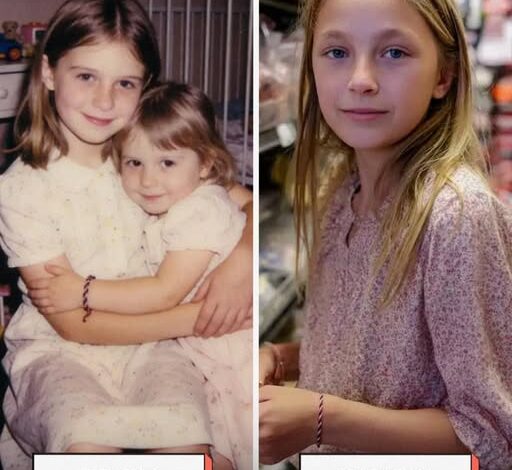
A thin braided bracelet, red and blue, worn and slightly frayed but unmistakable.
My body stopped before my mind could catch up. My fingers actually tingled, as if they remembered the thread.
When I was eight, the orphanage received a box of craft supplies. I stole two colors of thread—red and blue—and spent hours trying to make friendship bracelets like the older girls had. Mine came out crooked, too tight, tied with an ugly knot.
I tied one around my wrist.
I tied the other around Mia’s.
“So you don’t forget me,” I told her. “Even if we get different families.”
She wore it the day I left.
Now it was on this child’s wrist, decades later, like time had folded in on itself.
I stepped closer, voice gentle because I didn’t trust my face.
“That’s a really cool bracelet.”
She looked up, curious, not afraid. “Thanks. My mom gave it to me.”
“Did she make it?” I asked, trying to sound normal.
The girl shook her head. “Mom said someone special made it for her when she was little. Now it’s mine. I can’t lose it or she’ll cry.”
A woman approached with a box of cereal. Jeans, sneakers, hair pulled up. No heavy makeup. Ordinary in the way mothers often are when they’re tired and running errands.
Then she looked at her daughter and smiled.
And something in my chest lurched.
Her eyes. The tilt of her eyebrows. The way she squinted at labels. Her walk, her posture—small, familiar details that slammed into me like a memory given a body.
The girl tugged her sleeve. “Mom, can we get the chocolate ones?”
The woman laughed softly, then glanced at me. “Sorry,” she said politely, the way people do when they sense they’ve interrupted something.
“I was just admiring the bracelet,” I managed.
Her hand brushed her daughter’s wrist with a tenderness that made my throat close. “She won’t take it off,” she said. “Because I told her it matters.”
“Did someone give it to you?” I asked, and my voice shook despite my effort.
The woman’s expression shifted—just a fraction, but enough. Her eyes sharpened.
“Yeah,” she said slowly. “A long time ago.”
“In a children’s home?” The words fell out before I could stop them.
Her face went pale.
“How do you know that?” she asked.
“I grew up in one,” I said. “And I made two bracelets like that. One for me. One for my little sister.”
The woman stared at me like she was seeing a ghost she’d both wanted and feared.
“What was your sister’s name?” I asked, barely breathing.
Her daughter’s eyes went wide as if she could feel something big happening without fully understanding it.
The woman hesitated, then said, “Elena.”
My knees almost gave out.
“That’s my name,” I whispered.
The little girl looked between us. “Mom,” she said softly. “Like your sister.”
For a moment we stood there in the cookie aisle, surrounded by fluorescent lights and ordinary life—shopping carts rolling by, someone laughing near the dairy section—while my world cracked open and rearranged itself.
“Are you…” the woman started, voice thin. “Elena?”
“Yeah,” I said. “It’s me. I think.”
We checked out in a blur and went to the small café attached to the store. The little girl—Lily, she said—got hot chocolate. We got coffee we didn’t drink.
Up close, every doubt dissolved. The nose. The hands. The nervous laugh. All Mia, just grown.
“They told me you got adopted,” she said, eyes shining. “They said you were happy and that was it. I thought you forgot me.”
“Never,” I said, and the word came out raw. “I went back when I was eighteen. They told me your name was changed and your file was sealed. I tried again. I kept trying. I didn’t know if you didn’t want to be found.”
“They changed my last name,” she said. “We moved. Every time I asked, they said that part of my life was over. I tried to look you up when I was older, but I didn’t know where to start.”
Lily watched us carefully, clutching her cup, absorbing the shape of a history she’d never been told.
“What about the bracelet?” I asked.
Mia glanced at Lily’s wrist, her mouth trembling.
“I kept it in a box for years,” she said. “I couldn’t wear it anymore, but I couldn’t let it go. When Lily turned eight, I gave it to her. I told her it came from someone important. I didn’t want it to die in a drawer.”
Lily lifted her arm proudly. “I take good care of it,” she said.
“You did,” I told her, and my voice broke.
We talked until the staff started wiping tables and stacking chairs. About memories that matched perfectly. About the chipped blue mug everyone fought over. About hiding under the stairs. About the volunteer who smelled like oranges.
Before we left, Mia looked at me with tears on her cheeks and said, “You kept your promise.”
“I tried,” I whispered.
“You did,” she said. “You found me.”
We didn’t pretend thirty-two years hadn’t passed. We didn’t pretend everything would be easy. We started small—numbers exchanged, photos, calls, careful visits when money and schedules allowed.
But when I think about the day I left the orphanage, I don’t only hear Mia screaming my name anymore.
I also see this: two women sitting in a grocery store café with bad coffee, laughing and crying at the same time, while a little girl swings her legs under the table and guards a crooked red-and-blue bracelet like it’s treasure.
After all those years, I never thought this is how I’d find her.
But I did. And this time, I wasn’t letting go.