My Smart Home Said She Was Fine—But Her Silence Was Freezing
My mother called me in the middle of a blizzard to say she was freezing to death, but my phone’s smart-home app insisted her living room was a toasty seventy-two degrees.
“It’s broken, Michael,” her voice cracked over the line. “The air… it feels like ice. I can’t stop shivering.”
I looked at my dual-monitor setup, the unread emails piling up, and the untouched lunch on my desk. Efficiency is my religion. I solve problems for a living. And right now, the data told me there was no problem.
“Mom, I’m looking at the sensor readings right now. The furnace is firing at eighty percent capacity. It’s warm there.”
“It doesn’t feel warm,” she whispered.
I sighed, a sharp sound that I hoped the phone’s noise-cancellation would filter out. “Fine. I’m coming.”
I grabbed my keys and whistled for Dante.
Dante is not a normal dog. He is a Xoloitzcuintli—a Mexican hairless breed. To the uninitiated, he looks like a prehistoric accident. His skin is slate-gray, tough, and entirely bald except for a ridiculous mohawk of coarse hair between his ears. He has anxiety issues, he hates strangers, and because he has no fur, he is perpetually cold. I usually keep him in cashmere sweaters that cost more than my own shoes.
I couldn’t leave him alone—he tears up the drywall if I’m gone for more than four hours—so I wrapped him in his thickest fleece vest and carried him to the car.
The drive to the suburbs took forty minutes of white-knuckle navigation through the sleet. My blood pressure was spiking. I had a Zoom call in two hours. I had a gym session scheduled. I had a life to manage.
When I pulled into the driveway of the small, 1970s ranch house where I grew up, the windows were glowing warm yellow. It didn’t look like a house in distress.
I unlocked the front door and was immediately hit by a wall of heat. It was stifling. The thermostat in the hallway read seventy-four.
“Mom?” I called out, stripping off my heavy coat. “Mom, it’s a sauna in here!”
I marched into the living room, ready to give a lecture on how to read a digital display. I was ready to explain, with logic and facts, that her sensory perception was failing.
Then I stopped.
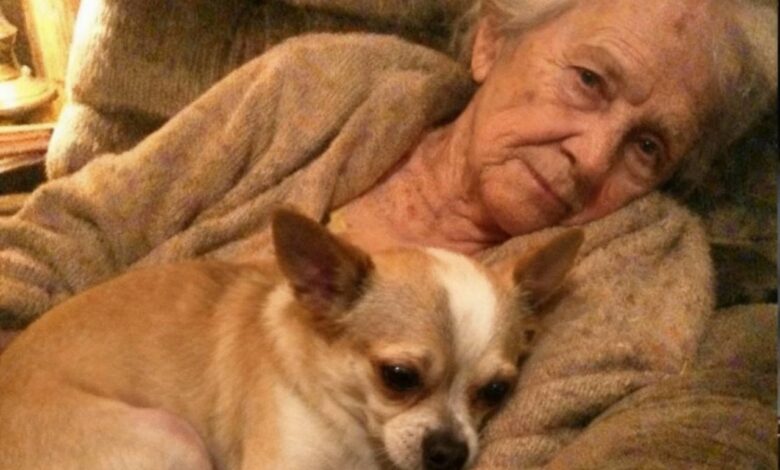
My mother was sitting in her old beige recliner, the one with the flattened cushion where my father used to sit. She wasn’t wearing her heavy robe. She was just in a thin cardigan.
And Dante was there.
My neurotic, stranger-hating, high-maintenance dog had climbed up onto the chair. But he wasn’t shivering. He wasn’t growling.
Dante had wiggled out of his expensive fleece vest. It lay discarded on the floor. He was pressed tight against my mother’s side, his naked, slate-gray skin touching her hand. He had curled his body into a “C” shape, molding himself against her hip and stomach. His head was resting heavily on her thigh, eyes closed, breathing in a slow, rhythmic trance.
My mother’s hand, gnarled with arthritis, was slowly stroking his warm, hairless back.
“He’s so hot,” she whispered, not looking at me. “I didn’t know dogs could be this hot, Michael. He’s like a little furnace.”
“He’s a Xolo,” I said, my voice losing its edge. “They were bred to be healers. Ancient people used them as bed warmers for the sick. They radiate heat differently.”
“He came right to me,” she said. “I thought he would bark. You always say he hates new people.”
“He usually does.”
I walked over and checked the thermostat on the wall again. “Mom, the heat is working. It’s seventy-four degrees. You shouldn’t be cold.”
She stopped stroking Dante for a second. The dog let out a low, grumbling sigh of protest, and she immediately resumed her rhythm.
“I lied,” she said softly.
I froze. “What?”
She finally looked at me. Her eyes were clear, but they looked tired. So incredibly tired.
“The furnace isn’t broken, Michael. The house is warm. The walls are warm.” She tapped her own chest, right over her heart. “I’m cold in here.”
She looked back down at the dog. “Since your father died, the silence in this house… it has a temperature. It settles in your bones about four o’clock in the afternoon, and no amount of blankets can get it out. I just… I needed to see someone. I needed to feel something living.”
She let out a shaky laugh. “I was going to ask you to fix the machine. But your dog… he knew I didn’t need the machine fixed.”
I looked at Dante. I had spent thousands of dollars on his training, his diet, and his wardrobe. I treated him like a project to be managed. I treated my mother the same way—a series of tasks to be completed, bills to be automated, safety checks to be run remotely.
But Dante, with his funny face and naked skin, understood the assignment better than I did. He understood that she didn’t need heat; she needed warmth. He offered the only thing he had: his physical presence. His skin against hers. No barriers. No wool. No technology.
I felt a lump rise in my throat, hot and sharp.
I looked at my watch. The Zoom meeting. The gym. The efficiency spreadsheet.
I took my phone out of my pocket and turned it off.
“Move over, buddy,” I said to Dante.
I pulled the ottoman over to the chair. I sat down, close enough that my knee touched her other side. I took her other hand. It was freezing.
“I’m not going anywhere,” I said. “And neither is Dante.”
We sat there for hours while the snow buried the driveway outside. We didn’t talk much. We just sat in the quiet, warmed by a funny-looking dog who knew that sometimes, the only cure for the cold is to be close enough to share a heartbeat.
We live in a world that sells us “smart” solutions for everything. We have apps to track our sleep, thermostats to regulate our air, and devices to simulate connection. But we are biologically ancient. We are pack animals.
We don’t need more heat. We need more warmth.
If there is an empty chair in your life, or an old house you haven’t visited in a while, go there. Don’t send a text. Don’t send a gift card. Go.
Because the most expensive heater in the world can’t do what a twenty-minute visit does.
Be the warmth. Before the winter comes for good.
PART 2 — “The House Was Warm. The Report Said So.”
The blizzard broke sometime before dawn.
I knew because my phone—my loyal little oracle—buzzed on the coffee table with a neat, cheerful notification:
WEATHER CLEARING. ALL SYSTEMS NORMAL.
All systems normal.
Like last night never happened. Like my mother hadn’t admitted that the cold wasn’t in the ducts, but in the silence. Like a naked, anxious dog hadn’t crawled into the hollow of her grief and turned himself into a living hot-water bottle.
I watched my mother sleep in the recliner, her chin dipped toward her chest, Dante still molded to her side. He didn’t look like a “good dog” in the way people like to picture it. No soft fur. No golden retriever smile. Just slate-gray skin, long limbs, a face that looked carved out of old stone—and the faintest ridiculous ridge of hair like a stubborn question mark between his ears.
He breathed slow. She breathed slow.
And for the first time in a long time, the house didn’t feel like a museum.
It felt… inhabited.
I should’ve been relieved. I should’ve checked a box in my head labeled CRISIS AVOIDED and gone back to my life.
Instead I sat on the carpet in my socks, staring at the discarded fleece vest on the floor, thinking about how the dog had wiggled out of it like he’d shed more than fabric.
Subscribe for New Story Updates!
Sign up to get updates on the latest chapters, sequels, and exclusive content.
Website
Your Email…
Subscribe
We use your personal data for interest-based advertising, as outlined in our Privacy Notice.
No barriers, my brain whispered.
No wool. No app. No “I’ll call you later.” No “I’ll set up automatic grocery delivery.” No elegant solutions.
Just skin. Heat. Presence.
My mother made a small sound in her sleep—half sigh, half whimper. Dante’s eyes opened instantly. Not wide. Not panicked. Just… aware. Like he’d been assigned a post and he was staying on it.
He shifted his body tighter against her ribs and she quieted.
I didn’t move.
Because the truth was, I was terrified.
Not of the weather. Not of the furnace.
Of the fact that I had almost believed a number more than I believed my mother’s voice.
When she woke, she didn’t start with “good morning.”
She started with, “Don’t you dare tell me I’m dramatic.”
Her eyes were puffy, but sharp. She had that look mothers get when they’ve decided you are the child again.
“I wasn’t going to,” I said.
“Yes you were.”
I opened my mouth, then closed it. She was right.
She scratched Dante’s shoulder with two fingers. He leaned into it like he’d been starved for touch his whole life—which was ridiculous, because I’d pet him plenty. I’d just never pet him like that. Never like I wasn’t trying to calm him down or correct a behavior.
Never like he was allowed to be messy and needy and alive.
“I’m sorry,” I said, and it came out too quiet to feel like enough.
She watched me for a moment, then nodded once, as if filing it away. “Coffee?”
“I can make it.”
“You’ll burn the house down.”
“I won’t.”
“You will. You always did.”
That was her version of affection: a small insult wrapped in a memory.
I followed her into the kitchen anyway.
The kitchen smelled like my childhood—old wood, cinnamon that had seeped into cabinets over decades, the faint metallic tang of well water. The window above the sink was frosted along the edges. Outside, the world looked rinsed clean, the lawn buried under a smooth, untouched layer of white.
My mother moved slowly, but she moved with purpose. She knew where everything was without looking. Her hands shook a little when she reached for mugs.
“Arthritis?” I asked.
“Age,” she corrected.
She set a mug down, then paused with her palm on the counter like the house was tilting.
I watched her too hard. The way she blinked. The way she steadied herself.
My phone buzzed again. Another tidy update. Another “normal.”
I hated it.
I turned the screen face-down on the table like it was being rude.
My mother noticed.
“Look at you,” she said softly. “Turning it off like some kind of rebel.”
“I didn’t turn it off,” I lied.
She smiled like she could see right through me. “Michael.”
“I muted it.”
“Same thing.”
I poured coffee. The steam hit my face and I realized I hadn’t cried last night, not really. I’d gotten close—lump-in-the-throat close—but I’d swallowed it down like I always did.
Now, standing in the kitchen where my father used to pretend he didn’t know where the spoons were so my mother would find them for him, I felt it again: that hot, sharp pressure behind the eyes.
My mother sipped her coffee and stared out the window.
“I didn’t call you because I was cold,” she said, almost casually, like talking about the weather.
“I know.”
“I called you because I was scared.”
I swallowed. “Of what?”
She didn’t answer right away. Her fingers tightened around the mug.
“Of becoming invisible,” she said finally. “It happens slowly. People stop needing you. Then they stop calling you. Then you start talking to the television like it’s a person.”
I opened my mouth.
She held up a hand. “Don’t you tell me to join a club.”
“I wasn’t going to.”
“Yes you were.”
There it was again. She knew my scripts. Join a club. Get a hobby. Stay busy. All of it was true, and all of it was useless at four o’clock in the afternoon when the house got cold in your bones.
“I’m here,” I said, and even as I said it, I felt the next thought rise in my mind like a calendar reminder:
But not forever.
My mother looked down at Dante. “Is he always this… warm?”
“He runs hot.”
“He should come live with me.”
I laughed, because it was absurd. “He’d destroy your house.”
“Good,” she said. “At least something would change.”
Dante lifted his head at the sound of her voice, ears pricking, mohawk bristling slightly like a tiny antenna. He looked at her with that ancient, unreadable expression that always made people uncomfortable. Like he could see things under the skin.
My mother scratched his chest. He leaned in.
And then she said, very softly, “I didn’t just lie about being cold.”
The air changed.
The same way it had last night when she admitted the truth.
My stomach tightened. “What else?”
She took a breath. “I signed up for one of those… programs.”
“What programs?”
“The ones that let you stay in your house longer.” She said it carefully, like she’d rehearsed. “They installed the sensors.”
I stared. “What sensors?”
She pointed, and for the first time I saw them.
A small white puck above the hallway doorframe. A slim strip near the baseboard. A little box near the thermostat that wasn’t the thermostat.
My brain, which loved systems, suddenly felt like it was crawling out of its own skin.
“You didn’t tell me,” I said.
“You would’ve talked me out of it.”
“I would’ve—” I stopped. Because she was right. I would’ve read the fine print. I would’ve asked about data storage. I would’ve made it about risk and cost and privacy. I would’ve turned her fear into a spreadsheet.
“When did you do this?” I asked.
“A few months ago.”
“And you didn’t think to mention—”
She cut me off. “I didn’t want to be a problem.”
The sentence landed like a weight.
I didn’t want to be a problem.
That was the real disease in this country. Not dementia. Not arthritis. Not heart failure.
The belief that needing people makes you a burden.
I stared at the little devices on my mother’s walls and felt something ugly crawl up my throat.
“Does it notify you?” I asked.
“It notifies someone.”
“Who?”
She hesitated, just a fraction too long.
“Mom.”
“It’s a monitoring service,” she said quickly. “Not a company you know. Just… people. They check the patterns. If I don’t move enough, if the temperature drops, if—”
“If you’re cold,” I said flatly.
She flinched.
My phone buzzed again, like it was enjoying itself.
I picked it up, thumbs moving without thinking, opening the smart-home dashboard I’d built for her. Temperature. Humidity. Furnace load. Door sensors. Motion. All of it clean, simple, obedient.
And now there was a new tab.
WELLNESS.
I stared at it like it was an insult.
There was a graph. “Activity trend.” “Sleep interruptions.” “Kitchen visits.”
My mother’s life reduced to data points.
I looked up. “You let strangers track when you go to the bathroom.”
“They’re not strangers,” she said, defensive now. “They’re trained. They’re… professionals.”
That word—professionals—hit a nerve.
Because I was a professional too. And last night, with all my training and efficiency and devices, I almost dismissed her as a malfunction.
My mother set her mug down hard. “Don’t look at me like that.”
“Like what?”
“Like I’m pathetic.”
I opened my mouth to deny it, but the truth was my face probably did say something like that. Not because I thought she was pathetic.
Because I was scared.
Scared of how close we were to a future where my mother’s loneliness would be managed by strangers and sensors and automated check-ins instead of… me.
“Why didn’t you just call me?” I asked.
Her laugh was small and bitter. “Michael, I did.”
After breakfast, I offered to shovel the driveway.
My mother said, “You’ll throw your back out.”
I said, “I go to the gym.”
She said, “All those muscles and no common sense.”
I shoveled anyway.
The snow was heavy, wet, the kind that clung to the shovel like it wanted to come inside. Dante pranced at the edge of the yard in his fleece vest, offended by the cold and yet compelled by it. Every time a gust hit him, he looked personally betrayed.
As I worked, I kept thinking about those sensors.
About my mother choosing surveillance over bothering me.
About me building her an entire “smart” system and still missing the one thing she needed.
Warmth.
I heard the front door creak.
My mother stepped onto the porch with a blanket around her shoulders, holding a small paper bag.
“What’s that?” I asked, leaning on the shovel.
“Something for you,” she said.
She came down the steps carefully, like the ice might reach up and grab her ankles. She held out the bag.
Inside was an old knit cap.
Gray. Faded. The kind of hat a man wears when he doesn’t care how he looks, only whether his ears freeze.
My father’s hat.
“I found it in the hall closet,” she said, her voice too neutral. “You always used to steal it.”
I stared at the hat like it might bite.
“Mom—”
“Put it on,” she said, almost bossy. “Your ears are red.”
“My ears are fine.”
“They’re red.”
I wanted to argue, because arguing was safer than feeling.
Instead I took the hat and put it on.
It smelled like dust and laundry soap and something I couldn’t name.
Memory, maybe.
My mother’s mouth tightened, like she was holding something back.
Dante trotted over and sniffed the hat, then sneezed dramatically, as if offended by the past.
My mother laughed—really laughed—and the sound startled me. It was brighter than the house, brighter than the snow.
Then her face changed.
She swayed.
The shovel slipped in my hands.
“Mom?”
She blinked like the world had gone blurry. “I’m fine.”
She was not fine.
I dropped the shovel and grabbed her elbow. Her skin was cold, even under the blanket.
“You’re dizzy,” I said.
“It’s nothing.”
I hated that phrase. It’s nothing. The anthem of people who don’t want to be trouble.
I guided her back toward the porch. “Sit.”
She resisted, pride stiffening her spine.
“Mom,” I said, sharper now. “Sit.”
She sat.
Her breathing was shallow.
My brain flipped into diagnostic mode like a switch.
Dehydration. Low blood sugar. Blood pressure. Something cardiac.
But the app—the stupid app—had said “all systems normal.”
I ran inside and grabbed water, crackers, the little blood pressure cuff she’d insisted she didn’t need because “I’m not an invalid.”
I wrapped it around her arm. Pressed start.
The numbers popped up.
Not catastrophic. Not fine.
Her eyes flicked toward the driveway, toward the world, as if she didn’t want the neighbors to see.
I felt a flare of anger that wasn’t really anger at her. It was anger at the culture that had trained her to hide.
“Why didn’t you tell me you were feeling off?” I demanded.
“I didn’t want to ruin your day,” she said weakly.
“My day?” I barked, and Dante startled, ears twitching. I lowered my voice. “Mom, I don’t care about my day.”
She looked at me, and for a moment she looked like she didn’t believe me.
That was the worst part.
Not the dizziness.
Not the sensors.
The fact that my own mother had been trained by my behavior to think my schedule mattered more than her body.
I crouched in front of her. “Listen to me. Last night you called because you were cold in here.” I tapped my chest like she had. “Today you’re dizzy. Those are not interruptions. Those are… alarms.”
Her eyes softened, and for a second she looked very old. “You were always such a serious little boy.”
“I’m serious because I’m scared,” I admitted.
She blinked fast, like she was going to cry but refused to give herself permission.
Then Dante did something strange.
He stepped forward, climbed onto her lap—awkward, bony, all elbows—and pressed his bare forehead against her sternum, right over her heart.
He didn’t lick. He didn’t wag.
He just held.
My mother’s shoulders dropped like she’d been carrying a weight for years and he’d finally convinced her to set it down.
She put a hand on his back and exhaled.
And I watched it happen—the thing I couldn’t quantify.
Her breathing slowed.
Not magically. Not instantly cured.
But enough that the panic in my own chest eased.
I sat beside her on the porch step, cold soaking through my jeans, and I realized something that felt like betrayal:
My dog was better at this than I was.
Later, after she insisted she was fine and I insisted on making soup anyway, we ended up in the hallway where the new sensors were.
I stood there staring at them like they were cameras.
“Do they…” I started, then stopped because I didn’t even know how to ask without sounding paranoid.
My mother read my mind. “They don’t have video.”
“That’s not the point.”
“I know.” She sighed. “Michael, I didn’t do it because I wanted to be watched. I did it because I wanted to stay here. In this house.”
“Why?” I asked, and I hated that it came out like a challenge.
She looked around, and for the first time I saw the house the way she saw it.
Not as outdated real estate. Not as a maintenance headache.
As a map.
“This is where your father…” She trailed off, her throat tightening. “This is where he was. Everywhere. Even in the stupid things. The squeaky step. The cabinet that sticks. The way the bathroom door never shuts right unless you lift it.”
I knew all of those things. I’d just never considered them sacred.
My mother touched the hallway wall, fingers dragging over the paint. “If I leave, it’s like I’m admitting he’s gone for good.”
He is gone for good, my rational brain wanted to say.
But my rational brain was the same one that almost let her freeze alone in a warm house.
So I stayed quiet.
“What about me?” I asked instead, because the question had been rotting inside me for years. “If you stay here because of him… where do I fit?”
My mother’s eyes widened slightly, as if I’d said something vulnerable and inappropriate.
Then she did something she almost never did.
She reached up and touched my cheek.
Her hand was still cold.
“You fit,” she said simply. “But you fit like a visitor. Like you’re afraid to leave fingerprints.”
The words hit hard.
Because she was right.
I’d been treating my mother like a system I could monitor from a distance, not a human being I was allowed to touch.
That afternoon, while she napped, I sat at the kitchen table and did something I hadn’t done in years.
I opened a drawer.
Not for a charging cable or a tool.
For paper.
I found a stack of envelopes. Old bills. Holiday cards. A few handwritten notes.
And at the bottom, folded into a tight square like it was trying to disappear, was a letter.
My name, written in my father’s handwriting.
Michael.
My chest went hot.
I stared at it for a full minute without touching it, like opening it would release something toxic into the air.
Then I unfolded it.
The paper was thin, the ink slightly faded.
My father’s handwriting was never neat. It leaned forward like he was always in a hurry.
It said:
If you’re reading this, it means I’m not there to do the small things anymore.
I know you, son. You’ll want to fix everything. You’ll want to buy the right device, hire the right person, automate the right system.
Do it if you need to.
But don’t forget the one thing you can’t outsource.
Be there.
Your mother doesn’t need a hero. She needs a human.
And if you ever wonder what to do when the house gets cold, remember: the chair isn’t empty. It’s waiting.
There were no dramatic declarations. No “I love you” in big letters.
Just my father, plain as ever, telling me the truth the way he always did.
My hands shook.
I heard a soft sound behind me.
I turned.
My mother stood in the doorway, watching me hold the letter like it was fragile.
“You found it,” she said.
“You knew it was there,” I accused, but my voice cracked.
She nodded, eyes shining. “I didn’t want to give it to you. I wanted you to… stumble into it. Like you used to stumble into the garage and pretend you were helping.”
I laughed, but it came out broken.
My mother walked over slowly. She didn’t take the letter.
She just rested her hand on my shoulder.
Dante padded in behind her, silent as a shadow, and pressed his warm body against my shin.
And I stood there between them—my mother’s cold hand on my shoulder, my dog’s hot skin against my leg—feeling like the world was trying, gently and insistently, to teach me something I’d been resisting my whole life.
That night, I did something reckless.
I posted a video.
Not of my mother’s face. Not of her house. Not of anything identifiable.
Just Dante—this strange, bald little furnace—curled against her hand while she stroked his back in slow circles.
You could hear the quiet in the background. You could hear the clock ticking. You could hear the kind of silence that has weight.
I wrote one sentence:
“My smart home said everything was warm. My mom was still freezing.”
Then I added, without thinking too hard:
“Maybe we’re outsourcing the wrong things.”
I didn’t expect much. A few likes. Maybe a friend commenting “Aw.”
Within an hour, my phone lit up like a slot machine.
Hundreds. Then thousands.
People weren’t just watching.
They were fighting.
Some comments were soft and grateful:
“This made me call my dad.”
“My grandma says the same thing—cold in her bones at four.”
“That dog is an angel.”
Others were sharp, almost angry:
“So now we’re guilt-tripping adult children? Not everyone can drop everything.”
“Parents manipulate. They say they’re ‘lonely’ to control you.”
“What if the kid had trauma? What if the parent was abusive?”
“Stop using your mom’s pain for internet points.”
The thread turned into a battlefield of modern life.
Duty vs boundaries.
Compassion vs self-preservation.
“Family first” vs “Protect your peace.”
I stared at the screen, stomach twisting.
Because the truth was: some of them were right.
Not every parent is safe.
Not every child can come home.
Not every story is my story.
And yet…
There was also the other truth.
The one my father wrote in shaky ink.
Don’t outsource the one thing you can’t outsource.
I wanted to jump into the comments and explain. Clarify. Control the narrative.
But you can’t control grief. You can’t control the way people pour their own history into your words.
My mother wandered into the living room in her slippers, saw my face, and sighed. “What did you do now?”
I showed her the video.
She watched it without expression.
Then she read a few comments.
Her mouth tightened.
“They’re arguing,” she said.
“Yes.”
“About you?”
“About everything.”
She handed my phone back like it was a hot pan. “People love to argue. It makes them feel alive.”
I stared at her. “Does it bother you?”
She shrugged, but I saw the flicker in her eyes. “A little.”
“I can take it down.”
She shook her head. “No. Leave it.”
“Why?”
She looked at Dante, who was asleep in the corner like a collapsed statue. “Because maybe someone out there needs to hear it.”
“But what if they—”
She cut me off. “Michael, if you want to live a life where nobody misunderstands you, you’ll have to never say anything real.”
I went still.
Because that was the most modern sentence my mother had ever said.
By midnight, the video had traveled farther than I could understand.
I got messages from strangers.
Some thanked me.
Some accused me.
Some told me stories I didn’t ask for—stories of parents who were cruel, children who were gone, homes that were not safe, grief that had curdled into rage.
And mixed in with all of it was a single repeating theme:
Everyone is cold.
In different ways.
Some people are cold because they’re alone.
Some are cold because they were hurt and they learned warmth is dangerous.
Some are cold because they’re exhausted, working too much, surviving.
Some are cold because they’ve built a life so optimized there’s no room for mess.
I sat on my childhood couch with my mother asleep in the recliner and Dante pressed against my calf, and I realized something that made my throat tighten again:
We’re all arguing about the same thing.
Who deserves warmth.
Who’s responsible for it.
Who has to give it.
Who gets to refuse.
And maybe that argument is why the video spread.
Not because of the dog.
Not even because of my mother.
Because I accidentally poked the sore spot we all pretend isn’t there:
We’ve built a world where it’s considered normal to be functioning and still be freezing inside.
The next morning, the blizzard was just a memory. The roads were clear. My schedule—my precious schedule—was waiting.
I stood by the front door with my coat on, keys in hand.
My mother watched me from the recliner.
Dante watched me too, ears angled forward, as if he could smell my intention.
I said, “I have to go back.”
My mother nodded like she’d expected it. “Of course.”
And there it was again—that quiet resignation that made my chest ache.
I looked at the chair. The flattened cushion where my father used to sit. The warmth that was only warmth because we had filled it.
I looked at my mother’s hands—cold, gnarled, still capable of stroking a dog like it was prayer.
I looked at my phone on the table, face-down.
It could tell me the temperature of this room. The furnace load. The humidity. The motion in the hallway.
It could not tell me the weight of her loneliness.
It could not tell me when four o’clock arrived and the silence settled into her bones.
It could not tell me when she decided, quietly, not to be a problem.
I set my keys back down.
My mother blinked. “What are you doing?”
I pulled my coat off.
“I’m staying one more day,” I said.
Her mouth opened slightly, like she didn’t know what to do with that sentence.
“That’s ridiculous,” she said automatically, because accepting tenderness is hard.
“I know.”
“You have work.”
“I’ll manage.”
“You have a life.”
I looked at her. “This is my life too.”
For a second, she looked like she might cry.
Then she did what she always did when emotions got too close:
She scoffed. “Well, then at least fix that cabinet door while you’re here.”
I laughed.
Dante sneezed at the exact same time, like he was laughing too.
And in that small, ordinary moment—between a stubborn mother, a weird bald dog, and a son finally leaving fingerprints—I felt something shift.
Not magically.
Not permanently solved.
But warmer.
Here’s the part people in the comments won’t agree on—and maybe they shouldn’t.
Some parents are safe. Some aren’t.
Some children can show up. Some can’t.
Some homes are healing. Some are haunted.
But I learned this, in a warm house during a blizzard:
Data can tell you if a room is heated.
Only a body can tell you if someone is warm.
And warmth—real warmth—has a cost.
It costs time.
It costs inconvenience.
It costs sitting in silence when you’d rather scroll.
It costs being close enough to feel someone else’s trembling.
We’re living in an age where everything can be monitored, optimized, tracked, and managed.
But grief doesn’t care about graphs.
Loneliness doesn’t respond to alerts.
And love—real love—doesn’t arrive as a notification.
It arrives like Dante did.
Unpolished. Unreasonable. Physical.
Pressing skin to skin as if to say:
I’m here. I’m here. I’m here.
So argue in the comments if you want.
About boundaries. About obligation. About guilt. About who owes who.
I won’t pretend there’s one answer that fits everyone.
I only know this:
There are people sitting in warm houses right now, freezing in places no thermostat can reach.
And sometimes the bravest, most controversial thing you can do—
is show up anyway.