My teenage son asked me to drop him off three blocks from school every morning
My teenage son asked me to drop him off three blocks from school every morning. When I finally followed him, I discovered why and it destroyed me.
For six months, Ethan had been making the same request.
“Mom, can you drop me off at the corner of Fifth and Main?”
Not at the school entrance like every other parent.
Three blocks away.
At first, I thought it was normal teenage embarrassment.
He was fifteen. Sophomore year. The age where being seen with your parents is social suicide.
“Sure, honey,” I’d say.
I’d pull over at the corner. He’d grab his backpack. Wave goodbye.
And I’d drive to work thinking nothing of it.
Until last Tuesday.
I had a dentist appointment that got cancelled at the last minute.
I was driving past Ethan’s school around 8:15 AM, right after drop-off time.
And I saw him.
Walking up the front steps.
But he wasn’t alone.
He was carrying two backpacks. His own, and another one.
A smaller one. Pink with unicorn patches.
And next to him was a little girl. Maybe seven or eight years old. She was holding his hand.
I pulled into the parking lot and watched.
Ethan walked her all the way to the elementary school entrance on the other side of the building.
He knelt down. Fixed her hair. Said something that made her smile.
Then he handed her the pink backpack and watched her go inside.
Only then did he walk to the high school entrance.
I sat in my car, completely confused.
Who was that child?
I called the school office.
“Hi, this is Amanda Chen, Ethan Chen’s mother. I have a quick question about the elementary school. Do you have a student named…” I paused. I didn’t even know her name.
“I’m sorry, what student?” the secretary asked.
“Never mind,” I said. “Wrong number.”
I drove home and couldn’t focus on anything.
That night at dinner, I asked casually, “How was school?”
“Fine,” Ethan said. The same thing he always said.
“Anything interesting happen?”
“Not really.”
He wasn’t lying, exactly. But he wasn’t telling me something.
The next morning, I did something I’m not proud of.
I dropped him off at the corner like usual.
Then I parked down the street and followed him on foot.
I watched him walk two blocks.
Then he stopped at a run-down apartment building.
He went inside.
Five minutes later, he came out holding the hand of the same little girl from yesterday.
She was wearing the same clothes. A t-shirt that was too small and jeans with holes in the knees.
Her hair was messy. Unbrushed.
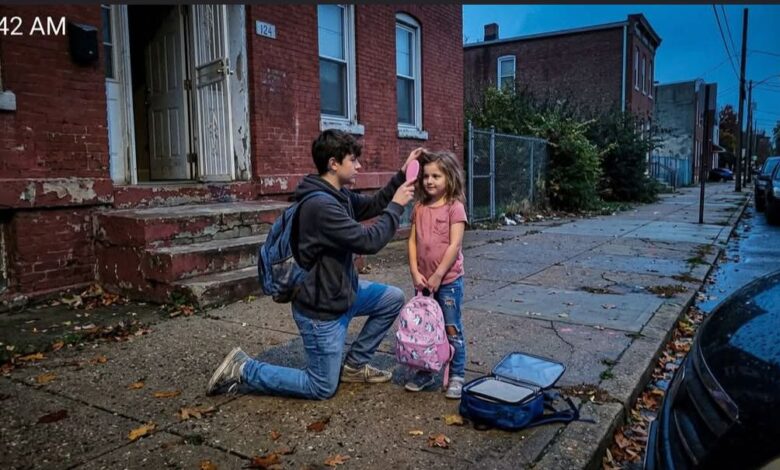
Ethan knelt down on the sidewalk and pulled a hairbrush out of his backpack.
He brushed her hair gently. Carefully. Like he’d done it a hundred times before.
Then he pulled out a lunch box. Handed it to her.
She put it in her pink backpack.
They walked together to school. Hand in hand.
I followed at a distance, crying behind my sunglasses.
At school, Ethan did the same thing I’d seen yesterday.
He walked her to the elementary entrance. Made sure she went inside safely.
Then he went to his own classes.
I drove home and waited.
When Ethan got home that afternoon, I was sitting at the kitchen table.
“Sit down,” I said. “We need to talk.”
He froze. “About what?”
“About the little girl you walk to school every morning.”
His face went white.
“Mom—”
“Who is she, Ethan?”
He sat down slowly. He looked terrified.
“Her name is Sophie,” he said quietly.
“Why are you walking her to school?”
He stared at the table.
“Because no one else will.”
“What does that mean?”
He took a deep breath.
“She lives in the apartment building on Seventh Street. Her mom is… she’s not around much. She works nights. Sometimes she doesn’t come home.”
My heart broke a little.
“Sophie’s eight years old. She was walking to school alone. In the dark. At 7:30 in the morning.”
“Ethan—”
“I saw her one day,” he interrupted. “Six months ago. She was walking by herself, crying. Her backpack was open and her stuff was falling out. Some older kids were laughing at her.”
His voice cracked.
“I helped her pick up her stuff. I asked where her mom was. She said her mom was sleeping and she couldn’t wake her up.”
Tears started rolling down his cheeks.
“She’s eight, Mom. She’s a baby. And she was walking to school alone through a bad neighborhood. Anything could have happened to her.”
“So you started walking with her,” I said softly.
He nodded. “Every morning. I go to her apartment. I make sure she’s awake and dressed. I brush her hair because she doesn’t know how to do it herself yet.”
“The lunch box?”
“I make her lunch at night and bring it in the morning. She was going to school hungry. She told me sometimes she doesn’t eat dinner either because her mom forgets to buy food.”
I covered my mouth with my hand.
“Why didn’t you tell me?” I asked.
“Because I thought you’d make me stop,” Ethan said. “I thought you’d say it’s not our problem. Or that it’s dangerous. Or that I should focus on my own life.”
“Ethan—”
“She needs me, Mom,” he said desperately. “She doesn’t have anyone else. Her mom is barely there. She doesn’t have a dad. She doesn’t have grandparents. She has me.”
He was crying openly now.
“If I stop showing up, she’ll go back to walking alone. She’ll go back to being hungry. She’ll go back to being scared.”
I got up and hugged him.
“You’re not stopping,” I said. “You’re not stopping anything.”
He pulled back and looked at me. “Really?”
“Really. But we’re going to do this right.”
That evening, I went to Sophie’s apartment.
A woman answered the door. Late twenties. Exhausted. Wearing a waitress uniform.
“Can I help you?” she asked.
“Hi, I’m Amanda Chen. My son Ethan has been walking your daughter Sophie to school.”
Her face changed. Embarrassment. Shame. Defense.
“I didn’t ask him to do that.”
“I know,” I said gently. “But he’s been doing it. For six months.”
She looked down. “I work nights. Double shifts. I’m trying to keep the lights on. Sometimes I don’t get home until 7 AM and I’m too tired to wake up when Sophie needs to leave for school.”
“I’m not here to judge you,” I said. “I’m here to help.”
She looked up, surprised.
“I want to set up a routine,” I said. “My son wants to keep walking Sophie to school. I’d like to make sure she has lunches packed. And on days when you’re working late, she can come to our house for dinner.”
The woman’s eyes filled with tears.
“Why would you do that?”
“Because my son taught me something,” I said. “He taught me that we don’t look away when people need help. We show up.”
Her name was Jessica.
She broke down crying on her doorway.
“I’m trying so hard,” she sobbed. “I’m doing everything I can. But it’s not enough. I know it’s not enough.”
“Then let us help,” I said. “Please.”
That was four months ago.
Sophie comes to our house three nights a week now.
She has dinner with us. Does her homework at our kitchen table. Plays with our dog.
Jessica works her shifts and doesn’t have to worry.
Ethan still walks Sophie to school every morning.
But now I drive them both.
And every morning, I watch my son brush a little girl’s hair and make sure she has everything she needs.
And I’m so proud I can barely breathe.
Last week, Sophie’s teacher called me.
“I don’t know what’s happening at home,” she said, “but Sophie is like a different child. She’s happy. She’s focused. Her grades are improving. She told me she has a big brother now.”
I looked at Ethan, who was helping Sophie with her math homework.
“She does,” I said. “And he’s the best big brother she could ask for.”
Yesterday, Jessica got a promotion.
Day shift. Better pay. Health insurance.
She cried when she told me.
“I can be home when Sophie gets out of school now,” she said. “I can actually be her mom again.”
“You’ve always been her mom,” I said. “You were just doing it alone. Now you’re not.”
She hugged me.
“Thank you,” she whispered. “For not judging me. For helping us.”
“Thank Ethan,” I said. “He’s the one who saw her first.”
This morning, Sophie ran up to our car with a drawing.
It was a picture of four people holding hands.
“That’s me, my mom, Ethan, and Miss Amanda,” she said proudly. “We’re a family.”
She’s right.
We are.
Not by blood. Not by law.
But by choice.
My son chose to see a child in need and help her.
And he taught me that family isn’t just the people you’re born with.
It’s the people you show up for.
Every single day.
If you see a child struggling, don’t look away.
If you see a parent drowning, don’t judge them.
If you have the ability to help, help.
Because somewhere, there’s a kid walking to school alone.
Scared. Hungry. Invisible.
And all it takes is one person to see them.
One person to show up.
One person to say, “You’re not alone anymore.”
Be that person.
Like my son was.
Like I’m trying to be.
Because that’s what changes lives.
Not money. Not programs. Not systems.
Just one person who refuses to look away