Neighbor Asked My Son to Shovel Snow for $10 a Day but Refused to Pay — So I Taught Him a Lesson He’ll Never Forget
I’d always known my son Ben had a bigger heart than the world deserved.
He was twelve—gangly limbs, scraped knees, and that particular kind of optimism kids carry before life tries to sand it down. The kind that makes them believe effort is always met with fairness, that adults mean what they say, and that the world keeps its promises if you do your part.
I wish that belief was always true.
It started on a snowy morning in early December. I was making breakfast—eggs, toast, the usual—when Ben came flying into the kitchen, cheeks pink from the cold, hair damp at the edges from melted snow.
“Mom!” he said, out of breath and glowing like he’d won something. “Mr. Dickinson said he’ll pay me ten dollars every time I shovel his driveway!”
Mr. Dickinson was our neighbor. Wealthy. Loud about it. The kind of man who collected luxury cars and bragged about “deals” the way other people brag about their kids’ accomplishments. He liked to talk about business as if it was a sport where you scored points by outsmarting people.
Still, Ben was excited, and I wasn’t going to stomp on that.
“That’s great, sweetheart,” I said, ruffling his hair. “What are you going to do with the money?”
Ben didn’t even hesitate. “I’m buying you a scarf. And I’m getting Annie that dollhouse with the lights.”
He said it with the seriousness of a man announcing an investment strategy. His eyes lit up as he described the scarf—red with tiny snowflakes—and the dollhouse Annie had stared at in the toy store window so long she’d fogged the glass with her breath.
My chest tightened in that way it does when your kid does something kind and you realize you’re raising the type of human you actually want in the world.
“And I’m saving what’s left for a telescope,” he added, almost as an afterthought.
Of course he was.
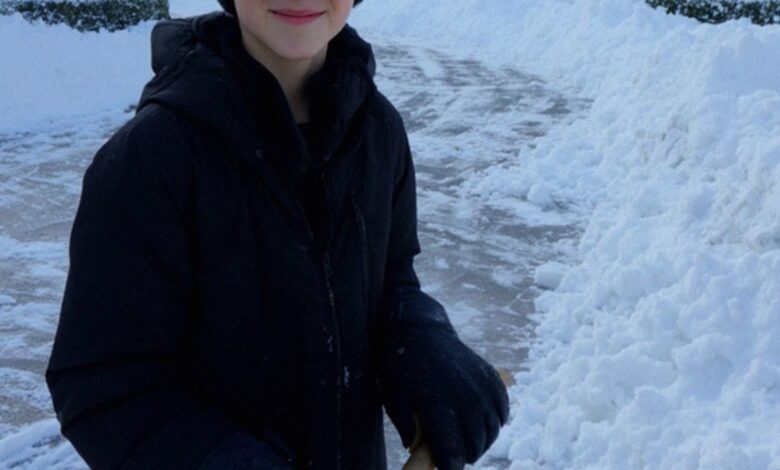
For the next few weeks, Ben treated the driveway like a job site. Every morning before school, he bundled up in his oversized coat, hat pulled down to his eyebrows, and marched across the yard with his shovel like he was heading into battle.
From the kitchen window, I watched him work. The scrape of metal on pavement. The little clouds of his breath. The way he stopped sometimes, hands on the shovel handle, catching his breath with his shoulders rising and falling.
When he came in, his fingers were stiff, his cheeks red, and he always looked like he’d just done something important.
“How’d it go today?” I’d ask, handing him hot chocolate.
“Good,” he’d say, grinning. “I’m getting faster.”
Then, every night, he’d sit at the kitchen table with a beat-up notepad and tally his earnings like it was a ledger.
“Only twenty more dollars, Mom,” he said one night, tapping his pencil like he was counting down to Christmas itself. “Then I can get the dollhouse and the telescope!”
By December 23rd, he was a machine. He left the house humming a Christmas song that wasn’t even the right tune, just the right mood.
I expected him to come home the way he always did—tired but proud.
But when the door slammed open an hour later, something in my gut turned cold before I even saw his face.
“Ben?” I called, stepping into the hall.
He stood there with his gloves clenched in his hands, boots half-off, shoulders shaking like he was trying to hold himself together and failing. Tears clung to his lashes.
I dropped to my knees in front of him. “Hey—hey. What happened?”
At first he couldn’t talk. He just swallowed and tried to breathe around whatever was crushing his chest.
Then it came out, broken and small.
“Mr. Dickinson… he said he’s not paying me. Not a single cent.”
My heart did that thing where it feels like it stops and sprints at the same time.
“What do you mean he’s not paying you?”
Ben wiped his face with the back of his glove, smearing wet across his cheek. “He said it’s a lesson. He said I should never accept a job without a contract.”
And then, like the words finally sunk in, his face crumpled all over again.
“Mom, I worked so hard. I was going to buy you the scarf. I was going to get Annie the dollhouse. Why would he do that?”
There are plenty of things that make a parent angry. But there’s a special kind of rage reserved for adults who think hurting a child is educational.
I pulled Ben into my arms, pressing my cheek to the top of his hat. “Listen to me,” I said, steady as I could manage. “You did nothing wrong. You worked. You kept your word. This is on him, not you.”
Ben sniffled. “But he said—”
“I don’t care what he said,” I cut in softly. “You don’t worry about this. I’m going to handle it.”
I stood up, grabbed my coat, and walked across the snow like I had a mission.
Dickinson’s house was glowing with holiday lights, the kind that look cheerful until you realize they’re just decoration—no warmth behind them. Music drifted out faintly, something jazzy and smug.
I rang the bell.
He opened the door holding a wine glass, wearing a tailored suit like it was casual wear. He looked at me the way people look at a minor inconvenience.
“Mrs. Carter,” he said, syrupy and fake. “To what do I owe the pleasure?”
“I think you know,” I said. “Ben shoveled your driveway. You owe him eighty dollars.”
He actually chuckled. Like I’d told him a cute story.
“No contract, no payment,” he said, swirling the wine. “That’s how the real world works.”
I stared at him for a beat, long enough to let him feel the weight of what he’d just admitted out loud.
Then I smiled.
Not warm. Not friendly. The kind of smile you give a person right before they learn something unpleasant.
“You’re absolutely right, Mr. Dickinson,” I said evenly. “The real world is about consequences.”
He blinked, confused for half a second.
“Enjoy your evening,” I added, and walked away.
By the time I stepped back into my house, my plan was already fully formed. I didn’t tell Ben every detail—he was twelve, not an accomplice—but I did tell him one thing:
“We’re going to make this right.”
The next morning, while Dickinson and his guests were still asleep under their expensive blankets, I woke my household like it was a drill.
“Up,” I said, clapping once. “Time to move.”
My husband looked at me like he had questions and immediately decided he didn’t want the answers yet. Ben sat up in bed, still puffy-eyed, but he caught the look on my face and didn’t argue.
“What are we doing?” he asked.
“We’re fixing a problem,” I said. “Put on your boots.”
Outside, the air was bitter and still. My husband fired up the snowblower, the rumble echoing down the quiet street. Ben grabbed his shovel. Annie—too little for real work—insisted on coming out with her tiny toy shovel like she was part of a serious crew.
We cleared our driveway. Then our sidewalk. Then we started helping the neighbors closest to us, the ones who always waved but never asked for anything.
And then—piece by piece—we “relocated” the snow.
We didn’t touch anyone’s property in a way that would get us in trouble. We didn’t damage anything. We didn’t trespass into his garage or throw snow at his windows.
We simply did what Dickinson claimed was part of the “real world.”
We undid the benefit he tried to steal.
Every shovelful went toward his pristine driveway.
Ben paused halfway through, leaning on his shovel, breath puffing out. He looked at the growing mountain and then up at me, a small smile starting to creep back onto his face.
“That’s… a lot of snow,” he said.
“That’s the point,” I replied, scooping another heavy load onto the pile. “Consider it a practical lesson.”
Annie giggled, pushing tiny mounds with her toy shovel. “Mr. Grumpy’s not gonna like this,” she announced like a weather forecast.
By mid-morning, Dickinson’s driveway looked like a winter fortress. Snowbank higher than the hood of his sleek black car. Clean, deliberate, impossible to ignore.
I stepped back, brushed my gloves off, and let myself admire the work.
“That,” I said, “is what you get when you teach kids the wrong lesson.”
It didn’t take long.
The front door slammed open, and there he came, stomping through the snow in expensive shoes that weren’t meant for actual living. His face was red, and he was shouting before he was even close enough for normal conversation.
“What the hell is this?” he bellowed. “What have you done to my driveway?”
I walked out slowly, like I had all the time in the world.
“Oh, Mr. Dickinson,” I said, tilting my head. “I thought you’d appreciate this. It’s a lesson.”
His eyes narrowed. “A lesson in what?”
“A lesson in labor,” I said pleasantly. “Ben provided a service. You refused to pay. So now you don’t get to enjoy the benefit.”
“You can’t do this,” he snapped.
I glanced around. A couple neighbors had stepped outside, pretending to check their mail, absolutely not pretending very well. The vibe was unmistakable: We’re watching. And we’re not on your side.
“I’m not damaging anything,” I said, calm as ice. “I’m not stealing anything. And I’m not threatening you. I’m simply making sure you don’t profit off a child’s work.”
Dickinson’s mouth opened. Closed. He looked from me to the neighbors, clocking the audience he didn’t choose.
Then he hissed, “This is harassment.”
I shrugged. “Call whoever you want. But if you’re going to talk about contracts and the real world, you might want to remember how it looks when a grown man brags about stiffing a twelve-year-old.”
That landed.
You could see it—the calculation, the self-preservation kicking in. Because men like him don’t care about right and wrong, but they care deeply about optics.
He turned sharply and marched back toward his house without another word.
That evening, the doorbell rang.
I opened the door, and there he stood with an envelope. He didn’t look me in the eye.
“Tell your son… I’m sorry,” he muttered, like the words tasted bad.
I took the envelope, said nothing, and closed the door.
Ben was in the living room, pretending not to watch. I walked over and handed it to him.
Inside were eight crisp ten-dollar bills.
Ben stared for a second, then his face changed—like relief and pride were fighting for first place. He jumped up and wrapped his arms around me, squeezing tight.
“Thanks, Mom,” he whispered into my sweater.
I hugged him back and kissed the top of his head.
“Here’s the real lesson,” I said softly. “Work matters. Your word matters. And if someone tries to use you, you don’t let them turn your kindness into their profit.”
Ben nodded, holding the envelope like it was more than money. Like it was proof.
And the next day, when he went to buy that scarf for me and the dollhouse for Annie, he walked a little taller—not because he’d won, but because he’d learned something that Mr. Dickinson never understood:
You don’t teach kids about the real world by breaking them.
You teach them by showing them they’re worth defending.