The Ardennes Forest, December 16, 1944!
It began with a sound no one in the 106th Infantry would ever mistake for thunder. The Ardennes, quiet only hours before, shook as more than a thousand German artillery guns opened fire across eighty miles of forest. Snow blasted from branches in violent white clouds. The earth bucked like something alive. Private Andy Harper lay in a foxhole near St. Vith, gripping his helmet as shells crashed down.
“Lie still!” his sergeant yelled.
“It feels like the end of the damn world!” Harper shouted back.
In a sense, it was. Hitler had thrown everything he had left into a single, desperate winter offensive that would become the Battle of the Bulge. His goal: split the Allied armies, seize Antwerp, and force a negotiated peace. And in the first hours, it was working.
Three days later, in a tense meeting at Supreme Headquarters, Eisenhower stared at a map covered in red arrows pushing deep into Allied lines. The Ardennes was supposed to be quiet—a place to rest battered divisions. Instead, the German advance was carving a deep wound straight through Belgium.
He turned to the man standing in the back of the room, jaw set like stone: Lt. General George S. Patton.
“George,” Eisenhower asked, “how long to disengage your army, turn north, and counterattack?”
Patton didn’t blink. “Forty-eight hours.”
The room erupted in disbelief. Moving an entire army—fuel, tanks, artillery, infantry—across frozen roads in a blizzard? Impossible. Patton cut them off before they finished protesting.
“I’ve already issued three contingency plans to my corps commanders,” he said. “They just don’t know which one they’re executing yet.”
Eisenhower studied him a long moment. Patton was reckless, infuriating, brilliant. And he was the only commander in Europe who might actually pull this off.
“Very well,” Eisenhower said. “Do it.”
Patton spun on his heel and walked out. One of the generals muttered, “It can’t be done.”
Eisenhower disagreed. “If anyone can… it’s him.”
Hours later at Third Army headquarters, Patton didn’t waste a second. He stormed into the room and barked, “Gentlemen, we are moving. Not tonight. Now.”
His officers stared at him as if he’d gone mad. Third Army was facing east—he wanted them to pivot ninety degrees north, into snowstorms and chaos, to rescue the surrounded 101st Airborne in Bastogne.
“The men are exhausted,” one officer warned. “They’re not equipped for Arctic temperatures.”
“Neither are the Germans,” Patton snapped. “But we are Americans. We improvise. We endure. And right now, the 101st is holding Bastogne by a thread. If we don’t get there, they’re dead.”
That was enough. Orders flew. Convoys roared into motion. Artillery units turned around on roads slick as glass. Soldiers dropped spoons mid-meal when runners burst in shouting, “Pack your gear! We move in one hour!”
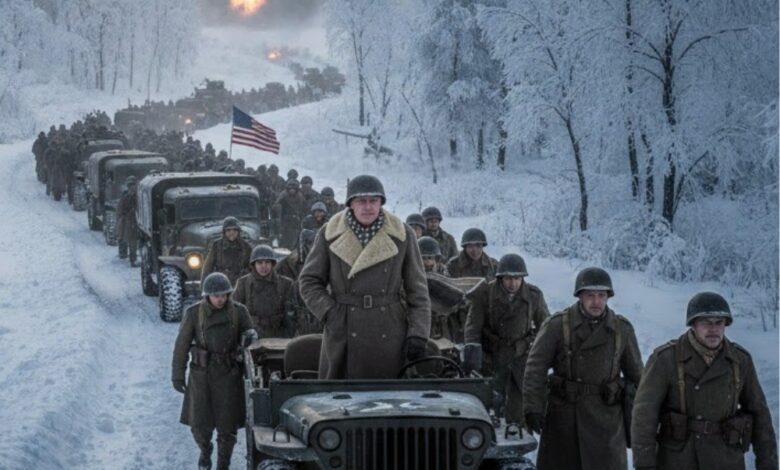
It was a logistical nightmare—fuel shortages, frozen engines, whiteout conditions—but the Third Army didn’t stop. They marched through the night, through drifts up to their knees, through wind that sliced like razors. Patton rode in an open jeep, snow whipping his face while he shouted to passing troops, “Keep moving, boys! We’re relieving Bastogne!”
His driver begged him to sit before he froze. Patton refused. “I didn’t come this far to save my skin.”
When the blizzard got so bad air support became impossible, Patton marched into Chaplain O’Neill’s tent.
“Father, I want a prayer.”
“A prayer, sir?”
“For good weather. I want clear skies.”
Within hours, a quarter-million prayer cards were in the hands of Third Army troops. Even the cynics muttered it under their breath.
And the next morning, the impossible happened. The sky opened. Sunlight poured over the snow. American planes thundered into action. Patton lit a cigar and grinned.
“God favors the side with the best commander.”
Meanwhile, in Bastogne, the 101st Airborne was frozen, starving, and surrounded by overwhelming German forces. The wounded lay in basements so cold breath turned to mist. Ammunition was nearly gone. Morphine had run out days earlier. When the Germans demanded surrender, acting commander General Anthony McAuliffe gave his famous reply: “NUTS.”
The men clung to those words, but they whispered something else in the long freezing nights: Patton is coming.
And he was.
By December 23rd, Patton’s tanks were grinding through snow toward Bastogne. Lieutenant Adam Brewer studied his map in a Sherman tank lit by a dim lamp.
“How long we going north?” a corporal asked.
“Until Patton says stop.”
“Think he’s crazy enough to pull this off?”
“No,” Brewer said. “He’s crazier. He thinks we can pull it off.”
Christmas morning, the 4th Armored Division launched its final push. Fog covered the fields. German machine guns ripped through the air, but nothing slowed the advance. Every mile cost blood.
Inside Bastogne, paratroopers heard the distant rumble of engines. At first it seemed like imagination—hope playing tricks—but then it grew louder. One soldier whispered, “American engines…”
On December 26th, a Sherman tank finally broke through the lines. A paratrooper staggered forward, waving his helmet.
“Goddamn! It’s the 4th Armored!”
Exhausted men cheered with voices cracked from cold. Some cried. Some collapsed. Bastogne was saved.
When the message reached Eisenhower, he read it twice.
“Bastogne relieved.”
He looked up and said softly, “By God… he actually did it.”
Patton arrived that night, walking among the frostbitten paratroopers. One sergeant saluted and said, “Sir… thought we’d never see you.”
Patton returned the salute. “You held. That’s the hardest part of war.”
Hitler’s grand offensive was finished. His last chance to change the war had shattered under American grit and Patton’s brutal, relentless push.
Later, standing among fresh graves in the snow, Patton brushed frost from a nineteen-year-old soldier’s headstone. He removed his helmet and whispered a simple prayer.
“Let them not have died in vain.”
Victory had come—but at a price written across the Ardennes in white crosses and frozen silence.
Two weeks later, Eisenhower told his commanders, “No one did the impossible except you,” looking directly at Patton.
Patton only shrugged. “Just doing my job.”
A lie, of course. No one else could have moved an entire army through a blizzard, across impossible terrain, at impossible speed, and broken one of the most desperate sieges in modern history.
And as winter dragged on and the war moved toward its final act, Patton kept going, driven by duty, fury, and the ghosts of the men he couldn’t save.
He prayed once more before crossing into Germany.
“Lord, give us clear skies. Give us clarity to strike. And when the last round is fired… grant peace.”
Then he stood, put on his helmet, and walked back toward the war.