The Distance Between Us Was Closer Than I Ever Realized!
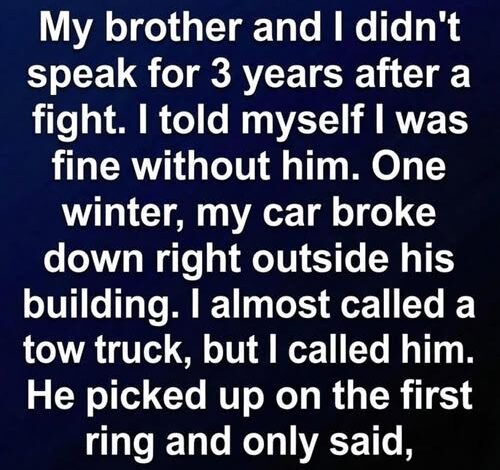
The physics of emotional distance is a strange thing. We often imagine that moving away from someone requires miles of geography or a cataclysmic explosion of anger, but in reality, the greatest chasms are forged in silence. My brother and I were close enough to remember the specific cadence of each other’s laughter, yet distant enough to spend years pretending that our shared history was a closed book. Our fallout wasn’t cinematic; there were no shattered plates or dramatic ultimatums delivered in the rain. It was a slow erosion—a single conversation where words were sharpened into weapons, a series of misunderstandings that went uncorrected, and a pride that eventually fossilized into a permanent state of estrangement.
I convinced myself that the silence was a form of self-respect. I adopted the modern philosophy that toxic ties, even those bound by blood, should be severed for the sake of one’s mental peace. Over time, the absence of his voice stopped feeling like a missing limb and started feeling like a scar—noticeable if I looked for it, but otherwise just part of the landscape. I built a life that had no room for him, a carefully curated existence where birthdays were celebrated without his snide humor and holidays were trimmed down to a manageable, quiet circle. I called this peace, but in the low light of a winter evening, I suspect I knew it was merely a well-maintained void.
The story I told myself was neat, contained, and entirely unchallenged for three years. I was the person who moved on, the one who didn’t need the baggage of a complicated fraternal bond. But life has a way of mocking our most resolute narratives.
It happened on a Tuesday night in January, the kind of night where the air feels brittle enough to snap. I was driving home through a part of the city I rarely frequented, lost in the mundane rhythm of a podcast and the hum of the heater. Without warning, my car gave a singular, pathetic cough and lost all power. I coasted into a dark curb, the dashboard lights flickering out like dying embers. The silence that followed was immediate and terrifying.
I sat there for a moment, gripping the steering wheel, waiting for the irony to settle in. As I looked out the frost-covered windshield, I realized exactly where the universe had decided to strand me. I was parked directly in front of his apartment building—an old, red-brick mid-rise I hadn’t stepped foot in since the night of our final argument. The streetlights above blinked rhythmically, their yellow glow illuminating the snow that had begun to drift lazily onto the sidewalk. It felt as though the city itself had conspired to nudge me into a corner I had spent years navigating around.
The sensible choice was to call a tow truck. I pulled out my phone, my fingers hovering over the app for roadside assistance. But the cold was beginning to seep through the glass, and the estimated wait time was nearly two hours. I scrolled through my contacts, intending to call a friend, when my thumb paused over a name I had never quite found the heart to delete. I stared at it for a long time.
Every logical excuse I had polished over the years rose up to stop me. Don’t bother him. He probably won’t even answer. You’ll just make things awkward. You don’t need his help. I listened to those voices, weighed them against the biting chill in my toes, and then I ignored them. I pressed the call button before I could talk myself out of it.
He picked up on the second ring.
“Hello?”
There was no hesitation in his voice, no guarded suspicion. He spoke my name with a familiar, effortless inflection, as if we had spoken only yesterday. For a heartbeat, the air left my lungs. I hadn’t realized how much I had missed the specific pitch of his voice until it was vibrating against my ear. When I finally found my own voice, it sounded thin and brittle, like the ice on the pavement. I explained the situation—the stalled engine, the cold, the fact that I was sitting right outside his door.
There was a brief pause, long enough for the old fears of rejection to rush back in, cold and sharp. Then, he spoke four words that dismantled three years of pride: “Don’t move. I’m coming.”
Five minutes later, he emerged from the lobby, bundled in a heavy coat and a scarf I recognized from a Christmas long ago. He looked exactly the same, yet entirely different. The lines around his eyes were deeper, but his movements were still characterized by that same practical, unhurried calm. He didn’t ask why it had taken a mechanical failure for me to call. He didn’t demand an apology or reference the biting things we had said to one another. He simply produced a set of jumper cables and a thermos of coffee.
We spent the next hour working in the cold. He helped me navigate the logistics of the breakdown, stayed with me while we determined the car needed a professional mechanic, and eventually insisted I come inside to warm up while we waited for the tow truck.
Inside his apartment, the air smelled of cedar and old books. We sat in his small kitchen, our hands wrapped around warm mugs, talking about nothing of consequence. We discussed the weather, the city’s failing infrastructure, and the health of our aging parents. The heavy, soul-clearing conversations didn’t happen that night. We didn’t dissect the anatomy of our fallout or assign blame for the lost years. We didn’t have to.
What settled between us in that quiet kitchen was a realization far more profound than any apology. The distance we had maintained hadn’t erased the bond; it had only stretched it to its absolute limit. I saw in the way he offered me a seat, and the way he remembered exactly how I took my coffee, that the foundation was still there. We had been pretending that the space between us was an ocean, when in reality, it was just a hallway we were both too afraid to walk down.
Reconciliation is rarely the grand, cinematic event we imagine it to be. It doesn’t always require a long-form explanation or a tearful confession. Sometimes, it begins with the humility of being stranded. It begins with a stalled car on a cold evening and the courage to reach out to the one person you never truly meant to forget. As I eventually watched my car being towed away and accepted a ride from him to my own front door, I realized that the distance wasn’t a wall—it was a choice. And that night, under the cover of a winter storm, we chose to finally close the gap.