The Doctor Who Held My Hand! A Story of Loss, Healing, and Hope
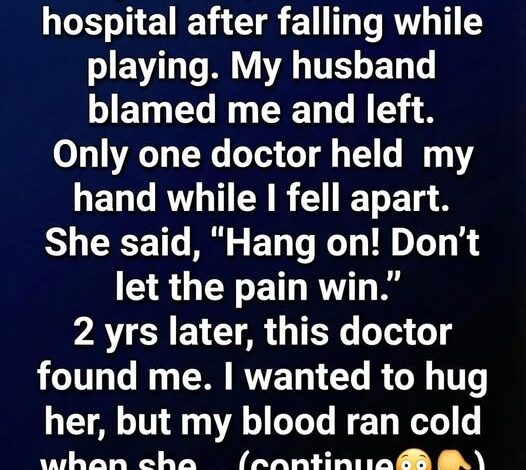
The architecture of a human life is remarkably fragile, capable of being dismantled by nothing more than a momentary lapse in gravity. For Elena, the collapse happened on a Tuesday afternoon—a day of mundane beauty that ended when her seven-year-old son, Leo, slipped on a playground climbing frame. There were no dramatic warning signs, no premonitions; there was only a thud, a silence, and a sleep from which he would never wake. In the clinical, sterile environment of the hospital, Elena’s world became quiet in the loudest way possible. The cacophony of her own heartbeat and the rhythmic hiss of a ventilator were the only sounds that pierced the vacuum of her shock.
Tragedy, however, rarely strikes in isolation. While Elena sought to anchor herself in the wake of the accident, her husband, Mark, drifted into a different kind of darkness. Overwhelmed by a volatile mixture of grief and misplaced guilt—he had been the one to take Leo to the park that day—his pain curdled into blame. Within weeks, he walked away, unable to look at Elena without seeing the reflection of his own failure. He left her alone in a house that felt bloated with memories, the weight of Leo’s empty shoes by the door feeling heavier than any physical burden she had ever carried.
During those final hours in the ICU, when the machines were silenced and the reality of the “never again” settled in, one person remained anchored in the storm with her. Dr. Aris was a woman whose professional armor seemed to have been softened by years of witnessing the unthinkable. She didn’t offer the hollow platitudes of “everything happens for a reason” or “time heals all wounds.” Instead, she sat in the shadows of the room and held Elena’s hand. Her grip was warm, human, and steady. “Hang on,” Aris had whispered as Elena prepared to leave the hospital for the first time without her son. “Don’t let the pain win.” At the time, the words felt like an impossible demand, but they became the fragile thread that kept Elena moving forward when the abyss threatened to swallow her whole.
The ensuing months were an exercise in slow-motion survival. There were days when the sheer effort of existing felt like wading through deep water, where Elena couldn’t bring herself to leave the bed that still smelled of her son’s laundry. Other days, she forced herself into the sunlight, a deliberate act of defiance against the gloom. She joined a support group for grieving parents, where she learned the vocabulary of loss, and she began a ritual of “living memory.” She planted a small garden—marigolds and snapdragons, Leo’s favorites—and started a journal of letters to him. In those pages, she didn’t just record her sorrow; she recorded the things he was missing, ensuring he remained a participant in her life. The pain never vanished, but it began to change shape. It softened from a jagged glass shard into a smooth stone—something she could carry in her pocket without collapsing.
Two years after the accident, Elena attended a community symposium focused on child safety and the psychology of healing. She went seeking further closure, but instead, she found a familiar voice. Standing at the podium was Dr. Aris. The doctor was speaking about the “humanity of the white coat,” emphasizing that empathy is not a distraction from medicine but its most vital tool. When the session ended and their eyes met across the crowded room, a flicker of recognition passed between them, followed by a smile that bridged the gap between the worst day of Elena’s life and the present.
Elena approached her, intending only to offer a heartfelt thank you for the hand-hold that had saved her life. But as they sat together in a quiet corner of the hall, the conversation took a turn that Elena never expected. With a voice that wavered for the first time, Dr. Aris revealed that shortly after Leo’s death, her own daughter had been seriously injured in a strikingly similar accident at a school gymnasium. The doctor had found herself on the other side of the stethoscope, experiencing the same paralyzing terror and the same gut-wrenching “what ifs.”
“I spent years telling families how to be brave,” Aris admitted, looking at her hands. “But when it was my child, I realized I didn’t know how to follow my own advice. I kept thinking about you. I kept thinking about how you walked out of that hospital and kept going. I realized that if you could survive your loss, I had to survive my fear.”
The revelation was profound. It stripped away the last of the “patient-doctor” hierarchy and replaced it with a raw, shared humanity. They weren’t just two women who had met in a tragedy; they were two survivors who had unknowingly been each other’s silent strength. Aris explained that her daughter’s recovery had been long and difficult, and the experience had inspired her to shift her career toward injury prevention and creating support networks for families navigating medical trauma.
Instead of feeling frightened by the coincidence, Elena felt a surge of purpose. They talked for hours about the strange ways tragedy can be composted into something that grows. They discussed the fact that resilience isn’t about returning to the person you were before the break, but about becoming someone entirely new—someone built around the scar tissue.
Together, they decided to launch a local initiative called “Leo’s Light.” It started as a small awareness campaign, providing parents with practical safety information for playgrounds and sports. However, it quickly evolved into something much larger: a community-led support system that offered emotional “first aid” to families in crisis. They created a space where grief was not treated as a condition to be cured, but as a journey to be shared.
In the first meeting of their initiative, Elena stood before a group of parents and realized that Dr. Aris’s words from two years prior had come full circle. Pain had not won. It hadn’t won when Mark walked out, it hadn’t won when the garden wilted in the winter, and it hadn’t won when Elena felt she couldn’t take another step. It had been transformed into compassion, connection, and a quiet, ironclad promise that Leo’s memory would act as a shield for other children.
For the first time since that Tuesday afternoon, Elena’s heart felt lighter. The past was not forgotten—it would never be—but it was no longer a weight that dragged her down. It had become the foundation for something meaningful. She looked at Dr. Aris, who was busy comforting a young mother in the back of the room, and she reached out to take her hand. This time, it wasn’t a gesture of desperation, but one of partnership. They had moved beyond the loss and into the healing, proving that even when the world breaks, the pieces can be gathered and used to build a lighthouse.