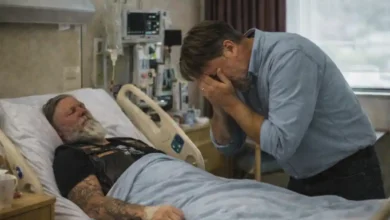
What I Learned Too Late About My Fathers Sacrifice!
I never expected a dusty cardboard box to undo years of assumptions I’d built about my childhood, but that’s exactly what happened the afternoon I finally opened it. It had been sitting in my closet for months after my father passed, tucked between old winter coats and boxes of holiday decorations. I kept telling myself I’d get around to sorting it, but part of me wasn’t ready. When I finally slit the tape and peeled back the flaps, I had no idea I was about to confront a truth I’d been blind to for most of my life.
Inside was an old leather folder — the same one my father carried everywhere when I was growing up. I used to tease him about it, calling it “his ancient briefcase.” I always assumed it held bills, tax papers, maybe a spare checkbook. Nothing interesting. Nothing emotional. Nothing that could shake the foundation of who I thought he was.
But the moment I opened it, I saw a neatly folded letter sitting right on top, addressed to me in my father’s familiar handwriting. The handwriting of packed lunches, school field trip forms, birthday cards. Somehow, seeing it again made my chest tighten. I sat down on the floor and began to read.
His words were steady, measured — just like the man I remembered. He wrote about the years after my mother died, a time I had always remembered through the lens of a lonely, confused child. He explained why he worked so much, why he missed so many dinners, why he seemed distant in ways I once interpreted as emotional coldness. He wrote that he was terrified in those early years, trying to raise four children alone, trying to keep the mortgage paid and the lights on, trying to be everything at once without letting any of us see how scared he was.
“I wasn’t absent because I didn’t care,” he wrote. “I was absent because I was fighting every day to keep life steady for you.”
Every memory I had of him stumbling through the door late, eating reheated leftovers standing up at the counter, falling asleep in his chair before asking me about school — it all shifted. I remembered thinking he didn’t want to be around us, that he didn’t care about what happened in my life. But the truth was sitting there in ink: he cared so much that he sacrificed pieces of himself to make sure we never saw just how heavy the load was.
Then I got to the part that stopped me cold.
He confessed something I never knew, something I would’ve bet anything wasn’t true. All my life, I’d believed I’d earned my education through my own grit — the scholarships, the grants, the part-time jobs. I wore that belief like a badge. I told myself I’d succeeded without help. I told myself I’d made it on my own.
But tucked behind the letter were receipts, payment confirmations, scribbled math notes showing savings goals. He had quietly been paying small but critical amounts toward my tuition. Whenever I thought a mysterious scholarship had come through or a fee had somehow disappeared from my bill, it was him. Working weekends. Taking extra night shifts. Cashing out unused vacation days. He made those payments without ever putting his name on them, because he wanted me to believe I had built my own future.
“I wanted you to feel strong,” he wrote. “But I also want you to know now that I believed in your future more than I believed in my own comfort.”
I pressed the paper to my chest, overwhelmed. For years I had resented his silence, his exhaustion, his absence from parent-teacher nights, my choir performances, the milestones I thought he didn’t care about. Now, suddenly, those absences were cast in a different light — the light of someone doing everything he could, quietly, relentlessly, with no expectation of thanks.
At the bottom of the box was a small bundle wrapped in soft cloth. When I unwrapped it, I found his gold watch — old-fashioned, heavy, always ticking steadily on his wrist. I remembered teasing him about it, telling him everyone else had smart watches now, and he would just smile and say, “This one’s reliable. That’s enough.”
On the back of the watch was a faint engraving I’d never noticed, worn by time and years of use. I tilted it toward the light and saw the initials of all four of his children. Underneath them were two simple words:
“My purpose.”
It hit me like a punch. This watch had traveled with him through every shift, every late night, every sacrifice. He’d carried us with him, literally pressed against his pulse, every day of his life.
I took the watch outside and sat on the porch as the sun dipped low, turning the sky orange. I turned it over and over in my hands, feeling the smoothness of the metal, imagining all the years he wore it, all the moments he looked at it while thinking of us. I felt guilt for the years I’d misunderstood him, gratitude for the sacrifices he never mentioned, and a quiet awe for the strength he’d carried alone.
In that sunset glow, it finally hit me: love isn’t always loud. It isn’t always expressed in hugs or long talks or emotional speeches. Sometimes it comes in the form of exhaustion, of quiet endurance, of sacrifices made in the dark when no one is watching. Sometimes it’s a man who misses recitals not because he doesn’t care, but because he is working to keep your world from falling apart. Sometimes it’s a folder full of hidden payments and a watch engraved with a purpose he never once spoke aloud.
I closed the box, holding the watch in my palm, and made myself a promise: to live with the same quiet strength he carried. To let his sacrifices matter by choosing gratitude over resentment, understanding over assumption, and love over judgment.
I learned too late what my father had given up for us. But I won’t waste the lesson.