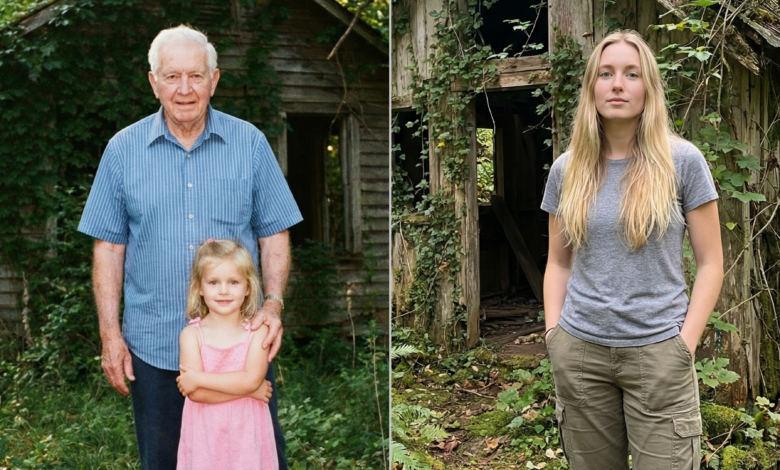
When My Father Split the Inheritance, My Brother Got Everything While I Got Only Grandpas Cabin – and a Secret He Took to the Grave!
The decision came down at the kitchen table, the way life-changing things often do—quietly, without ceremony, like it was just another conversation that wouldn’t leave a mark.
My father sat across from us, hands folded, voice steady but firm. He said he didn’t want problems later, didn’t want arguments after he was gone. So he was settling everything now.
My brother Chris leaned back in his chair, relaxed, almost amused. I sat there tense, already feeling like I was about to lose something I couldn’t yet name.
“The house goes to you,” Dad said to Chris.
Chris didn’t hesitate. He didn’t question it. He just nodded, like that outcome had always been obvious.
Then Dad looked at me.
“You’ll get your grandfather’s cabin.”
For a second, I thought I’d misheard.
“The cabin?” I repeated. “The old hunting place?”
Dad gave a small nod, almost apologetic. “You’re still studying. You don’t need much right now.”
Chris laughed under his breath, the kind of laugh that doesn’t even try to hide what it means.
“That place is falling apart,” he said.
I wanted to say something. Anything. But the words stuck somewhere between my chest and my throat. Dad added one more sentence, softer this time.
“It’s what your grandfather would’ve wanted.”
That ended it.
No one argued after that.
Outside, in the driveway, Chris caught up to me. He leaned against his truck, arms crossed, wearing that same smug expression he’d had inside.
“So that’s it,” he said. “You and your little shack.”
I didn’t answer.
“All those weekends you spent out there,” he added. “Guess being the favorite didn’t pay off.”
That hit harder than I expected.
“That’s not fair,” I said.
He gestured toward the house behind us—the one we grew up in, full of history, full of everything that mattered.
“This is fair,” he said. “You can keep the memories. I’ll take something real.”
Then he drove off, leaving dust and silence behind him.
I stood there longer than I should have, staring at the empty space where his truck had been, replaying his words in my head. Part of me wanted to believe he was right. That I had lost.
But the truth was, that cabin had never been just a building to me.
My earliest memories weren’t tied to the house we grew up in. They belonged to that place. A narrow bed, a dim lantern, and my grandfather sitting beside me, reading stories like they mattered.
“Read the dragon part again,” I’d say.
And he always did.
With him, I didn’t feel like I had to compete or perform or be less than my brother. I didn’t have to shrink myself. I could just exist, and that was enough.
Chris had always been the one people noticed. The athlete. The confident one. The one who made my father proud without trying.
I was the quiet one. The one who asked too many questions. The one who preferred a worn book in a cabin over applause on a field.
You learn early which version of yourself the world values more.
Except my grandfather never made me feel like I came second.
One day, when I was a kid, I asked him why he spent so much time out there instead of in his comfortable house in town.
He smiled, the kind of smile that made you feel like you’d asked the right question.
“Some places let you breathe,” he said. “Others just let you survive.”
I didn’t understand it back then.
Years later, I did.
When he died, something inside me went quiet. The funeral passed like a blur—people speaking, words about family and legacy—but none of it reached me. I couldn’t say anything. I couldn’t even cry properly. It was like grief had locked itself somewhere deep and refused to come out.
Eventually, life moved on.
It always does.
When I finally went to see what I’d been given, I expected disappointment.
Chris hadn’t been wrong about one thing—the place looked terrible.
The cabin leaned slightly, like it had given up holding itself together. The path was overgrown, the door stiff from years of neglect. It took effort just to get inside.
The air was stale. Dust coated everything. It felt less like stepping into a memory and more like walking into something that had been abandoned for too long.
I took a step forward—and froze.
The floor beneath the old bed had collapsed.
A dark opening stared back at me.
My heart jumped into my throat.
I grabbed a flashlight and crouched, shining it down into the hole.
Stone steps.
A cellar.
I hesitated for a moment, then started down.
The space below wasn’t random. It was organized. Shelves lined the walls, filled with metal boxes. A large trunk sat near the base of the stairs, covered in dust but clearly placed there on purpose.
This wasn’t decay.
This was hidden.
My hands shook as I opened the trunk.
Inside were documents—maps, deeds, papers tied together carefully. It took a moment for my brain to catch up with what I was seeing. Names, numbers, land boundaries.
Then I saw the envelope.
My name written across it in my grandfather’s handwriting.
I sat down before opening it, like I needed the ground beneath me to stay steady.
Inside was a letter.
He wrote that he hadn’t hidden this because he didn’t trust me. He had hidden it because he trusted me more than anyone else.
He wrote that Chris always wanted what he could see immediately, while I had been willing to stay, to listen, to care for things that didn’t offer instant reward.
The land—everything around that cabin—was worth more than the house. He had known it all along.
But that wasn’t why he gave it to me.
He gave it to me because I understood its value beyond money.
Because I never treated it like something to take from, but something to take care of.
By the time I finished reading, something inside me had shifted.
Not relief. Not joy.
Clarity.
The lawyer confirmed it later. The land was worth far more than anyone had realized.
My father sounded stunned when he called. Chris didn’t stay quiet for long.
He showed up angry, demanding answers, accusing me of knowing all along.
“I didn’t,” I told him.
He didn’t believe me.
“He played favorites,” Chris said.
I handed him the letter.
He barely read it.
“So what?” he snapped. “That makes it fair?”
“It makes it clear,” I said. “That’s enough.”
He looked at me like I was insane when I told him I wasn’t selling.
That I was keeping the land. Fixing the cabin. Preserving it.
“You’re throwing away millions,” he said.
“Maybe,” I replied. “But I’m not throwing away what it means.”
He left the same way he always did—angry, unwilling to understand.
But this time, I didn’t feel smaller watching him go.
Months passed.
I rebuilt the cabin piece by piece. Learned the land the way my grandfather had. Turned down offer after offer from people who saw only profit where I saw something else.
People asked why.
The answer was simple.
I had been trusted with it.
One evening, as the sun dropped low and the light stretched across the trees, I stood outside the cabin and looked at it—not as the girl who once needed to be chosen, but as someone who finally understood why she had been.
I didn’t need to prove anything anymore.
He had already known.