15 Everyday Objects With Secrets That Will Absolutely Change Your Life
You have been using these items every single day of your life, completely oblivious to the fact that you have been doing it wrong the entire time. From the clothes on your back to the tools in your kitchen, the world around you is packed with ingenious design hacks that manufacturers have been hiding in plain sight. Most of us glance at a random notch, a weirdly shaped hole, or a strange groove and think nothing of it, but these aren’t just aesthetic quirks—they are purposeful, life-saving, and incredibly clever features designed to make your daily existence easier.
Have you ever stopped to wonder why your ballpoint pen has a hole in the cap? It isn’t a stylistic choice or a ventilation trick for the ink. It was specifically engineered to save lives. Because young children have a tendency to chew on pen caps, manufacturers realized that swallowing one could lead to a catastrophic airway blockage. That tiny hole is a safety mechanism; if a cap is accidentally swallowed, it allows just enough air to pass through to keep a child breathing until they can reach medical help. It is a simple, invisible design element that has likely prevented thousands of tragedies.
Moving into the kitchen, the mystery of the Solo cup lines finally gets an answer. Those horizontal ridges aren’t just for grip or decoration. They are actually a built-in measurement system. The bottom line corresponds to a standard shot of hard liquor, the middle line is precisely the right amount for a glass of wine, and the top ridge is perfectly calibrated for a standard serving of beer. Similarly, if you have ever struggled to measure the right amount of dry spaghetti, look at your ladle. That circular hole in the center isn’t there to drain water—it’s a portion-control tool designed to measure exactly one serving of pasta.
Speaking of clever cooking tools, have you ever noticed a hole at the end of your pot handle? Most people assume it’s for hanging the pot on a rack, which is true, but it serves a dual purpose during the cooking process: it is the perfect rest for your stirring spoon. It keeps your utensil elevated and ready for action while preventing it from sliding into the pot or making a mess on your stovetop. And those expandable, ribbed ketchup containers at your local fast-food joint? You have likely been struggling to dip your fries because the container is too small. Simply pull the accordion-like edges outward, and the cup expands, doubling its capacity and giving you enough room to properly coat your food.
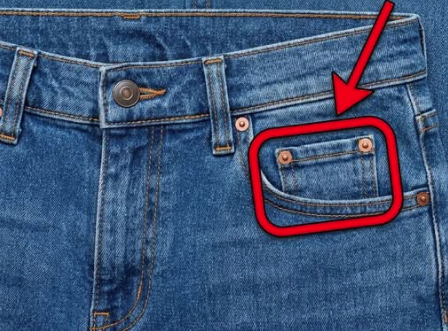
Your wardrobe is also hiding a wealth of “secret” features you have likely ignored. That tiny, mysterious fifth pocket on your denim jeans—the one that seems too small for anything useful—dates back to the era of the pocket watch. In the nineteenth century, it was an essential storage space for keeping your timepiece safe and secure. Furthermore, those extra buttons and the small fabric patches that come with new garments aren’t just spare parts for repairs. The fabric swatch is actually a vital diagnostic tool. Before you use a new, harsh cleaning agent or detergent on your delicate clothing, you are supposed to test the product on that small, hidden patch to ensure it won’t bleach or ruin the fabric of the entire garment.
Even the simple wooden hanger has a historical purpose that goes beyond aesthetics. Originally, these were crafted from cedar wood specifically to repel moths and other pests that would otherwise feast on your wool sweaters and business suits. When it comes to your vehicle, the hidden secrets are even more practical. If you ever find yourself hunting for the gas cap, stop looking for a handle or walking around the car. Just check your dashboard’s fuel gauge. There is almost always a tiny arrow next to the fuel pump icon; that arrow is pointing directly to the side of the car where your tank is located.
Perhaps the most dramatic feature in your car is the removable headrest. While it is certainly there for comfort, it is also a critical emergency survival tool. In a scenario where you are trapped inside your vehicle following an accident, the metal rods of the headrest are designed to be strong enough to shatter your side windows, providing you with a critical escape route when doors are jammed.
Finally, consider the Chinese takeout container. That uniquely folded box isn’t just about portability; it is a miracle of origami engineering. If you unfold the edges, the box transforms into a flat paper plate, allowing you to eat your meal without dirtying a single dish. And if you have a padlock sitting in your garage or on a shed, look for a tiny hole near the keyhole. That isn’t a defect—it is a drain hole that allows moisture and water to escape, preventing the internal mechanism from rusting and freezing up during the winter.
The world is full of these “aha!” moments, but we often move through our days in a blur of routine, ignoring the thoughtful engineering that makes our lives safer and more efficient. Whether it is the margins on a sheet of paper—which were originally designed to protect text from rodents—or the long, thin necks of beer bottles—meant to be held to keep the warmth of your hand from heating the drink—everything has a reason for being. The next time you find yourself stuck at a red light or waiting for your takeout to heat up, look a little closer at the items around you. You might find that the world is much more intelligently designed than you ever imagined. And who knows? Knowing these secrets might just make your day a little bit easier, even if you do forget them by tomorrow morning.