A Stranger Kept Leaving Groceries on Her Porch. When She Found Out Why, She Broke Down in Tears
The first time someone left groceries on my porch, I was sure it was a mistake.
Big Costco bags. Milk. Bread. Peanut butter. Cereal. Enough food for weeks. No receipt. No note. Nothing.
My name is Sandra. I’m 68 years old. I’ve lived alone ever since my husband, Raymond, passed away. I survive on a fixed income, and I’m careful with every dollar. Too careful, maybe.
I called the store immediately.
“Someone delivered groceries to my address by accident,” I told them.
There was a pause.
“No record of any delivery to your street, ma’am.”
That only made it stranger.
I carried the bags to my neighbor, thinking maybe they were meant for her. She shook her head, confused.
“Not mine. But keep them, Sandra. Maybe it’s an early Christmas gift from somewhere.”
It didn’t feel like a gift.
It felt like charity.
And I don’t take charity.
Two weeks later, it happened again.
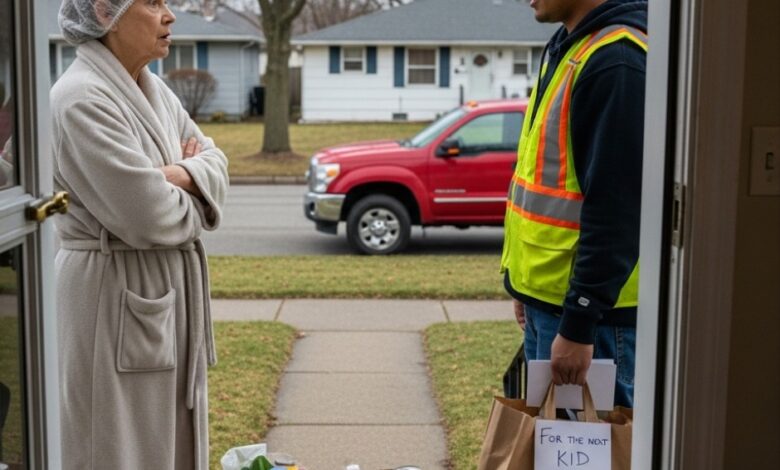
More bags appeared on my porch—this time filled with cleaning supplies, toilet paper, canned food. That’s when anger replaced confusion. Who was doing this? Why me? Did I really look that helpless?
I decided I wouldn’t let it happen again without answers.
The following Saturday, I stayed awake before dawn and watched from behind the curtain. At exactly 6 a.m., a pickup truck slowed near my house. A young Hispanic man stepped out—maybe 30 years old—wearing work boots and a construction vest. He moved quietly, setting the bags on my porch like he didn’t want to be seen.
I was already outside when he came the next week.
“Why are you doing this?” I demanded.
I startled him so badly he nearly dropped the bags.
“I—I’m sorry,” he said quickly. “I didn’t mean to offend—”
“I don’t need pity,” I snapped.
He froze. Then his voice softened.
“It’s not pity. You don’t remember me, do you?”
I looked hard at his face. Nothing came to mind.
“Ten years ago,” he said, “you worked at Monroe Elementary. In the cafeteria.”
I did. I was a lunch lady for 25 years before my knees finally gave out.
“I was in fifth grade. My dad got deported that year. My mom worked three jobs. We barely had food.”
My chest tightened as he continued.
“Every day for eight months, you gave me extra food. More mashed potatoes. Extra chicken. A second milk. You’d say the kitchen made too much and it would go to waste.”
He smiled faintly.
“I knew you were lying. Other kids didn’t get extra.”
Tears burned my eyes. I remembered so many hungry children—faces blurred by time, but the need never forgotten.
“You never made me feel ashamed,” he said. “You never made me ask. You just filled my tray and smiled.”
I whispered, “So this is repayment?”
He shook his head firmly.
“You can’t repay what you did. You kept a kid from starving. I’m not repaying—I’m continuing.”
He told me that he and his construction crew now help five families every month—people who once helped them when they were children. Teachers. Coaches. Cafeteria workers. People who saw them.
He handed me a small card.
“If you ever know a kid who’s hungry, call this number. We have a fund now. It’s small, but it’s there.”
My hands shook as I took it.
“What’s your name?” I asked.
“Carlos.”
I smiled through tears.
“Carlos… I only gave you extra mashed potatoes.”
He looked at me gently.
“You gave me dignity, Mrs. Sandra. There’s a difference.”
He drove away, leaving me standing on my porch, crying over grocery bags.
That morning, I finally understood something I’d been too proud to see.
Kindness doesn’t end when the moment ends.
It grows roots.
It becomes someone else’s hands.
It feeds forward.
I volunteer at the food pantry now. My knees ache, but I can still pack boxes and sort cans. And I keep Carlos’s card in my wallet.
Because receiving grace is just as important as giving it.
Let people help you.
Then help someone else.
That’s how it works.