More Than Degrees and Titles! What My Sister Taught Me About True Greatness
People love to dress greatness up in expensive clothes. They point to diplomas framed behind glass, job titles printed on business cards, awards handed out under bright lights. We’re taught to believe that if you don’t have credentials, you don’t have proof. That real achievement lives in boardrooms, lecture halls, and glossy headlines.
That’s what I used to believe, too—until I watched my sister become the strongest person I’ve ever known in a cramped apartment that smelled like laundry soap and cheap coffee, with no audience and no applause.
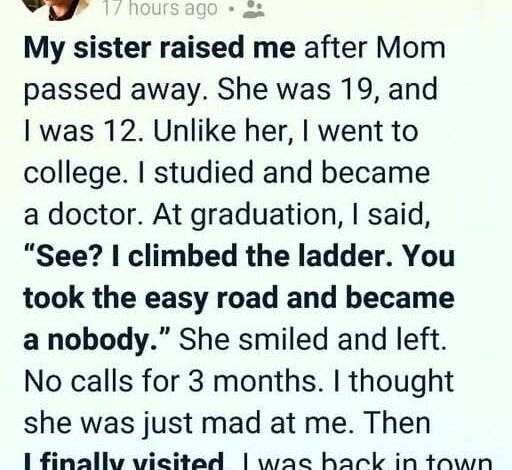
I was twelve when my life split into “before” and “after.” The day our mother died didn’t arrive like a dramatic moment in a movie. It came quietly, in a hospital corridor that felt too bright and too cold. I remember the sting of antiseptic in the air, the squeak of shoes on polished floors, and the way adults spoke in lowered voices like volume could soften the truth. Someone touched my shoulder and said something about “being strong,” but all I could hear was the absence—my mother’s voice, my mother’s laugh, the steady rhythm of a life I assumed would always be there.
At the funeral, I stood beside my sister and watched her face. She was nineteen, technically an adult, but still young enough to have a future that belonged to her. The kind of age meant for exams, new friends, messy dreams, late nights that end in laughter. She should have been planning her next semester. She should have been arguing about music, flirting, figuring out who she wanted to be.
Instead, she stood beside the casket with a stillness that didn’t look like detachment. It looked like decision.
That was the moment she stopped being only my sister. She became my anchor.
She didn’t announce it. She didn’t cry dramatically in front of people or make speeches about sacrifice. She just started moving differently, like she’d shifted into a role she never wanted but refused to abandon. The days after the funeral were a blur for me—neighbors bringing food, relatives giving advice they didn’t have to live with, people promising help and then disappearing back into their lives.
My sister didn’t disappear.
She took a hard look at our reality and began doing what grown-ups do when the ground collapses: she built something stable out of whatever she could find.
University ended in a single decision. She didn’t call it quitting. She called it “pausing.” But we both knew what it was. Textbooks got packed away. Notes in spiral notebooks went into a box. She traded lecture halls for double shifts, and her schedule became a patchwork of work hours, bus routes, and sleep stolen in short, exhausted pieces.
She started waking before sunrise, moving quietly so she wouldn’t wake me. Some mornings I’d catch a glimpse of her in the hallway, pulling on a jacket, hair still damp from a rushed shower, eyes already tired. She’d smile at me like everything was normal.
“Breakfast is on the counter,” she’d whisper. “Eat, okay?”
Then the door would close, and she’d be gone.
She worked jobs that didn’t care that she was smart. Jobs that didn’t reward effort with dignity. She cleaned, served, stocked shelves, answered phones, did anything that kept money coming in. When she came home at night, she’d move through the apartment like she was made of lead—shoulders slumped, hands rough, feet swollen. But if I was still awake, she’d sit beside me anyway, ask about school, check my homework, pretend she had the energy to care about a science project.
I didn’t understand it then. I thought adults were just built to endure. I thought exhaustion was something you could shake off with sleep.
Now I know she was surviving on something else entirely: stubborn love.
Greatness, I learned, wasn’t dramatic. It was quiet math done in a dim kitchen at midnight. It was turning a single bag of groceries into a week of meals—rice, eggs, beans, frozen vegetables, whatever was on sale. It was learning exactly how long a carton of milk could last, exactly how thin you could slice bread and still call it a sandwich. It was paying rent first, even when the refrigerator looked too empty.
It was the invisible skill of making scarcity feel like normal.
She became an expert in small miracles. Somehow there was always enough for school supplies. Somehow my jacket got replaced when it didn’t fit anymore. Somehow she found a way to put a few dollars aside so I could go on a field trip without being the kid who stayed behind. She did it without letting me see the panic behind her eyes when bills arrived.
Sometimes I’d hear her at night, when she thought I was asleep. The scratch of a pen on paper. The soft click of a calculator. A long, quiet exhale that sounded like someone trying not to break in half.
Once, when I came out for water, I saw her sitting at the table with a checkbook open and an unpaid bill beside it. She looked up quickly and smiled too fast.
“Go back to bed,” she said gently. “You’ve got school.”
“Are we okay?” I asked.
She didn’t hesitate. “We’re going to be okay.”
She said it like a promise she had already signed in blood.
I watched her miss out on everything people tell you you’re supposed to enjoy at nineteen. There were no spring breaks. No carefree weekends. No nights out with friends that ended with stories and photos. Her friends drifted away, not because they didn’t care, but because life divides people when one person’s world becomes heavier than the others can understand.
I learned how loneliness can sit right beside responsibility.
And yet she never let our home become a shrine to grief. She didn’t let it turn into a place where sadness collected in corners. She cleaned even when she was tired. She played music while cooking, turning ordinary evenings into something almost warm. She asked me about my day like my life mattered, like the future still existed.
I didn’t realize until much later how much of her own grief she swallowed to make that possible. She carried the loss of our mother quietly, like she believed if she fell apart, I would fall apart too. Maybe she was right.
The years moved forward. I grew taller. My voice changed. My anger at the unfairness of everything burned hot and then cooled into determination. I studied hard, not because I loved school, but because I could see what she was giving up. It felt like the only way to respect it was to do something with it.
When I finally earned the degrees everyone loves to praise, when I got the job that made relatives suddenly act proud, I hung my certificates on the wall like proof that her sacrifices had meant something.
But every time I look at them, I don’t see my intelligence.
I see her.
I see her counting coins for bus fare and deciding to walk home instead. I see her hands red from cleaning chemicals. I see her shoulders squared even when she was exhausted. I see her buying me shoes and pretending it wasn’t a big deal. I see her telling me we’d be okay even when she had no guarantee.
People call her “selfless,” like it’s a soft compliment. Like it’s a personality trait. But what she did wasn’t softness.
It was ferocious.
It was leadership without authority. Strength without recognition. Intelligence measured in survival, in strategy, in emotional control, in the ability to carry two lives when one would have been hard enough.
The toll is there if you know how to look. The lines around her eyes. The calluses on her hands. The way she sometimes pauses before answering simple questions, like her body still expects life to demand something from her. Those aren’t signs of weakness. They’re evidence. They’re what it looks like when someone spends years fighting a quiet war against poverty, grief, and exhaustion—and wins.
She never got a diploma for it. No ceremony. No applause.
But she taught me what greatness actually is.
It isn’t being admired. It’s being reliable. It’s choosing responsibility when no one is watching. It’s taking your own dreams and setting them on a shelf because someone you love needs you more than you need yourself. It’s doing the hard thing every day until it becomes your identity.
If the world insists greatness comes with titles, fine. Let them keep their definitions.
Mine is the nineteen-year-old girl who stood in a hospital corridor with grief in her throat, looked at a scared twelve-year-old boy, and decided, without a single dramatic word, that he would not be abandoned.
Her legacy isn’t in magazines or trophies.
It’s in the life I live now—because she chose to carry me until I could stand on my own.