Woman arrested after alleged plan to asassinate Trump, shocking plan revealed!
A quiet jail cell in Ripley, West Virginia, became the unlikely focal point of a national crisis this week after authorities arrested a local librarian over what they describe as a dangerous online threat against former President Donald Trump. Investigators say the case is not about heated political rhetoric or protected opinion, but about words they believe crossed into a credible call for violence—words posted publicly, shared widely, and amplified at a moment of heightened tension across the country.
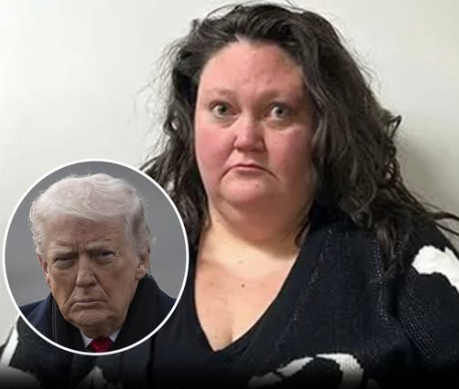
The woman at the center of the case, identified by law enforcement as Morgan L. Morrow, had been a familiar face in Ripley. For years, residents knew her as someone who checked out books, organized shelves, and helped children find their way through homework assignments and reading lists. That image shattered almost overnight when federal and state authorities announced her arrest on charges related to making a terroristic threat.
According to investigators, the case began with a single social media post. Officials say the caption, shared publicly on Instagram, contained language that went beyond criticism or satire and was interpreted as an explicit call for lethal action against a specific political figure. Within hours, screenshots circulated. Tips poured in. Law enforcement agencies moved quickly, citing concerns that even a brief delay could have serious consequences.
Authorities stress that the issue was not whether Morrow possessed weapons or had a detailed plan in place. In their view, intent was inferred from the wording itself and the context in which it appeared. Prosecutors argue that when public figures are targeted online, especially during periods of political volatility, even a lone statement can function as a spark—one capable of igniting real-world violence by someone else.
What intensified the response, investigators say, was what followed in the comment section. Strangers allegedly added messages that glorified violence or echoed similar sentiments about harming public officials. Law enforcement officials describe the exchange as an example of how quickly online spaces can escalate, turning isolated posts into something they believe poses a broader public safety risk.
Within hours of the post being flagged, authorities secured warrants, collected digital evidence, and took Morrow into custody without incident. She now faces serious charges that carry the possibility of significant prison time if prosecutors prevail. Her legal team has not commented publicly in detail, but court filings indicate she plans to contest the characterization of her words as a genuine threat.
The local library, where Morrow had worked, moved swiftly to distance itself from the situation. Administrators placed her on immediate leave and issued a brief statement emphasizing that the institution does not condone violence or threats of any kind. Inside the building, the mood has reportedly been subdued. Staff members declined interviews, while patrons expressed disbelief that someone they knew in such a quiet role could be linked to allegations of this magnitude.
For residents of Ripley, the arrest has been jarring. The town is not accustomed to national attention, let alone scrutiny tied to terrorism-related charges. Neighbors described seeing federal vehicles on familiar streets and news crews setting up outside buildings that usually draw little notice. The sudden spotlight has left many struggling to reconcile the allegations with the person they thought they knew.
Legal experts say the case underscores a growing tension in American law: the boundary between free expression and criminal threat in the digital age. Courts have long protected political speech, even when it is offensive or extreme. However, prosecutors argue that this protection ends when speech is interpreted as encouraging or facilitating violence. In recent years, authorities have increasingly emphasized the idea that words alone can constitute a threat if they are specific, directed, and capable of inspiring action.
Civil liberties advocates caution that such cases must be handled carefully. They warn that aggressive prosecutions risk chilling legitimate speech if standards are applied too broadly. Supporters of the charges counter that public safety demands decisive action, particularly when rhetoric targets individuals who have already been the focus of real-world attacks.
Nationally, the arrest has fueled an already heated debate about online platforms and accountability. Social media companies are again facing questions about moderation, reporting mechanisms, and how quickly potentially dangerous content is addressed. Investigators confirmed that cooperation from the platform played a role in identifying and preserving evidence, though details remain sealed as the case proceeds.
As the legal process unfolds, Morrow remains in custody, awaiting further court hearings. Prosecutors have indicated they will rely heavily on digital evidence, including the original post, subsequent comments, and any related messages recovered during the investigation. Defense attorneys are expected to argue that the language was exaggerated, metaphorical, or taken out of context—claims that will ultimately be weighed by a judge and jury.
Beyond the courtroom, the case has left a lingering sense of unease. It highlights how a single post, typed in seconds, can carry consequences that ripple far beyond its intended audience. In an era where political anger spreads rapidly and anonymously, authorities argue that the margin for error has narrowed dramatically.
For Ripley, the story is no longer about a librarian or a mugshot. It is about how quickly ordinary lives can be pulled into extraordinary circumstances, and how the digital world has collapsed the distance between private expression and national impact. As the case moves forward, it stands as a stark reminder that in today’s climate, words posted online do not stay online—and the line between speech and threat is one the justice system is increasingly willing to enforce.