The flight manifest called him “HR-1,” but when his mother whispered, “That’s my baby down there,” an entire plane had to decide what kind of country it was.
The flight manifest called him “HR-1,” but when his mother whispered, “That’s my baby down there,” an entire plane had to decide what kind of country it was.
Before we even pushed back, my lead attendant called the cockpit and said, “Captain, we’ve got human remains on board.”
I’ve been flying long enough to know what that means.
What I wasn’t ready for was the second part.
“Military escort,” she said quietly. “And his mother is in the main cabin.”
I closed my eyes for a second.
That changes everything.
A few minutes later, the escort came to the cockpit.
He looked maybe twenty-six, tops. Dress uniform perfect. Face wrecked.
“Sergeant Elijah Brooks,” he said. “I’m escorting Private First Class Daniel Ruiz home.”
Home.
He swallowed hard before adding, “His mom is traveling alone.”
Not wife. Not parents.
Mom.
Alone.
I asked him to sit for a second, but he stayed standing like if he bent at all, he might break.
“We’ll take care of them,” I told him.
He nodded once.
That was all he had in him.
I stepped out before departure and walked back to find her.
Row 18A.
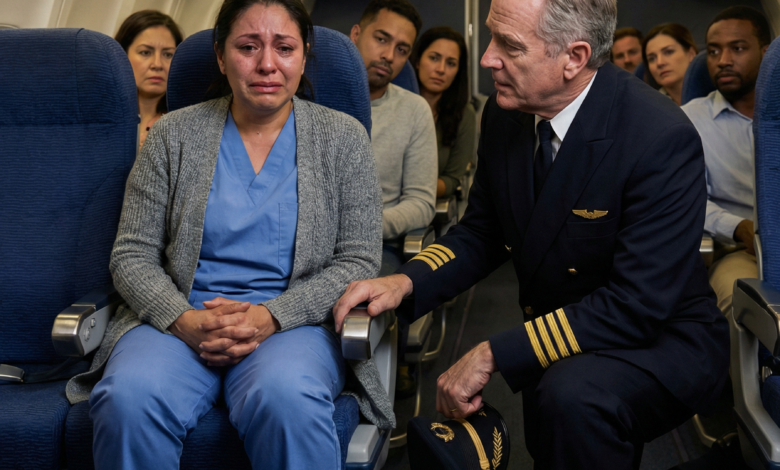
Blue scrubs. Cheap sneakers. A faded cardigan pulled tight around her even though the cabin was warm. She had one small purse, one pharmacy envelope stuffed with papers, and the kind of hands that tell the truth about a person’s life.
Working hands.
She looked like she’d come straight from a shift she couldn’t afford to miss.
“Mrs. Ruiz?” I asked.
She stood halfway, like she thought she was in trouble.
That hit me harder than anything.
“Please don’t get up,” I said. “I’m the captain. I just wanted to tell you how sorry I am.”
She sat back down slowly.
Her eyes were swollen, but dry. Past crying.
“He hated when I worked doubles,” she said, almost apologizing. “He used to tell me one day I wouldn’t have to.”
I didn’t say anything.
“He joined up after my diagnosis,” she went on. “Said I needed better coverage. Said maybe this way I could finally get my surgery.”
Then she looked down at the seat belt in her lap.
“He was nineteen. He was supposed to come home alive, not useful.”
I have heard a lot of hard sentences in my life.
That one stayed.
We took off.
For the first hour, it was like any other full flight across America.
One man in the premium cabin was already upset because the internet was slow.
A woman near the front kept arguing on speakerphone about a real estate closing.
Two college-age kids across the aisle from Mrs. Ruiz were laughing over videos, not cruelly, just loudly, still living in a world where death belonged to somebody else.
Most people never mean any harm.
They’re just busy being the center of their own lives.
Then weather built up over the middle of the country, and we had to circle.
Twenty-two extra minutes.
That’s all.
The man up front hit his call button so many times the attendant finally called me.
“He wants compensation,” she said. “He says this airline always has an excuse.”
I asked what exactly he said.
There was a pause.
Then she answered, “He said if the delay was because of cargo, somebody should’ve loaded it faster.”
Cargo.
I stood up so fast I hit my knee on the panel.
When I looked through the cockpit peephole, I could see him leaning into the aisle, expensive jacket, expensive watch, face red with annoyance like the whole country existed to keep him comfortable.
Behind him, Sergeant Brooks had heard every word.
He stood.
He didn’t storm up there.
He didn’t raise his voice.
He just walked forward, one measured step at a time, until he stopped beside the man’s seat.
The man looked up, irritated.
“What?” he snapped.
The sergeant stared at him for a long second.
Then he said, very softly, “His name was Daniel.”
That was it.
Not a speech.
Not a threat.
Just a name.
The man’s mouth opened, then closed.
He looked at the uniform.
Then, for the first time, he looked past it.
Past the brass, the shine, the posture.
He saw the face of a young man escorting another young man home in a box.
He sank back in his seat and didn’t speak again.
But that wasn’t the part that undid me.
What undid me was when I looked farther back and saw Mrs. Ruiz.
She had heard it too.
Heard her son called cargo.
And she was sitting there with both hands pressed tight over her mouth, shoulders shaking, trying with everything she had not to make a sound.
Like even her grief needed to stay polite in public.
I got on the microphone.
My voice did not sound like my own.
“Ladies and gentlemen, this is your captain speaking.”
The cabin went still.
“In the hold beneath us is a nineteen-year-old service member making his final trip home. His mother is seated with us today. When we arrive, I’m asking for one thing. Please remain in your seats. No phones. No rushing the aisle. Just give this family two minutes of quiet dignity.”
Nobody moved.
Nobody argued.
When we landed, the usual impatience never came.
No one popped up early.
No one reached for a bag.
You could feel people thinking.
That alone is rare.
The door opened.
Sergeant Brooks stood first.
Then Mrs. Ruiz.
She clutched that pharmacy envelope to her chest like it was the last thing tying her together.
They started walking down the aisle.
And halfway to the front, one of the college kids stood up.
A young woman.
Pink nails. Messy bun. Oversized sweatshirt.
She stepped into the aisle and put her hand over her heart.
Then the other one stood.
Then the flight attendant.
Then the quiet older man in the back.
Then row by row, one after another, the whole plane stood in silence.
No clapping.
That’s what made it worse.
No performance.
No big moment.
Just strangers standing there with tears on their faces, making a path.
The businessman stood too.
He was crying.
Not dramatically.
Just the stunned kind of crying a person does when shame finally reaches the right place.
Mrs. Ruiz stopped when she saw them.
She looked around like she didn’t understand what was happening.
Then she whispered, “He would’ve been so embarrassed.”
And for the first time, people laughed through their tears.
Small. Broken. Human.
Sergeant Brooks put his hand lightly at her back, and together they stepped off the plane.
From my side window, I watched the ground crew waiting in a line beside the transport vehicle.
No one was talking.
No machines were moving.
A whole noisy airport had somehow found a way to hush itself.
Then the flag-draped case came into view.
Mrs. Ruiz took one step forward and folded.
Not fainted.
Folded.
Like every double shift, every overdue bill, every doctor she postponed, every prayer she tried to bargain with had all landed at once.
Sergeant Brooks caught her before she hit the ground.
And as he held her up, I saw her reach for that case with one trembling hand and say the words no mother should ever have to say.
“I’m here, mijo. Mama’s here. You don’t have to travel alone anymore.”
I stayed in my seat and cried so hard I couldn’t read my own instruments.
I’ve flown rich people and runaways, newlyweds and prisoners, babies and bodies.
But that day I carried something heavier than grief.
I carried the distance between the people who can afford to be impatient and the people who bury children because they were trying to keep the lights on, pay for treatment, or save somebody at home.
And for two minutes on that plane, that distance disappeared.
Not because we solved anything.
Not because the country got better.
Just because one grieving mother walked past us, and for once, nobody looked away