The bagger everyone treated like he was slow became the only person who noticed an old woman had vanished—and what he found behind her door broke the whole town
The bagger everyone treated like he was slow became the only person who noticed an old woman had vanished—and what he found behind her door broke the whole town.
“Can I help you with that, ma’am?”
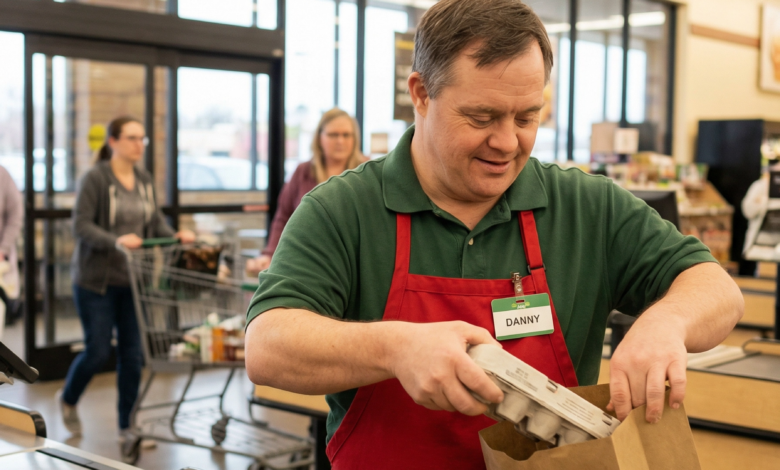
Tommy was already reaching for the paper bags before the next customer had even finished unloading canned soup and frozen peas onto the belt.
He had worked at the little grocery store on the east side of town for eleven years.
Same blue apron. Same name tag. Same careful hands.
He was not the fastest worker in the building. Everybody knew that.
He took his time with eggs. Kept bread away from heavy cans. Separated cold food from dry goods like it was a matter of honor.
And he smiled at people like they mattered.
Not the fake kind of smile people use at work.
A real one.
“How’s your day going, sir?”
“That pie looks like a good choice.”
“You want me to carry these out for you?”
Some shoppers loved him.
Some looked past him like he was part of the register.
A few would glance at his face, lower their voice, and ask for “someone quicker.”
Tommy never argued. Never snapped back. Never looked embarrassed.
He just kept doing his job.
Every Thursday at 3:15, Mrs. Alvarez came in.
Tiny woman. White cardigan, even in warm weather. Purse clutched in both hands. Cash folded neat inside an old coin pouch.
She bought almost the same thing every week.
Bananas. Bread. Milk. Soup. A frozen dinner or two if they were on sale.
Tommy always took her lane if he could.
He bagged everything extra carefully. Walked her to her car. Opened the trunk. Waited until she was settled behind the wheel before heading back inside.
He never acted rushed.
He talked to her the way grandsons are supposed to talk to grandmothers.
Then one Thursday, she didn’t come.
Tommy kept looking at the front doors between customers.
At 3:15.
At 3:30.
At 4:00.
Nothing.
“Maybe she changed her shopping day,” one cashier said.
Tommy frowned. “She always comes on Thursday.”
The next Thursday, she didn’t come again.
This time he stopped smiling.
After his shift, he stood outside the manager’s office, twisting his apron in both hands.
“I think something is wrong with Mrs. Alvarez.”
His manager looked up from a pile of invoices. “Who?”
“The lady with the white sweater. The bananas and soup. I take her groceries out.”
The manager sighed. “Tommy, people stop coming in. It happens.”
“But she didn’t just stop.”
“You don’t know that.”
Tommy lifted his chin. “I remember her address.”
The manager blinked. “You what?”
“From her checks. Building on Maple. Third floor. Apartment 3B.”
For a second, the room went quiet.
The manager had spent years watching Tommy notice things everybody else missed.
Which cashier had a migraine.
Which regular customer had started buying smaller portions after her husband died.
Which man always bought birthday cakes for children he never brought with him.
Tommy paid attention. That was his gift.
So the manager set his pen down.
“Fine,” he said. “But I’m coming with you.”
The apartment building looked tired before they even got out of the car.
Peeling paint.
Crooked railing.
Mail jammed into boxes so full it bent the metal.
By the time they reached the third floor, Tommy was breathing hard, but he knocked right away.
No answer.
He knocked again. Louder this time.
Still nothing.
The manager was already turning to leave when they heard a weak voice from inside.
“Who is it?”
Tommy stepped closer to the door. “Mrs. Alvarez? It’s Tommy. From the grocery store.”
There was a long pause.
Then the lock clicked.
The door opened two inches.
Mrs. Alvarez stood there in slippers and a housecoat, one hand on the frame like it was the only thing keeping her up.
Her face was pale. Her eyes looked frightened and embarrassed all at once.
“Tommy?”
He smiled, but this time it shook a little. “You missed two Thursdays.”
And just like that, she started crying.
Not loudly.
Not dramatically.
Just the kind of crying that comes when someone has been alone too long.
The apartment was clean but nearly empty.
A chair by the window.
A lamp with a cracked shade.
A television older than Tommy.
No flowers. No cards. No fresh groceries on the counter.
“I fell,” she said after a minute. “Trying to get to the bathroom. Hurt my hip. Doctor said I shouldn’t drive. I kept thinking I’d get stronger in a day or two.”
She looked down, ashamed.
“But I didn’t.”
Tommy glanced at the kitchen, then back at her.
“What have you been eating?”
She tried to laugh. “Crackers. Tea. Whatever was left.”
The manager looked like somebody had punched him.
Tommy asked the question like the answer was obvious.
“What do you need from the store?”
Mrs. Alvarez stared at him.
Then she whispered, “You don’t have to do that.”
“I know,” Tommy said. “I want to.”
The next Thursday, he brought her groceries after work.
Then he did it again the Thursday after that.
And the Thursday after that.
At first he paid with money from his own paycheck.
The manager found out and got angry.
Not at Mrs. Alvarez.
At Tommy.
“You can barely cover your own bills,” he said. “This has to stop.”
Tommy looked confused. “She still needs food.”
That was the end of the argument.
A cashier slipped twenty dollars into an envelope and left it in the office.
Then a stock boy added ten.
Then a bakery clerk brought five in crumpled singles.
One customer heard about it and asked if she could help.
Then another.
Then another.
Within a month, the store kept a coffee can under the front counter for Mrs. Alvarez’s groceries.
Nobody put their name on the money.
Nobody wanted credit.
They just kept giving.
Because the truth made people uncomfortable.
An old woman had disappeared for two weeks in a town full of neighbors, and the only person who went looking for her was the employee some customers thought was the least capable person in the building.
Tommy never understood why everyone acted like he’d done something heroic.
“She’s my friend,” he would say.
Like that explained everything.
Maybe it did.
For three years, he brought her groceries every Thursday.
He stayed a few extra minutes each time.
Sometimes she told him stories about dancing in her kitchen with her husband when they were young.
Sometimes she talked about her children in other states who were always “busy.”
Sometimes she just sat and listened while Tommy told her who bought ice cream, who got a new car, who had a baby, who forgot their coupons.
He made her feel like she was still part of the world.
When she died in her sleep, there were only a handful of people at the funeral.
A neighbor.
A niece from out of state.
A pastor.
Tommy sat in the front row wearing his best button-down shirt, holding a folded tissue in both hands.
After the service, the niece walked up to him with red eyes and an envelope.
“You’re Tommy,” she said.
He nodded.
“She talked about you in every call. Every letter. She said you were the only person who saw her after she stopped being useful to everyone else.”
Tommy looked down.
Inside the envelope was a note in shaky handwriting.
Thank you for noticing when I disappeared.
Thank you for making me feel remembered.
Thank you for treating me like I still mattered.
Tommy read it twice.
Then he folded it carefully and tucked it into his pocket.
He still works at that grocery store.
Still bags bread on top and eggs where they won’t break.
Still offers to carry groceries to the car.
Still notices when somebody doesn’t come in anymore.
Because some people think his job is bagging food.
It isn’t.
His real job is seeing the people the rest of the world stops seeing.
And judging by how many of us walk past loneliness every day without lifting our heads, he may be the best employee any town could ever hope to have.
Part 2
Three days after Mrs. Alvarez was buried, her son walked into the grocery store, pointed at Tommy in front of a line of customers, and said, “Did you ask my mother for money?”
The whole front end froze.
A carton of eggs sat half-bagged on the counter.
The register beeped once, then stopped.
Tommy looked up from a loaf of wheat bread he was setting on top of canned beans.
He blinked.
“What?”
The man stepped closer.
He was in his late fifties maybe, clean jacket, tired face, the kind of face that looked like sleep had not helped in a long time.
“You heard me.”
His voice was not loud.
That somehow made it worse.
“My cousin said there’s some paper at the lawyer’s office with your name on it. My mother died, and somehow your name is on her papers.”
Tommy’s hands stayed on the bread.
He did not pull them back.
He did not know what to do with them.
“I didn’t ask her for anything.”
A woman at register two stopped unloading her groceries.
The cashier nearest the door looked down like she suddenly had a very important reason to study her receipt tape.
Tommy’s manager came out of the office fast enough to bump the doorframe with his shoulder.
“Sir,” he said, “this isn’t the place.”
The son gave a short laugh that did not sound like laughing.
“No? Because this place had no problem sending an employee into my mother’s apartment.”
“She invited him in,” the manager said.
“She was injured and alone.”
“She was vulnerable.”
“So she was.”
That landed harder than anyone expected.
The son’s mouth tightened.
The manager’s face changed.
Tommy looked from one of them to the other, like he was trying to follow a conversation moving too fast.
Customers pretended not to listen.
Which meant they listened harder.
The son turned back to Tommy.
“Did you ever once tell her to call her family?”
Tommy swallowed.
“She talked to her family.”
“That wasn’t my question.”
Tommy stared at him.
Mrs. Alvarez had talked about her children while he carried in bananas and soup and milk.
Sometimes she smiled when she said their names.
Sometimes she looked at the window when she said them.
He had never asked how often they called.
It had felt private.
The son took that silence and made something ugly out of it.
“That’s what I thought.”
“Enough,” the manager said.
“Either calm down or leave.”
For a second it looked like the man might say something worse.
Something he could never pull back.
Then he looked around at all the strangers watching him grieve in aisle lights and freezer hum, and something inside him seemed to cave in.
He rubbed one hand over his mouth.
“I buried my mother on Monday.”
Nobody answered.
“She left me a ceramic bird and a box of old Christmas cards,” he said.
“Now I’m hearing she left money to a grocery store bagger.”
His voice cracked on the last word.
Not because he thought Tommy was beneath it.
Because pain had made him cruel for one second, and he knew it.
Tommy heard it anyway.
Everybody did.
The manager stepped closer to the counter.
“Sir,” he said, quieter now, “go home today. Get some rest. Then call the office and handle this the right way.”
The son looked at Tommy one more time.
Not angry this time.
Not exactly.
Wounded.
Confused.
Like he had shown up ready to accuse a thief and instead found a man still holding somebody else’s bread the careful way.
Then he left.
The door shut behind him.
Nobody moved for two full seconds.
Then one of the cashiers whispered, “Oh my Lord.”
A customer muttered, “Well.”
The line started breathing again.
Tommy finished bagging the groceries in front of him.
He did it the same way he always did.
Eggs protected.
Bread on top.
Frozen together.
But his hands were shaking.
When the rush finally thinned out, the manager told him to take his break.
Tommy sat outside on an overturned milk crate near the back loading door.
He had not touched the sandwich in his lunch bag.
He just held Mrs. Alvarez’s note in both hands and read the first line over and over again.
Thank you for noticing when I disappeared.
The back door opened.
The manager stepped out holding two paper cups of coffee.
He handed one to Tommy even though Tommy did not really drink coffee.
Tommy took it anyway.
“Did she leave me money?” he asked.
The manager leaned against the wall beside him.
“I don’t know.”
The truth was in how careful he said it.
Which meant he had heard enough to think maybe yes.
Tommy stared at the coffee.
“I didn’t ask her.”
“I know.”
“She bought bananas.”
“I know.”
“And soup.”
“I know.”
Tommy looked up.
“Why did he say it like that?”
The manager exhaled through his nose.
Because grief did not always come out clean.
Because guilt could put on anger faster than it could put on honesty.
Because people liked simple stories when complicated ones hurt too much.
He did not say any of that.
He just said, “Because people say bad things when they’re hurting.”
Tommy turned the paper cup in his hands.
“She loved them.”
The manager glanced at him.
“How do you know?”
“She always saved the good stories for them.”
That answer stayed with the manager a long time.
An hour later, the store phone rang.
One of the cashiers picked it up.
Then she turned, covered the receiver, and said softly, “Tommy? It’s Mrs. Alvarez’s niece.”
Tommy stood so fast the milk crate scraped concrete.
He took the phone in the office with the door half closed.
“Hello?”
The voice on the other end was tired and kind.
“This is Elena,” she said.
“We met at the funeral.”
Tommy nodded even though she could not see him.
“Yes.”
“I’m sorry about this morning.”
He did not know what she meant at first.
Then he did.
“Oh.”
“My cousin Daniel should not have come in there like that.”
Tommy looked through the office window at the registers.
People were moving again.
The world had gone back to normal for everybody except the people inside the problem.
“He’s upset,” Elena said.
“They all are.”
Tommy gripped the phone a little tighter.
“Did she leave me money?”
There was a pause.
Then Elena said, “She left instructions.”
Tommy waited.
“In a savings envelope at the law office. And a letter.”
Another pause.
“She didn’t leave it to you like a gift,” Elena said carefully.
“She left it in your care.”
Tommy frowned.
“I don’t understand.”
“I didn’t either,” Elena said.
“Not until I read the first page.”
Tommy sat down in the chair by the filing cabinet.
“Can you tell me?”
“She wanted the money used for groceries and visits.”
He blinked.
“For who?”
“For people like her.”
The office seemed suddenly too small.
The humming soda fridge outside the wall sounded loud enough to be in the room.
Elena kept going.
“She wrote that the town keeps waiting for family to do everything, and family keeps waiting for time to appear from nowhere, and in the meantime lonely people learn how to disappear quietly.”
Tommy closed his eyes.
“She said you would know who needed it.”
His first feeling was not pride.
It was fear.
“That’s too much.”
“I know.”
“She shouldn’t have done that.”
“She thought she should.”
Tommy rubbed one hand over his forehead.
“How much?”
Elena let out a slow breath.
“A little over nineteen thousand.”
Tommy almost dropped the phone.
“Nineteen—”
“I know.”
“That’s too much.”
“Yes.”
“She needed that.”
“She didn’t anymore,” Elena said softly.
The room went still.
“She left instructions for some of her personal things too,” Elena said after a moment.
“But the money is what everyone is fighting over.”
Tommy stared at the gray office floor.
“Her children are mad.”
“They’re hurt.”
“That too.”
He could hear voices at the registers.
A cart rattling over the front tile.
Somebody laughing at something near produce.
The ordinary sound of ordinary life.
And inside it, this.
Elena lowered her voice.
“There’s more.”
Tommy waited.
“She left a second note for you in the apartment.”
His head lifted.
“What note?”
“She taped an envelope inside the kitchen, according to the paper she filed.”
Tommy frowned.
“Why?”
“I don’t know.”
The manager was watching from the doorway now.
Not interrupting.
Just making sure Tommy was steady.
Elena said, “I’m going over there tomorrow afternoon. Daniel and my cousin Marissa will be there too. I was hoping you’d come.”
Tommy’s first instinct was yes.
His second was fear again.
“I don’t want them mad.”
“They’re already mad.”
The honesty of it made him almost smile.
“I don’t want to make it worse.”
Elena was quiet.
Then she said, “Tommy, I think my aunt believed you would understand something the rest of us won’t.”
He looked down at Mrs. Alvarez’s folded note in his shirt pocket.
“She was my friend.”
“I know,” Elena said.
“Come anyway.”
After he hung up, the manager stayed in the doorway.
Tommy told him the amount.
The manager sat down hard in the second chair.
“Nineteen thousand?”
Tommy nodded.
“For groceries.”
The manager leaned back and stared at the ceiling tile like it had personally offended him.
Then he laughed once.
Not because it was funny.
Because there are moments when the size of the truth is too much for silence.
“An old woman on soup and sale bread saved nineteen thousand dollars.”
Tommy nodded again.
“She clipped coupons.”
The manager looked at him.
“You say that like it explains everything.”
Tommy thought about it.
“It explains some.”
The next day was worse.
Not louder.
Worse.
People came in pretending not to know.
Then somehow finding a reason to mention it anyway.
“I heard a little something.”
“Must be strange.”
“Hope nobody took advantage.”
“You can never be too careful with older folks.”
One woman, who had once asked for a faster bagger while Tommy stood two feet from her, said it right in front of him.
“These situations are messy. Sometimes the sweetest people are the easiest to influence.”
Tommy placed her peaches gently into a separate paper bag.
He did not answer.
The cashier did.
“She found out she was alone because he noticed she stopped coming in.”
The woman flushed.
“That’s not what I meant.”
But everybody knew it was close enough.
By noon the town paper had called.
The manager said no comment.
Then the owner of the store called from home.
Then the owner’s wife.
Then the owner’s brother, who did not work there but felt qualified anyway.
The manager spent half the afternoon saying some version of the same sentence.
“No, we are not using a grieving family’s business for publicity.”
By two o’clock he looked ready to throw the office phone through the wall.
At three, Tommy untied his apron.
He smoothed it flat on the counter before handing it over.
“Do I still go?”
The manager was standing behind him already holding his own keys.
“I said I was coming, didn’t I?”
The apartment building looked more tired than it had the first time.
Maybe because now Tommy knew exactly what tired could hide.
There were two cars out front he did not recognize.
A silver sedan and a dark pickup truck with road dust up the sides.
They climbed to the third floor.
Before Tommy could knock, the door opened.
Elena stood there in jeans and a cardigan, dark hair pulled back, eyes worn out but warm.
She gave Tommy a sad little smile.
“Thank you for coming.”
Inside the apartment, everything looked both familiar and wrong.
The same cracked lamp.
The same chair by the window.
The same old television.
But the place had been touched by grief now.
Drawers half open.
A cardboard box by the sofa.
A coat folded over the armchair like somebody had meant to take it and then could not.
A man stood near the dining table going through a stack of papers.
Daniel.
Tommy knew right away.
He had Mrs. Alvarez’s eyes around the edges, where grief had not hardened him yet.
A woman Tommy guessed was Marissa stood by the kitchen sink with her arms crossed.
She looked tired too.
Not cruel.
Tired.
Daniel looked up when Tommy entered.
For one second, shame moved over his face.
Then pride covered it back up.
“You came.”
Tommy nodded.
“Elena asked me.”
Daniel glanced at the manager.
“And you brought supervision.”
The manager did not bite.
He just said, “I brought support.”
Marissa let out a sharp breath through her nose.
“Nobody needed a parade.”
Elena cut in before it could turn.
“There’s enough of that already.”
Tommy stood near the doorway, unsure where his hands belonged.
“I can go.”
“No,” Elena said quickly.
“My aunt wanted you here.”
Daniel dropped the papers on the table harder than he meant to.
“That’s the problem, Elena. Nobody knows what my mother wanted.”
Tommy looked at him.
“She wanted milk with the blue cap.”
Everybody turned.
Tommy shrugged, a little helpless.
“And the soup with the pull tab if her hands hurt that week.”
Silence.
Daniel stared at him.
Not angry this time.
Just hit with something he had not prepared for.
Marissa looked away first.
Elena touched the back of a chair.
“She also wanted us to stop acting like this is about one thing.”
Daniel laughed once, bitter and tired.
“Really? Because nineteen thousand dollars feels like one thing.”
Tommy spoke before anyone else could.
“I don’t want it.”
Everybody looked at him now.
He swallowed.
“I don’t want her money.”
Elena’s face softened.
Daniel’s shoulders dropped a fraction.
But Marissa asked the real question.
“Then what do you want?”
Tommy looked around the apartment.
The chair by the window.
The dry dish towel by the sink.
The calendar on the wall still turned to last month.
He answered honestly.
“I want her not to be gone.”
That shut the room down.
Nobody had a better sentence than that.
After a while, Elena handed Tommy a folded sheet from her aunt’s file.
“She wrote where the second envelope is.”
Tommy took it carefully.
Mrs. Alvarez’s handwriting leaned gently to the right.
For Tommy. Taped behind the kitchen door. He will know what to do. Please let him see it before anyone throws anything away.
Tommy looked toward the kitchen.
The manager gave a small nod.
“Go on.”
The kitchen was tiny.
Two steps from sink to stove.
Three to the refrigerator.
Tommy stood in the doorway and looked behind it.
At first he only saw an old grocery sack hanging from a hook.
Then his eyes adjusted.
There was an envelope taped near the hinge, yellowed a little at the edges.
But that was not what made him stop breathing.
Behind the door, covering almost the whole panel from top to bottom, were index cards.
Dozens of them.
Maybe more than that.
Each one taped carefully in straight rows.
Names.
Addresses.
Apartment numbers.
Little notes in shaky handwriting.
Mr. Hanley, 2C. Daughter comes Sundays. Likes oatmeal cookies.
Ms. Ruth on Pine. Light usually on by 6. If dark, check.
Tall man with limp at store. Buys cat food Tuesdays. Ask if he needs help carrying litter.
Woman in green coat from bus stop. Cries after phone calls.
Mr. and Mrs. Bell used to come together. Now only Mrs. Bell. No sugar in tea.
Tommy’s hand rose slowly to his mouth.
The envelope dropped from his fingers to the floor.
The manager stepped into the kitchen behind him.
Then stopped too.
“What is that?”
Tommy bent and picked up the envelope, but his eyes stayed on the cards.
Mrs. Alvarez had made a map.
Not of streets.
Of loneliness.
People she had worried about.
People she had watched from her window.
People Tommy had mentioned in passing while setting groceries on her counter.
People she had gathered in her mind because she knew what it was to become easy to miss.
Elena came in behind them.
Then Daniel.
Then Marissa.
Nobody spoke for a long time.
At the very bottom of the door, in larger writing than the rest, there was one final card.
People disappear a little at a time before they disappear all at once.
Under that:
Somebody should keep watch.
Daniel sat down hard in one of the kitchen chairs.
He looked sick.
Marissa covered her mouth.
Elena started crying before she made a sound.
Tommy slid his fingers over the edge of one index card but did not pull it loose.
“She was still noticing.”
It was such a small sentence.
But it broke the room open.
Because there it was.
The thing none of them wanted to carry.
Even when Mrs. Alvarez could barely get around her own apartment, she had still been paying attention to other people.
She had still been making lists.
Still remembering who might be alone.
Still telling herself that somebody should keep watch.
Daniel stared at the names.
“Why didn’t she tell us?”
Elena answered without looking away.
“Maybe she did.”
Nobody had the nerve to say she was wrong.
Tommy opened the envelope with careful fingers.
Inside were three things.
A handwritten letter.
A key on a pink plastic ring.
And a stack of folded receipts held together with a rubber band.
He looked at the receipts first.
Groceries.
Dates.
Amounts.
Three years of Thursdays.
Some paid from the coffee can.
Some marked with tiny initials from store workers.
Some marked with one neat word in Mrs. Alvarez’s handwriting.
Tommy.
His own name.
Again and again.
He set them down and opened the letter.
The page trembled in his hands.
Tommy,
If you are reading this, then I have already gone where old hips and lonely kitchens and bad weather cannot follow.
He blinked fast.
Her voice was right there in the words.
Plain.
Matter-of-fact.
A little funny when she wanted to be.
Do not let anyone tell you I did not know my own mind.
Daniel let out a breath.
Marissa looked down.
Tommy kept reading.
My children loved me, but love does not always arrive in the room when you need a ride, a bag of groceries, or someone to notice you have not opened your curtains in three days.
The manager leaned one shoulder against the refrigerator and closed his eyes.
Do not be cruel to them on my account. The world makes people tired and ashamed, and ashamed people call less than they mean to.
Elena wiped her face.
Daniel’s jaw tightened.
Tommy read the next lines twice.
I am leaving the savings your Mr. Alvarez thought was for emergencies. I have decided loneliness is an emergency.
No one moved.
Even the old refrigerator seemed to pause its rattling for a second.
Tommy went on.
Use it for groceries first. Then rides. Then visits. In that order. Food before feelings, because an empty stomach makes every sorrow louder.
The manager made a sound that was almost a laugh and almost a sob.
Tommy kept going.
Do not spend one dollar trying to make me look noble. I have no interest in my name on a plaque.
If my children object, tell them I leave them what is harder to price. I leave them my forgiveness, which I hope they will not waste.
Daniel stood up so fast the chair legs scraped.
“Forgiveness?”
His face had gone red in patches.
“Forgiveness?”
Elena reached for him.
He pulled away.
“My mother needed groceries and checks from a grocery store worker, and now I’m supposed to be grateful she forgave me?”
Tommy lowered the letter.
Nobody answered.
Because it was a real question.
Because pain did not stop being pain just because somebody wrote it down beautifully.
Daniel looked around the kitchen like he could not breathe in it.
“All of you got the soft version of her.”
That surprised everyone.
Maybe even him.
He laughed again, but this time there was water in it.
“You got stories about dancing in the kitchen and sale bread and soup. I got ten years of phone calls where she said she was fine and then made me feel like garbage for living six states away.”
Elena said quietly, “Danny.”
“No.”
He turned to Tommy.
“You know what it is to get a call at work from a parent who says ‘I’m all right’ in that voice where you know they aren’t, and you’re three hundred miles from a mortgage payment and a daughter who needs braces and a job that already thinks you take too many days off?”
Tommy stared at him.
He did not know those exact things.
But he knew the look on Daniel’s face.
Cornered.
Guilty before he even opened his mouth.
Daniel rubbed both hands over his head.
“You people in this town will make this simple because simple is easier. Bad son. Good stranger. End of story.”
He shook his head.
“That’s not the story.”
No one argued.
Because it wasn’t.
Marissa leaned against the counter.
“She said the same thing to me every time I asked if she wanted to move closer.”
Her voice was rough.
“‘I don’t want to start over at my age.’”
She looked at the cards on the door.
“She wanted this place. Even when it wasn’t enough.”
Elena’s crying quieted.
She looked tired all the way through now.
“She wanted to belong somewhere familiar,” she said.
“And the familiar place let her vanish for two weeks.”
There it was.
The other truth.
The one that did not belong only to family.
The one that belonged to everybody.
Tommy looked down at the letter again.
At the next line.
His throat tightened before he read it.
You will be told to mind your own business. Ignore that whenever hunger, fear, or silence get too big.
He stopped.
The manager looked at him.
“What else?”
Tommy swallowed.
“She said… she said, ‘Nobody wants strangers knocking on their parents’ doors until the day they do.’”
That one sat in the room like something alive.
Because it was exactly the kind of sentence people hated when it was true.
Daniel looked at the floor.
Marissa looked out the window.
Elena closed her eyes.
And Tommy, still standing in that tiny kitchen, understood something Mrs. Alvarez had been trying to say with every bag of bananas and soup and bread.
This was not only about her.
It was about all the people the town had agreed not to see too clearly because seeing them might create an obligation.
The argument started that night and spread by morning.
Not in one place.
Everywhere.
At the store.
At the diner.
In the church parking lot after Wednesday service.
At the bus stop.
In line at the pharmacy.
In living rooms with televisions on too loud.
At kitchen tables where adult children called their parents out of guilt and then got angry at the guilt and blamed the article they had just read in the town paper.
Because of course the paper got it.
By noon the headline was all over town.
LOCAL WOMAN LEAVES SAVINGS TO STORE WORKER TO HELP ‘THE FORGOTTEN’
Some people loved it.
Some hated it.
Some loved hating it.
The comments online got ugly fast.
Not the kind of ugly that used curse words.
The cleaner kind.
The kind that sounds reasonable while cutting straight to the bone.
This is exactly why lonely seniors get manipulated.
Or maybe this is exactly why we should stop leaving care to families already drowning.
No employee should be entering customers’ homes. Full stop.
Funny how boundaries matter until your own mother is on the floor alone.
Blood should come first.
Blood came second for three years.
Maybe the real scandal is that a bagger had to do what an entire town didn’t.
The owner called another emergency meeting at the store.
He was a small man with a careful mustache and a permanent look of being five minutes from acid reflux.
He did not like conflict.
He liked stacked produce and predictable invoices and customers leaving with a generally favorable opinion of their shopping experience.
He sat at the break room table with both hands flat on the surface.
The manager stood at the coffee machine, arms crossed.
Tommy sat in a folding chair with Mrs. Alvarez’s note in his pocket and the second letter folded into his lunch bag.
The owner cleared his throat three different times before picking one.
“I need to protect the store.”
The manager’s mouth tightened.
Tommy just listened.
“That means,” the owner said, “effective immediately, no employee makes personal deliveries to customers’ homes unless it is an official store service approved through the office.”
“We don’t have an official delivery service,” the manager said.
“Exactly.”
“Then what you mean is no one helps anybody.”
The owner gave him a look.
“What I mean is no one opens us to liability.”
Tommy frowned.
“What is liability?”
The owner looked at the manager for help like this had somehow become his fault.
The manager answered.
“It means people get scared of being blamed.”
Tommy nodded slowly.
That made more sense to him than the other word had.
The owner went on.
“No employee accepts money, gifts, instructions, or personal errands from customers outside normal store business.”
Tommy nodded again.
He was still listening.
Still thinking.
The owner took that silence as agreement.
Then Tommy asked, “What if somebody’s hungry?”
The owner pressed his lips together.
“What if somebody falls?”
“Tommy—”
“What if they don’t come in anymore?”
The room went quiet.
Because everybody there had heard the first story.
And now the second one was wrapped around it like wire.
The owner softened a little.
“I’m not saying people shouldn’t care.”
“It sounds like that.”
The manager did not look at Tommy when he said it.
The owner rubbed his forehead.
“I’m saying this cannot be on store time and store responsibility.”
Tommy thought about that.
“So if I see somebody disappear, I do it after work?”
The owner looked like a man who had discovered too late that clarity was dangerous.
The manager almost smiled.
But nobody was smiling by the end of the meeting.
Because rules feel cold when they show up late.
Especially after kindness has already made them look small.
The days after that were strange.
People who had never once spoken more than four words to Tommy now wanted to tell him their opinion.
At length.
In detail.
Sometimes while he was bagging their tomatoes.
“I think what you did was beautiful.”
Or:
“You have to understand why the family’s upset.”
Or:
“My mother lives alone and I would not want some stranger involved.”
Or:
“My father lived alone and I would have paid money for a stranger to get involved.”
It was never really about Tommy.
He understood that.
He had become the place where other people put their fear.
He noticed something else too.
People were buying more greeting cards.
More landline phones.
More casserole ingredients.
More guilt.
You could almost see it in the carts.
Then on Tuesday morning, Mr. Clevenger did not come in.
Tommy noticed because Mr. Clevenger always bought cat food, prune juice, rye bread, and exactly two cans of cheap tuna every Tuesday at 10:20.
Same order.
Same coupon folded in his shirt pocket.
Same joke about the cat eating better than he did.
Tommy looked at the door at 10:20.
10:30.
10:45.
Nothing.
His stomach tightened.
At 11:05 he asked the cashier at lane three, “Did Mr. Clevenger come in earlier?”
She shook her head.
“Not that I saw.”
At noon he asked produce.
At one he asked the bakery clerk.
At two he asked the stock boy who sometimes helped carry litter to the parking lot.
No one had seen him.
Tommy tried to focus on his work.
He bagged potatoes.
He straightened carts.
He brought in a row of loose baskets from outside.
But every time the front doors opened, his head turned.
The manager noticed by midafternoon.
“Who are we waiting for?”
“Mr. Clevenger.”
The manager thought.
“Cat food. Tuesday.”
Tommy nodded.
The manager’s face changed.
He remembered.
He remembered because Tommy had taught him to remember some things.
“Could’ve changed days,” he said, though they both knew how thin it sounded.
Tommy looked down.
“Mrs. Alvarez changed days for two weeks.”
The manager swore under his breath.
Not because Tommy was wrong.
Because he wasn’t.
At five, Tommy untied his apron slowly.
The owner’s new rules sat in the air between him and the manager.
The manager looked toward the office.
Then toward the front doors.
Then back to Tommy.
“Do you know where he lives?”
Tommy nodded.
“Second building behind the laundromat. Green door. He said his mailbox sticks when it rains.”
The manager stared at him for a second.
Then he reached for his keys.
“You’re a menace,” he said.
Tommy frowned.
“No I’m not.”
“I know.”
They found Mr. Clevenger in his recliner with the television on and the cat screaming from the kitchen.
The front door was unlocked.
The mailbox was full.
He was conscious, barely, but confused and burning up with fever.
There was an empty glass on the floor beside him.
One shoe on.
One shoe off.
Tommy was already at his side before the manager finished calling for help.
“Mr. Clevenger?”
The old man’s eyes opened a little.
“Tommy?”
That one word nearly split the manager in half.
Because what kind of world lets a man in danger answer more easily to the grocery bagger than to anybody else?
Tommy took the old man’s hand.
“It’s okay.”
Mr. Clevenger tried to say something else.
It came out in pieces.
“Cat.”
Tommy looked toward the kitchen.
The cat was skinny and furious and very much alive.
“She’s okay,” Tommy said.
It was the first thing Mr. Clevenger had worried about.
Of course it was.
The paramedics came.
They moved quickly.
Professional.
Efficient.
One of them asked how long the man had been like this.
The manager and Tommy looked at each other.
Then away.
Nobody knew.
And that was exactly the problem.
By the time they got back to the store, word had already started.
The stock boy’s cousin lived in the same building.
The laundromat owner had seen the ambulance.
A customer recognized Tommy getting out of the manager’s car.
By closing time, the new question in town was not whether people should mind their own business.
It was what counted as minding your own business when somebody’s life might be slipping away inside it.
That Thursday night the church basement filled up so fast they had to bring in extra folding chairs.
The pastor had offered the space after three days of hearing the same argument from five different directions.
The town paper sent a reporter.
The owner came looking unwell.
The manager came looking ready for a fight.
Elena came with a folder under her arm.
Daniel came because not coming would have looked like cowardice, and besides, some part of him still wanted to hear his mother defended and some other part still wanted to be angry enough not to fall apart.
Marissa came late and sat in the back.
Tommy came because Elena asked him to.
He sat in the front row and held Mrs. Alvarez’s second letter so carefully it looked like it might bruise.
The pastor stood at the front.
“This is not a hearing,” he said.
“Nothing is being voted on tonight.”
That was the first lie.
Everything was being voted on.
Not with ballots.
With faces.
With folded arms.
With who people clapped for and who they looked away from.
A retired school principal spoke first.
“We cannot build a town on informal check-ins and random acts of charity. People need systems.”
A woman near the back said, “Where are these systems?”
No one answered right away.
A man who ran the tire shop stood up next.
“My sister cared for our mother for eight years while the rest of us worked and raised kids. If somebody from a grocery store had shown up acting like the hero of the story, I would’ve thrown him out.”
There were nods.
Real ones.
Then a nurse from the clinic spoke.
“I also know what happens when nobody shows up at all.”
More nods.
Different ones.
A younger woman with two toddlers in matching sweaters stood with one baby half asleep on her shoulder.
“I live forty minutes from my dad. I call. I try. But I’m one emergency away from dropping everything in one place and failing somewhere else. So yes, maybe family should do more. But maybe we also need to stop talking like love cancels out distance, money, illness, divorce, jobs, and being human.”
That one got quiet applause.
Because she had named the thing everybody danced around.
Care had become too heavy for one household at a time.
But nobody knew how to say that without sounding like they wanted out of the duty.
The owner finally stood.
“I am sorry for what happened to Mrs. Alvarez,” he said.
“And thankful beyond words for Tommy. But a grocery store cannot become the town’s social safety net.”
There were murmurs.
Then the manager stood before the murmurs finished.
“No one asked it to.”
That sharpened the room.
“What happened,” the manager said, “is that one of my employees noticed a person was gone, and because he did, she didn’t starve in her apartment. Then he kept helping because he has better instincts than most of us and less interest in excuses.”
The owner flushed.
The manager went on.
“Now another man was found sick because Tommy noticed he missed one Tuesday. So maybe the question isn’t whether the store can fix loneliness. Maybe the question is why everybody gets so nervous when decency threatens to become expected.”
That landed.
Hard.
A few people clapped.
A few did not.
Daniel stood up.
“Expected from who?”
The room turned.
From this angle he looked more like his mother.
That was unfortunate for everybody.
“From families?” he asked.
“From neighbors? From store workers? From churches? From already overworked people one crisis away from their own collapse?”
His hands were shaking now, but his voice stayed steady.
“My mother lived alone because she wanted to. She refused to move. She refused help half the time. She told us she was fine so often we stopped believing the other possibility because the other possibility was impossible to manage.”
He looked around.
“You all want a villain because villains are easier than math.”
Even the pastor looked startled by that one.
Daniel pointed without meaning to accuse any single person and somehow accusing all of them.
“My wife and I both worked two jobs when the mill closed. My son needed rehab after an accident. My daughter had panic attacks every time we talked about moving again. I called my mother. I sent money when she’d take it. I drove here when I could. And every time I left, she stood on that curb and told me not to ruin my life hovering over hers.”
His voice broke.
“She made it sound like leaving was kindness.”
The room went softer.
Not all the way.
But softer.
Daniel looked at Tommy then.
Straight at him.
“I’m not mad because you cared.”
That surprised Tommy more than anybody.
“I’m mad because you were there for the part I missed, and I don’t know where to put that.”
No one interrupted.
Because there was the split, laid open and honest.
A son who had not done enough.
A town that had done less.
A stranger who had done what he could.
And a dead woman who had loved all of them imperfectly.
Elena stood next.
She held up the folder.
“These are copies of the receipts from three years of groceries, plus my aunt’s note and her letter.”
She looked around the room.
“My aunt did not leave money because she loved her family less. She left money because she understood that loneliness was bigger than one family.”
She pulled out the second page from the letter.
“I’m going to read one part.”
No one objected.
Not even Daniel.
Elena read clearly.
Do not turn my life into a weapon against my children. If they failed me, it was in the ordinary ways people fail each other now: by being tired, far away, ashamed, overbooked, underpaid, and too used to hearing “I’m fine” when nobody is.
The room went so still it felt like weather.
She read the next line too.
But ordinary failure still leaves a person hungry on Thursday.
That was the line that changed the room.
Because it did not let anybody off.
Not family.
Not town.
Not systems.
Not neighbors.
Not churches.
Not the store.
Nobody.
Tommy was not supposed to speak.
He had not planned to.
But after that line, the pastor looked at him and asked the most dangerous question in the world.
“Tommy, do you want to say anything?”
He stood because sitting suddenly felt impossible.
He held the letter in both hands and looked out at faces that had spent a week making him into a symbol when he had only ever wanted to carry groceries carefully and make sure people got home okay.
His mouth opened.
Closed.
Opened again.
“She was my friend.”
A few people smiled through tears.
Not because it was cute.
Because it was clean.
He swallowed and kept going.
“I think…” He stopped to find the thought.
“I think people keep asking who should have done more.”
Nobody moved.
“And maybe that matters.”
He looked at Daniel.
Then at the owner.
Then at the woman with the sleeping baby.
Then at the nurse.
Then at a row of older people sitting with their hands folded in their laps.
“But I think it matters less than what happens when we notice and still decide it’s not our place.”
The room stayed with him.
He was shaking now.
But not from fear.
From saying something that had been true in him a long time.
“Mrs. Alvarez did not want people fighting over whether she was worth visiting.”
His voice roughened.
“She wanted bananas and soup and somebody to know if the light stayed off.”
A sound moved through the room.
Not words.
Recognition.
Tommy took a breath.
“If I stop at a door because somebody has not come in and I’m wrong, then maybe they laugh and tell me to go home.”
A few people huffed soft, sad laughter.
“But if I don’t stop and I’m right…”
He could not finish for a second.
Then he did.
“Then being polite is not the better sin.”
You could feel the room divide and join at the same time.
Some people crossed their arms tighter.
Some people uncrossed them.
The pastor looked down.
The owner looked tired enough to tell the truth.
Marissa, from the back row, said it first.
“So what do we do?”
Nobody answered immediately.
Because now the argument had reached the place arguments hate most.
Action.
The nurse spoke.
“You start small.”
The younger mother said, “You make it voluntary.”
The retired principal said, “You keep records.”
The tire shop owner said, “You better have boundaries.”
The manager said, “You better have backbone too.”
Daniel sat down and covered his eyes with one hand.
He looked spent.
Elena moved beside him without making a scene of it.
For the first time all week, nobody looked like they were winning.
That helped.
By the end of the night there was no official program.
No grand announcement.
No smiling photo.
Just a legal pad covered in names.
People willing to call, drive, drop off groceries, check on curtains, change smoke detector batteries, sit for twenty minutes, take soup, listen, notice.
The pastor offered a side room for monthly organizing.
The nurse offered to make a simple sheet about warning signs people should not ignore.
The owner, after enough people stared at him, offered a shelf near the front counter for donations of nonperishable basics.
He said it like a concession.
Everybody heard the decency in it anyway.
Someone asked what it would be called.
Tommy looked confused by the question.
But Elena answered.
“The Thursday List.”
A few people nodded.
Nobody loved the name because it was clever.
They loved it because it was plain.
And because plain things, when they are true, last longer.
The legal fight over the money did not vanish.
Nothing that touches guilt and inheritance ever does.
For two weeks Daniel considered contesting the whole thing.
More than considered it.
He met with the lawyer.
He made lists.
He talked with Marissa until both of them sounded meaner than they wanted to be.
The money could help his family.
That was true.
Their daughter’s student loans were real.
His son’s medical bills were real.
His own resentment was real too.
So was the humiliation of being publicly cast as the child who did not show up.
One Saturday morning he came to the store before opening.
Tommy was outside helping line up carts.
The air smelled like wet pavement and early bread.
Daniel stood by the cart return for so long Tommy noticed before he spoke.
“Hi.”
Daniel gave a strained nod.
“Hi.”
Tommy waited.
He was good at waiting.
It made people say things they might not have said if rushed.
Daniel finally held out a small cardboard box.
“She kept letters.”
Tommy took the box carefully.
Inside were birthday cards, school pictures, postcards, a hospital bracelet from years ago, two macaroni drawings gone soft at the edges, and a dozen folded pages tied with ribbon.
“She saved everything we ever sent,” Daniel said.
His face did something hard and private.
“I don’t know whether that makes me feel better or worse.”
Tommy looked into the box.
“She was proud.”
Daniel laughed without humor.
“You know what the worst part is?”
Tommy looked up.
“I did love her.”
There was no defense in it.
No performance.
Just raw fact.
“I just kept building my life around the idea that there would be one more month to do better.”
Tommy held the box to his chest.
“Lots of people think that.”
Daniel looked toward the dark store windows.
“That’s not a comfort.”
“No.”
Tommy was honest too.
“It’s not.”
Daniel put both hands in his pockets.
“I’m not contesting the money.”
Tommy blinked.
Daniel kept staring at the windows.
“If she wanted it used that way, then fine. Use it that way.”
He paused.
“But I need one thing.”
Tommy waited.
“Don’t let people talk about her like she was abandoned by monsters.”
Tommy thought about Mrs. Alvarez’s letter.
About forgiveness.
About ordinary failure.
He nodded.
“I won’t.”
Daniel swallowed hard.
“And don’t let them talk about you like you stole something.”
Tommy frowned a little.
“I didn’t.”
“I know.”
That was the closest thing to an apology either of them could manage that morning.
It was enough to start with.
Three months later, the Thursday List was not perfect.
Some weeks it felt held together by paper clips and casserole dishes and people forgetting to return phone calls.
Some volunteers were amazing once and then vanished into their own lives.
Some older folks welcomed help.
Some hated it.
Some wanted groceries but not conversation.
Some wanted conversation more than groceries.
One man called every check-in “communist nonsense” and then cried when the pastor stopped by because his furnace had gone out.
A widow on Birch Street refused all help until the stock boy fixed her porch light without making a fuss, and after that she accepted soup every Sunday as if it had been her idea.
The store shelf near the counter filled and emptied and filled again.
Bananas.
Soup.
Bread.
Tea.
Crackers.
Cat food.
Always more cat food than anyone expected.
The owner stopped complaining when customers started adding one extra item without being asked.
The manager stopped pretending he was not proud.
Elena handled the paperwork for the fund because she was organized and because Tommy hated paper forms.
Tommy did not touch the money except when he carried groceries bought with it.
That mattered to people.
Maybe it should not have mattered as much as it did.
But trust often starts in small, visible things.
Mrs. Alvarez’s nineteen thousand did not last forever.
It was never going to.
But it lasted long enough to prove a point.
Long enough for the town to realize money was not the whole engine anyway.
Attention was.
Attention and stubbornness and someone willing to say, “They always come on Thursdays,” and mean it.
By winter, the cards from behind Mrs. Alvarez’s kitchen door had been copied into a plain binder.
Not public.
Not gossip.
Just notes people used carefully.
Lives that needed a little watching.
Tommy did not like the binder at first.
It felt too official.
Too close to being paperwork instead of people.
Then one evening he opened it and saw a new line someone had added in neat blue ink.
Mrs. Bell now likes the peach yogurt, not vanilla. Ask about grandson’s new job.
He smiled so suddenly the cashier at lane one asked what happened.
“Nothing,” he said.
But that was not true.
Something had happened.
The noticing had spread.
That was the whole point.
One cold Thursday in December, Tommy carried groceries up three steps to a duplex at the edge of town.
The woman who answered was not on Mrs. Alvarez’s original door list.
She was younger than that list.
Maybe forty.
House sweatshirt.
Hair not brushed all the way through.
Eyes swollen from not enough sleep.
Two children’s drawings taped crookedly beside the door.
She looked embarrassed.
“You don’t have to bring them all the way in.”
Tommy looked past her.
No furniture in the front room except a folding table and one chair.
Space heater buzzing.
A child coughing somewhere deeper in the house.
“Yes I do,” he said.
She laughed once and stepped aside.
“No, really.”
He carried the bags to the kitchen anyway.
Bananas.
Soup.
Bread.
Milk.
Pull-tab cans because her youngest had a fever and her hands were full.
The woman stood by the counter twisting a dish towel.
“I hate this.”
Tommy set down the milk.
“What part?”
“All of it.”
He nodded.
That made her laugh again.
This time more like a person.
“Fair,” she said.
She pressed her lips together.
“I used to donate to things like this.”
Tommy looked up.
“Okay.”
She stared at him.
“That’s all you’re going to say?”
He thought about it.
“Yes.”
Her shoulders loosened.
A little.
Not because shame had vanished.
Because he had not fed it.
Before he left, her older child came around the corner in socks, looked at the bags, and whispered, “Are we okay now?”
The mother closed her eyes.
Tommy answered before she had to.
“You are tonight.”
That line got repeated all over town after she told someone who told someone else.
Not because it fixed poverty.
Not because it was profound.
Because people were starving for plain mercy that did not sound like a sermon.
By spring, even the people who had argued hardest still argued.
Just differently.
The retired principal insisted on better recordkeeping.
The tire shop owner demanded nobody be pressured into volunteer work.
The owner still muttered about risk.
The nurse still said risk was part of being alive near other humans.
Daniel came to two Thursday List meetings and sat in the back and never stayed for coffee.
Then one week he started making phone calls to three men whose children lived out of state.
No one made a speech about it.
Tommy did not either.
He just handed Daniel the updated list one Thursday and said, “Mr. Clevenger likes the cheap tuna, not the good one.”
Daniel looked at him.
“I know.”
That was how you could tell he had been paying attention.
Elena came every month.
She never missed.
Once, when Tommy was carrying a box of pantry items into the church side room, she touched his sleeve and said, “My aunt would love this.”
Tommy shook his head a little.
“No.”
Elena frowned.
“No?”
“She’d say there should be less talking and more soup.”
Elena laughed until she cried.
Then cried until she laughed again.
That happened sometimes with grief.
It mixed things.
One year after the funeral, the pastor asked if Tommy would say a few words at the Thursday List anniversary supper.
Tommy said no.
The pastor asked again.
Tommy said still no.
The manager finally tricked him by saying, “You don’t have to make a speech. Just answer one question.”
Tommy should have known better.
The church hall was full.
Not fancy.
Folding chairs.
Steam trays.
Cheap rolls.
Store sheet cake with Remembered written in blue icing that Tommy hated on sight because Mrs. Alvarez had specifically said no plaque and this felt dangerously close.
But Elena whispered, “Cake isn’t a plaque,” and he decided maybe that was true.
The pastor stood up.
He thanked volunteers.
The nurse.
The owner, who sat up a little straighter during his own thank-you.
The manager.
The families.
Then he called Tommy forward.
Tommy went reluctantly.
Like a man approaching a dentist.
The pastor smiled.
“I promised I’d only ask one thing.”
Tommy nodded suspiciously.
The pastor looked out over the room.
“Why do you think this worked?”
Tommy stared at him.
Then at the room.
Then at the cake.
Then at Daniel in the back, holding a paper plate and pretending not to be emotional.
Then at Elena.
Then at Mr. Clevenger, thinner but alive, with the cat food aisle stock boy sitting beside him.
Then at a widow from Birch Street sharing a roll with the young mother from the duplex.
Then at the owner’s wife, who now organized ride schedules better than anybody.
Then at the binder on the side table, thick with names and notes and the ordinary evidence that attention had become habit for at least some people.
Tommy cleared his throat.
Because unlike everybody else, he did not need a theory.
He had an answer.
“We stopped acting like noticing was weird.”
The room went quiet.
A second later, people laughed softly.
Not because it was funny.
Because it was exactly right.
Tommy shrugged.
“Before, everybody said they didn’t want to intrude.”
He looked down at his hands.
“Mostly I think they were afraid if they looked too close, they’d become responsible.”
A murmur moved through the room.
He lifted one shoulder.
“And now… maybe they are.”
He would have stopped there.
But Daniel, from the back, said in a voice rough with memory, “That’s not the same as being responsible for everything.”
Tommy looked at him.
“No.”
There was gratitude in that answer.
Real gratitude.
For the correction.
For the balance.
For the truth that had taken them both a year to say right.
“Not everything,” Tommy agreed.
“Just something.”
That was enough.
More than enough.
Nobody clapped right away.
Then everybody did.
Not for a hero.
For a sentence.
For a town that had learned the difference between perfection and presence.
After the supper, while people stacked chairs and wrapped leftover cake and argued over who was taking soup to Mrs. Bell because she still pretended she did not need help, Daniel walked over to Tommy near the coffee urn.
He held out a small folded card.
“My daughter wrote this,” he said.
Tommy took it carefully.
Inside, in round teenage handwriting, it said:
Thank you for making my dad call his mother before it was too late to call me more.
Tommy read it twice.
Then looked up.
Daniel rubbed the back of his neck.
“She’s dramatic.”
Tommy nodded.
“Yes.”
Daniel laughed.
Then he went quieter.
“I still think about the money sometimes.”
Tommy waited.
Daniel looked across the hall where volunteers were dividing up donated groceries.
“So does everybody,” he said.
Tommy nodded.
“Yes.”
“But I don’t think my mother left it to punish us anymore.”
Tommy folded the card shut.
“No.”
Daniel looked toward the kitchen where Elena was packing leftovers.
“I think she left it because she knew shame makes people hide. And hunger does too. And being old. And being broke. And being proud.”
He exhaled slowly.
“She was trying to leave less hiding behind.”
Tommy smiled.
“Yes.”
Daniel glanced at him.
“You really don’t use many words, do you?”
Tommy thought about it.
“Only when I need lots.”
That made Daniel laugh hard enough to wipe his eyes.
When Tommy got home that night, he took out both of Mrs. Alvarez’s letters and laid them flat on his kitchen table.
The first note was soft now at the folds.
The second had a grease spot in one corner from being carried in his lunch bag too many times.
He read them again.
Not because he had forgotten.
Because remembering was work too.
There was one line in the second letter he almost never read aloud.
One he kept mostly for himself.
You have been underestimated so often that people mistake your quiet for not knowing. Do not let them.
He touched that line with one finger.
Then folded the paper back up.
The next Thursday, at exactly 3:15, Tommy looked toward the front doors out of habit.
The manager, passing by with a clipboard, caught him doing it.
He did not say anything for a second.
Then he asked, “Still?”
Tommy nodded.
“Still.”
The manager followed his gaze.
The doors opened.
An older man came in slowly with a cane and a knitted cap.
Behind him, a woman with silver hair waved from the parking lot instead of coming inside because her ride had promised not to hover and she meant to honor that for at least one more week.
Then a young father came in carrying a list on a paper towel.
Then Mrs. Bell.
Then Mr. Clevenger, later than usual, looking annoyed about the weather and very alive.
The manager glanced at Tommy.
“What are you watching for now?”
Tommy adjusted a loaf of bread in a paper bag.
He smiled the small, real smile he always had.
“Who’s missing.”
And because of one old woman with a white cardigan, a kitchen full of soup, and a door covered in names, he was not the only one watching anymore.
That was never going to solve everything.
Some people would still fall through.
Some families would still fail each other in the ordinary ways.
Some lonely rooms would stay lonely longer than they should.
The town had not become magical.
Just less blind.
Sometimes that is the holiest kind of progress people can manage.
Not grand.
Not permanent.
Just a little less willing to call neglect privacy.
A little less eager to confuse love with intention.
A little more likely to ask one inconvenient question when the curtains stay shut too long.
And every Thursday, near the front counter, there was still a coffee can.
Not because it fixed the world.
Because it reminded people the world was not fixed.
Bananas.
Bread.
Milk.
Soup.
Some weeks cat food.
Some weeks diapers.
Some weeks tea.
Never names on the money.
Never glory.
Just bills folded by hands that had learned, finally, that noticing somebody is not the same thing as saving them.
But it is often how saving starts.