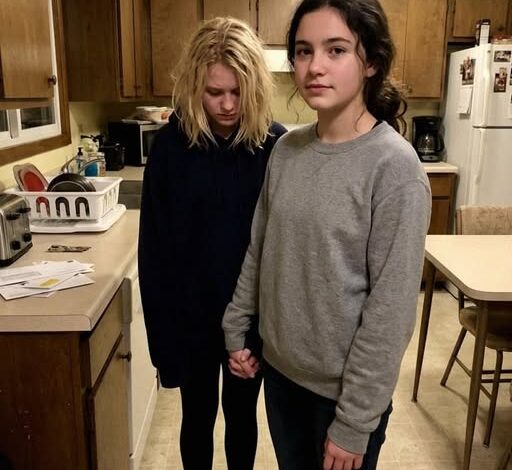
My 13-year-old daughter brought a starving classmate home for dinner — then something fell out of her backpack that I wasn’t prepared for.
Chapter 1: What Fell Out
Lizie’s face lost all color.
In my hand was a small plastic pill organizer, the kind older people use for heart medicine. But this one wasn’t filled with vitamins. It held three crackers wrapped in napkins, half a bruised banana, and two sugar packets from the school cafeteria. Tucked beneath it was a folded note written in shaky handwriting:
For Dad. Eat this before your shift. I’m okay.
For a second, I could not speak.
I had braced myself for something dangerous, something frightening, something no child should carry. What I was not prepared for was something somehow heavier: proof that this little girl was rationing scraps so her father could keep going.
Lizie snatched a breath and reached for the note, but I gently held it.
“You don’t have to explain all of this right now,” I said, softer than before.
Her eyes filled anyway. “He skips meals,” she whispered. “He says he already ate, but he didn’t. He works nights now too. My mom’s in the hospital and…” Her voice cracked. “I just try to save things.”
The kitchen went still.
My husband looked away and rubbed his chin, the way he does when he is trying not to show emotion. Sam stood there with her arms crossed, not in defiance this time, but like she had been carrying this truth alone and was relieved it was finally in the room.
I looked at Lizie again. Oversized hoodie. Careful bites. Flinching at sudden movement. Not trouble. Not attitude. Just a child trying to survive quietly enough that no one would call it a crisis.
And there it was—that uncomfortable lesson life brings when you think your own load is already too heavy: sometimes hardship can make your heart smaller, if you let it. But sometimes it can break it open.
I set the note back in her hand.
“You should have told us,” I said.
She lowered her eyes. “I didn’t want to be a burden.”
Those words landed harder than anything else that night.
That evening, after Lizie left, Sam sat at the table while I packed leftovers into containers.
“I know we don’t have extra,” she said carefully. “But she really needed us.”
I nodded. “I know.”
What I had mistaken for inconvenience was actually invitation. Not to rescue the world. Just to respond to the part of it that had reached our doorstep.
The next morning, I called the school counselor. Not to expose Lizie, but to ask better questions. By noon, we learned what pride had been trying to hold together: her mother had been hospitalized for months, her father was drowning in bills, and they had fallen through every crack that people assume someone else will cover.
That week, our family did what ordinary people can do when they stop waiting for perfect timing.
My husband picked up a few extra grocery staples and dropped them off “by accident.”
I started sending Lizie home with containers that looked like leftovers but were packed on purpose.
Sam quietly organized a snack drive at school without using Lizie’s name.
And our church, after hearing only the practical details, covered the electric bill anonymously.
No speeches. No pity parade. Just help that preserved dignity.
Lizie noticed, of course. Children always do.
“You don’t have to keep doing this,” she told me one night.
“Yes, we do,” I said. “And one day, when you can, you’ll do it for somebody else.”
She looked down at her plate, and for the first time, she smiled before taking a bite.
That was when I understood something I wish more people remembered: kindness is not proven by how much you have left over. It is proven by what you make room for even when life feels tight.
A month later, Lizie’s mother came home.
Weak, but home.
Her father came by one evening to thank us, cap in hand, eyes exhausted. He tried three times to say something meaningful and failed every one of them.
“You fed my daughter,” he finally said. “I don’t think you understand what that meant.”
Maybe not fully.
But I understood enough.
I understood that Sam had seen what I missed.
I understood that compassion often arrives wearing inconvenience first.
And I understood that a table does not become holy because of what is served on it, but because of who is welcomed to it.
We were still a family stretching groceries. Still watching prices. Still doing math over rice and meat.
But something had changed in our house.
Dinner no longer felt small.
Because once you learn that another person’s hidden hunger is standing right in front of you, you stop asking only, “Do we have enough?”
You start asking the better question:
“How can we share what God already put in our hands?”