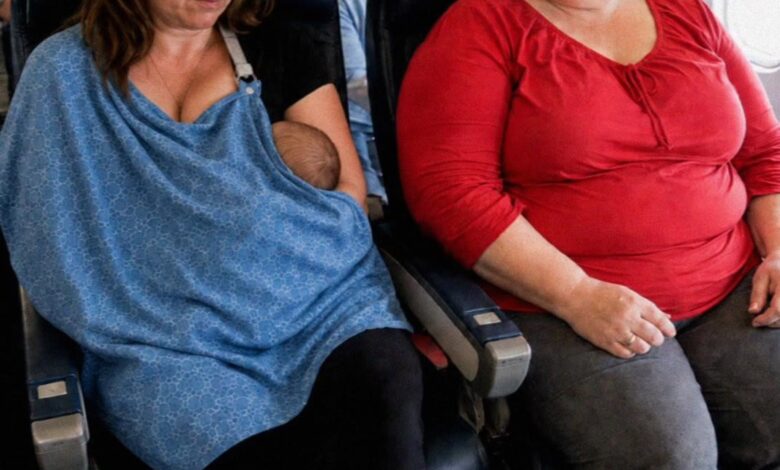
I Was Breastfeeding My 5-Month-Old Baby When the Woman Sitting Next to Me on the Plane Said, ‘Lock Yourself in the Toilet’ – Then My Older Daughter Put Her in Her Place
A month after burying my husband, I boarded a six-hour flight with our two children, hoping a visit with my mother might help us breathe again. Instead, the stranger beside me decided to judge my parenting before the plane had even left the ground.
A month ago, I buried my husband, Mark.
He was thirty-seven, funny, stubborn, and certain he would outlive everyone. Cancer took him in nine months.
When my mother invited the children and me to stay with her so I could escape the nightmare, even briefly, I agreed.
Louise was eight. Noah was five months old and still turned toward the door whenever he heard a man’s voice.
Louise had stopped asking when Daddy was coming home.
That hurt worse than the questions.
At night, after both children slept, I still reached toward Mark’s side of the bed before remembering. Grief had turned ordinary habits into traps. I packed his blue sweater in my carry-on, though I knew I would not wear it.
Louise saw me fold it and said nothing. She simply placed her favorite stuffed rabbit beside it, as if both objects belonged to the same emergency plan.
On the morning of our flight, she held Noah’s bottle while I checked our documents three times. Neither of us mentioned that Mark had always handled the passports. We did not need to.
The flight was full, and the only available seats placed Louise one row behind me. I settled into the aisle seat with Noah against my chest while she squeezed my shoulder from behind.
The woman beside me looked irritated before the doors had even closed.
She wore a gray suit, pearl earrings, and the expression of someone already composing a complaint.
Then she looked at Noah.
“If your baby starts screaming, I’m not going to sit here and listen to it. I’m warning you.”
“We haven’t taken off yet.”
“I know babies,” she said. “They always scream when people are trapped.”
“I’ll do my best.”
“People say that. Then everyone else suffers.”
Behind us, Louise leaned forward to speak up for her sibling.
“My brother is usually quiet.”
The woman ignored her.
Louise sat back, but I saw her frown reflected in the window. She had Mark’s sense of fairness, which usually appeared just before she said something dangerous.
I gave her a warning look.
She opened her tablet without another word.
The plane pushed back from the gate, and Noah startled at the sudden vibration. I braced for the cry Evelyn clearly expected, but he only blinked, curled one fist around my finger, and settled again.
Louise waved through the gap between the seats. I waved back, grateful for the small reassurance. Evelyn opened a magazine with a sharp snap and angled it between us like a wall.
Every few minutes, she checked Noah over the top edge. I could not tell whether she feared he might wake or resented that he had not yet proved her right. Either way, I waited.
For most of the first two hours, Noah slept. I watched the clouds and tried not to picture Mark’s empty hospital bed.
Then Noah woke crying.
I rocked him, offered his pacifier, checked his diaper, and whispered the song Mark used to sing off-key.
Nothing worked.
He was hungry.
I pulled a nursing cover from my bag and arranged it carefully. The woman noticed immediately.
“Oh, great,” she said. “I paid for this seat to hear someone else’s baby scream, and now I have to watch you feed him?”
My cheeks burned.
“He needs to eat.”
“How completely shameless. People with babies like that should stay home. What kind of mother feeds a child in public and can’t even calm him down on her own?”
I stared at her.
“He is calm now because I’m feeding him.”
She recoiled as though my answer offended her more than the nursing.
“Then go lock yourself in the toilet. Why should I have to look at this shameful display?”
“A bathroom isn’t where babies eat,” I said. “And this is a six-hour flight. He cannot go without food.”
She reached for the call button.
Before she could press it, Louise appeared beside us with her tablet against her chest.
“Mom, why don’t you take my seat? I can sit here so this lady feels more comfortable.”
“Louise, no.”
“It’s okay.”
The woman gave me a smug look, as though my daughter had finally supplied the proper parenting.
I stood carefully, keeping Noah covered. Louise slid into my seat.
As I passed her, she whispered, “She dropped something.”
“What?”
“I’ll show you later.”
I should have stopped her, but Noah stirred again.
Mark used to call it her courtroom face because she narrowed her eyes whenever she believed someone was hiding the truth.
I wanted to tell her that protecting me was not her job. She had already spent a month trying to protect Noah from every silence he could not understand.
From the row ahead, I could see Louise’s sneakers beneath the seat and one small hand resting near the armrest. She had always watched people closely.
Before I could call her back, she leaned down toward the floor, then straightened with something pale between her fingers. Evelyn noticed too late.
Louise bent down, picked up a small printed photograph that had fallen face-up near the woman’s shoe, and placed it beside the screen of her tablet.
The tablet was already open to a recent picture of me holding Noah while Louise leaned against my shoulder.
Then Louise turned the tablet and the photograph toward the woman.
The woman cried out so sharply that every head nearby turned.
She jumped up, struck her knee against the tray table, and hurried into the aisle.
A flight attendant intercepted her.
“Ma’am, what happened?”
The woman pointed at Louise.
“Where did you get that?”
Louise held up the photograph.
“You dropped it.”
“Give it back.”
“I was going to.”
The woman snatched the photograph, then looked at the image on Louise’s tablet again.
Her anger disappeared.
Something heavier replaced it.
“I need another seat.”
“I’m sorry, ma’am. The cabin is full.”
“Then let me stand.”
“You may step into the galley with me for a moment, but you’ll need to return before descent.”
The woman followed her without another word.
Louise turned toward me.
“What did you say to her?” I asked.
She locked the tablet.
“Something honest.”
“What?”
Louise looked toward the rear of the plane.
“I think she should hear me say it again.”
That answer worried me more than if she had admitted to being rude.
The woman returned several minutes later. She remained standing beside the row and looked at Louise.
“Would you repeat what you asked me?”
Louise glanced at me.
I nodded once.
She placed the photograph beside the image on her tablet again.
“I asked whether you would want someone to speak to your daughter the way you spoke to my mom.”
The woman stared at the two pictures.
“The woman in this photograph is my daughter, Jenna,” she said. “The baby is my grandson.”
Louise waited.
The woman swallowed.
“No,” she whispered.
“No what?” Louise asked.
“No, I would not want anyone speaking to Jenna that way.”
Louise closed the tablet.
“Then don’t.”
A nearby older passenger lowered his newspaper.
“The child asked you a fair question,” he said quietly.
The woman sat down.
She did not argue with him. She did not defend herself. She folded the photograph along an old crease, then quickly smoothed it flat again with trembling fingers.
For several moments, the only sounds were the engine and the soft rustle of passengers pretending not to listen.
Evelyn kept the photograph turned facedown on her lap. Louise stared at the dark tablet screen, suddenly looking eight again instead of fearless.
I reached back and touched her knee. She looked at me, searching my face for anger. I gave her a small nod. Her shoulders lowered.
Whatever happened next, I did not want her to believe courage meant never feeling afraid. Mark had often told her that bravery was simply deciding which fear deserved to be obeyed. She remembered.
After Noah finished eating, I returned to my original seat.
The woman kept her eyes on the photograph.
“My name is Evelyn,” she said. “And I’ve never met him.”
“Your grandson?”
She nodded.
“He’s five months old. Jenna has invited me several times.”
“Why haven’t you gone?”
“Because I disapprove of nearly everything she does.”
“Such as?”
“Where she lives. Her partner’s work. Her schedule. The way she feeds the baby during family gatherings instead of leaving the room.”
I looked at her.
“You’re flying there now?”
“For the first time.”
“And you planned to criticize her?”
Evelyn gave a short, humorless laugh.
“I spent the whole flight planning what I was going to tell her she was doing wrong. I haven’t even met the baby.”
I adjusted Noah against my shoulder.
“You didn’t know anything about me either.”
“No.”
“Feeding him wasn’t a display. He was hungry.”
Evelyn nodded.
“I understand that now.”
“My husband died a month ago,” I said. “I’m still learning how to do ordinary things without him. You looked at me for five minutes and decided I was a bad mother.”
Her eyes filled with tears.
“I’m sorry.”
I believed she meant it, but that did not erase what she had done.
“Don’t apologize because Louise embarrassed you,” I said. “Apologize because you understand why you were wrong.”
“I do.”
Evelyn took out her phone.
“I need to write to Jenna.”
She opened a blank message, then hesitated.
“What should I say?”
“I won’t write your apology for you.”
“I don’t know where to begin.”
“Say what you did. Don’t explain it away. Then tell her what will change.”
Evelyn looked down at the screen.
This time, she began typing.
She admitted she had judged Jenna from a distance and had been preparing to arrive with criticism instead of support. She wrote that she wanted to meet her grandson and learn what Jenna needed from her.
Then she pressed send.
Ten minutes later, her phone buzzed.
Jenna had replied:
*You may still come, but only if you mean every word you wrote.*
Evelyn showed me the screen.
“Do you think she believes me?”
“She’s giving you a chance to prove it.”
Evelyn read Jenna’s message three times.
The first time, relief softened her face. The second, she seemed to notice the condition hidden inside the invitation.
By the third, relief had become responsibility.
She locked her phone and placed it beside the photograph. Then she asked Louise whether Jenna looked angry in the picture. Louise considered the question seriously.
“She looks tired,” she said. “Those are not the same thing.”
Evelyn nodded, accepting the correction without defending herself. I watched that small exchange and understood why apologies were easier than change. Apologies lasted a minute. Change had to survive the landing.
After landing, we followed the signs toward baggage claim. My mother had texted that she was waiting near carousel six.
Evelyn walked beside us, clutching the photograph. Her confidence faded with every step toward the arrivals hall.
Jenna stood near the carousel with a baby in a green carrier. She resembled Evelyn around the eyes, but her expression was tired and guarded.
Evelyn stopped several feet away.
Jenna did not move closer.
“May I hug you?” Evelyn asked.
Jenna studied her, then nodded once.
Evelyn approached slowly.
The hug lasted only a few seconds. Jenna kept one arm around her baby, and Evelyn did not reach for him.
When they separated, Evelyn said something I could not hear. Jenna answered quietly.
Neither smiled, but they walked toward the baggage carousel together.
That was enough for a beginning.
Several weeks later, a card arrived at my mother’s house.
Inside was a photograph of Evelyn sitting beside Jenna on a sofa, holding her grandson while Jenna rested one hand on the baby’s back. Nobody looked perfectly comfortable, but nobody looked ready to leave.
Evelyn had written beneath it:
*I am learning to ask before helping and listen before correcting. Thank you for interrupting the person I was becoming.*
Louise pinned the card to the notice board in my mother’s kitchen.
“Why keep it?” I asked.
She smoothed one corner against the cork.
“Because speaking up doesn’t only stop a bad moment,” she said. “Sometimes it helps someone choose a better next one.”
Mark had taught her to speak when silence protected the wrong person.
That day, she had done more than defend me.
She had changed what happened next.