My husband came home after ten on Sunday morning wearing the same blue shirt he had left in the night before, and for the first time in twenty-three years of marriage, I did not ask where he had been.
## Chapter 1: The question I didn’t ask
My Husband Realized I No Longer Loved Him When I Stopped Asking Where He’d Been. The Silence At Sunday Breakfast Frightened Him More Than Any Accusation.
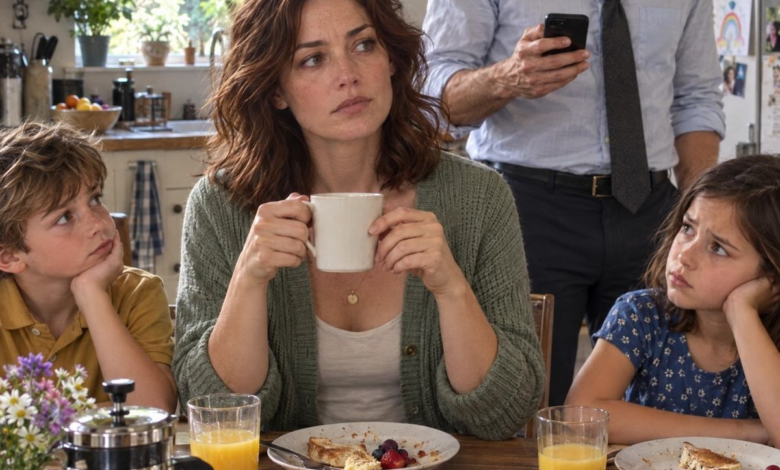
My husband returned after ten on Sunday morning, still wearing Saturday night’s shirt.
For the first time in twenty-three years of marriage, I didn’t ask where he’d been.
Daniel stood in the kitchen doorway, expecting questions.
When none came, he asked, “You’re not going to ask?”
I sipped my coffee and replied, “No.”
That frightened him more than any accusation.
Our daughter Emma sat opposite me when Daniel arrived.
She was twenty-one that spring, finishing her last semester at Ohio State, but still visited whenever possible on Sundays.
Sunday breakfast had always belonged to us.
Not Daniel.
Us.
Around eight, Emma usually texted asking whether coffee was ready. I’d pretend to be offended. She’d arrive in sweatpants, leave her shoes by the mudroom, and steal the crispiest bacon before I served it.
That morning, I’d prepared scrambled eggs with chives and raspberry-jam toast.
Nothing special.
Just breakfast.
I’d cracked the kitchen windows because Worthington finally had a pleasant April morning, carrying the scents of damp earth and freshly mowed grass.
Emma was describing a professor who’d changed the final-project requirements halfway through the semester.
I listened.
Fully.
That mattered.
A month earlier, half my attention would’ve been on Daniel.
Where was he?
Why hadn’t he returned?
Had he stayed with a friend?
Would his explanation match last Saturday’s?
Would a familiar woman’s name light up his phone?
Would I believe him?
But that morning, I’d slept until seven-thirty.
Showered.
Watered my kitchen herbs.
Made coffee.
Prepared breakfast.
Without checking the driveway once.
At 10:12, the garage door opened.
Emma briefly stopped talking.
Nothing dramatic.
Just a pause I noticed.
Seconds later, Daniel entered.
He was fifty-two, tall, and still handsome in the polished way that made people tell me I was lucky.
His dark hair had mostly grayed at the temples.
He wore the same blue button-down he’d left in Saturday evening.
He stopped upon seeing us.
His gaze shifted from Emma to me, then the clock, then back.
“Morning,” he said.
Emma looked down.
“Morning, Dad.”
I raised my cup.
“Morning.”
Nothing more.
Daniel remained standing.
I knew what he expected.
For almost a year, Sunday mornings had followed the same routine.
He arrived late.
I questioned when he’d come home.
Sometimes he claimed he’d slept in the guest room to avoid waking me.
Other times, he’d stayed at Mark’s after poker.
Or helped someone from work.
Sometimes he insisted I imagined things.
And when his excuses were especially weak, he’d become angry before I’d finished asking.
“You don’t trust me.”
“Why does everything have to become an interrogation?”
“Claire, I’m fifty-two years old. I’m allowed to have friends.”
“You make coming home feel like walking into a police station.”
Strangely, I thought questioning him meant fighting for our marriage.
I believed asking was responsible.
That caring where my husband slept was normal.
That enough information might eventually reveal the truth.
But that Sunday, I no longer cared enough to investigate.
Daniel placed his keys on the counter.
“You two already ate?”
“There’s more in the skillet,” I said.
He glanced at the stove.
Then me.
“You didn’t wait?”
“No.”
One word.
No hostility.
No punishment.
No performance.
Emma shifted in her chair.
Daniel opened a cabinet for a plate, then shut it without taking one.
I asked Emma, “What happened after your professor changed the deadline?”
She glanced toward her father.
Then answered.
“He said we could have an extra week, but now everyone’s project depends on everybody else finishing their section.”
“That sounds badly organized.”
“It is.”
Daniel still stood beside the counter, listening.
Finally, he said, “I got in pretty late.”
I spread jam on my toast.
“Okay.”
Silence.
“I didn’t want to wake you.”
“Okay.”
Emma looked up.
Daniel frowned.
For years, he’d complained about my exhausting questions.
Now their absence apparently offended him.
“You’re not going to ask?”
I faced him.
“Ask what?”
He laughed incredulously.
“What time I got home. Where I was. Who I was with. The usual.”
The usual.
As though my distress were simply another household tradition.
Coffee.
Eggs.
Toast.
Claire questioning her absent husband.
I lifted my cup.
“No.”
Daniel’s expression shifted.
Subtly.
Others might’ve missed it.
But I’d known that face for twenty-six years.
His mouth tightened.
His eyes searched mine for something missing.
“You don’t care?”
I could’ve lied.
Instead, I answered, “I don’t think there’s anything useful left for me to ask.”
Emma froze.
Daniel glanced at her, embarrassed.
“This isn’t a conversation for breakfast.”
I nearly smiled.
He’d started the conversation.
I’d been perfectly happy discussing Emma’s project.
“I agree,” I said.
Then returned my attention to our daughter.
After several seconds, Emma resumed her story.
Daniel finally prepared a plate and sat at the table’s far end.
We ate silently for perhaps five minutes.
What I remember isn’t anger.
I felt none.
And that frightened him.
He understood anger.
He could defend himself.
Deflect.
Attack.
Leave.
Return with flowers or takeout.
Accuse me of overreacting.
Blame work stress.
Suggest a weekend getaway.
But silence gave him nothing to argue against.
After breakfast, Emma helped load the dishwasher.
Daniel lingered nearby.
Twice he seemed about to speak.
Twice he stopped.
When Emma left, he followed me into the laundry room.
“Claire.”
I folded a sweater.
“What?”
“Are we okay?”
I looked at him.
Once, that question would’ve undone me.
I’d spent months wishing he’d ask.
Now I simply answered, “No.”
He stared.
“You say that like it doesn’t bother you.”
“It bothered me for a long time.”
“And now?”
I folded another sweater.
“Now I’m tired.”
That morning, Daniel finally recognized something had changed.
He didn’t understand how much.
Truthfully, neither did I.
But standing beside those folded warm towels, I knew I’d crossed an invisible boundary.
For months, I’d tried getting my husband to come home.
That Sunday, I realized I’d stopped waiting.
And once waiting ends, the clock loses its power.
## Chapter 2: All the sundays before
Daniel hadn’t always disappeared on Saturdays.
For most of our marriage, he was almost embarrassingly predictable.
I teased him about it.
He preferred the same booth at our neighborhood Italian restaurant.
Bought the same shaving cream regardless of sales.
Watched college football every Saturday and complained as though Ohio State games threatened his health.
On Sundays, he read the newspaper while I brewed coffee.
For nineteen years, he drank it the same way.
One spoonful of sugar.
A splash of half-and-half.
Never milk.
Never flavored creamer.
If I forgot the half-and-half, he reacted as though grocery stores had collapsed.
Those habits once reassured me.
I believed marriage consisted of knowing someone’s ordinary details.
Their coffee preference.
Favorite side of the bed.
Repeated party stories.
The knee that ached with changing weather.
The joke that always made them laugh.
I knew Daniel.
Or believed I did.
His Saturday nights began changing about eleven months before that silent breakfast.
Initially, the reasons seemed legitimate.
As operations director for a regional building-supply company, Daniel occasionally handled client dinners, inventory emergencies, and managers calling about problems.
One late Friday became two.
Then he joined a recreational golf group.
Mark supposedly started organizing poker nights.
Soon, Saturday always ran later than expected.
The first time Daniel returned after two a.m., I was waiting on the couch under a blanket.
He looked irritated.
“What are you doing awake?”
“Waiting for you.”
“You didn’t have to.”
I remembered that sentence.
Initially, I thought it was kindness.
Later, I recognized the warning.
You didn’t have to wait.
Eventually, I stopped.
But not then.
For months, I continued questioning him.
“What time did you leave Mark’s?”
“Late.”
“Who was there?”
“The usual people.”
“Why didn’t you answer my text?”
“My phone was in my jacket.”
“How did you get home?”
“I drove.”
“You were drinking.”
“I had two beers.”
“Then why do you smell like wine?”
“Jesus, Claire.”
Every question became proof of my supposed flaws.
Jealousy.
Control.
Suspicion.
Insecurity.
Unhappiness.
Daniel could turn his unexplained absences into problems with my personality.
The first undeniable crack came from something small.
A receipt.
While checking his jeans before washing them, I discovered a folded restaurant bill.
Not a hotel receipt.
Not jewelry.
Nothing sensational.
Just dinner.
Two entrées.
Two glasses of wine.
One shared dessert.
Saturday, 9:14 p.m.
The restaurant was in Dublin, twenty minutes away.
Daniel had claimed he was playing poker at Mark’s in Westerville.
I read the receipt three times in the laundry room.
Then photographed it.
I didn’t immediately confront him.
Even that surprised me.
Perhaps I already knew how he’d respond.
A client.
Coworker.
Friend.
Someone joining unexpectedly.
Someone seeking advice.
Someone else’s wife.
There would always be an explanation.
I waited until Sunday.
Around nine, Daniel came downstairs rubbing his face.
I was making coffee.
“Did you go anywhere after Mark’s last night?”
He paused.
“No.”
That hesitation mattered more than his answer.
“You stayed there all night?”
“Until I came home.”
I placed the receipt on the counter.
He studied it.
Then me.
I recognized the exact moment he began inventing an explanation.
“Oh. That.”
As though the receipt reminded him of something insignificant.
“That was earlier.”
“You told me you went straight to Mark’s.”
“I forgot.”
“You forgot dinner?”
“Claire, it was work-related.”
“With who?”
A slightly prolonged pause.
“Rachel.”
I knew Rachel Morgan, though not well.
She handled vendor relations for one of Daniel’s company’s manufacturers.
I’d met her twice at corporate events.
Forty-five, divorced, dryly funny, and noticeably attentive when Daniel spoke.
At the Christmas party, she’d touched his sleeve while laughing.
I remembered because Daniel moved closer instead of away.
“Just Rachel?”
“Yes.”
“Why didn’t you tell me?”
“Because I knew you’d do this.”
I stared.
“Do what?”
“Turn a work dinner into something.”
“You lied about where you were.”
“I didn’t lie.”
“You said you went straight to Mark’s.”
“I forgot about dinner because it wasn’t important.”
That was his method.
Minimize the incident.
Exaggerate my reaction.
Make me defend caring.
Within ten minutes, we weren’t discussing his dishonesty.
We were discussing my trust issues.
That afternoon, Daniel went for a drive.
I cried in the bathroom, hoping Emma wouldn’t hear.
She was home that weekend.
Months later, I learned she had.
She’d been sitting on the upstairs landing.
“I almost came down,” she said.
“Why didn’t you?”
“Because I knew you would pretend you were fine if you saw me.”
She was right.
I’d become skilled at hiding the truth from everyone.
Especially for Daniel.
When he missed family dinner, I blamed work.
When he forgot my sister’s birthday celebration, I claimed he had a headache.
When he disappeared for three hours and returned during Thanksgiving dessert, I told Mom he’d helped a coworker.
Nobody requested these excuses.
Daniel never thanked me.
I simply believed a good wife protected a struggling marriage.
What I failed to see was that I was preserving the appearance of a relationship Daniel had stopped protecting.
Then came the Saturday he disabled location sharing.
We’d shared locations for years.
Not to monitor each other.
For convenience.
Emma started it when she learned to drive.
The three of us kept the family setting enabled.
One Saturday, Daniel’s location vanished around 7:15.
When questioned, he shrugged.
“Probably an update.”
It happened again the following Saturday.
I stayed quiet.
The next week, I checked at eight.
Nothing.
Nine.
Nothing.
Ten.
Still nothing.
At eleven-thirty, I called.
No answer.
At midnight, I texted:
Are you coming home?
Nothing.
At 12:47:
Daniel?
At 1:16:
Please just tell me you’re safe.
He replied at 1:32.
I’m fine. Stop worrying.
I stared.
Stop worrying.
As though concern were an embarrassing habit.
The next morning, I asked again.
“What time did you get home?”
“Late.”
“Were you with Rachel?”
His eyes sharpened.
“Why would you ask that?”
“Because I’m asking.”
“Then no.”
I later discovered he’d been with her.
But that Sunday, I accepted his denial because I still needed hope that our marriage could survive.
The pattern continued.
Daniel lied.
I questioned.
He denied.
I investigated.
He minimized.
I cried.
He apologized for upsetting me without acknowledging his actions.
Then, for several days, he’d become affectionate.
Bring coffee.
Cook dinner.
Touch my back while passing through the kitchen.
Suggest watching a movie.
Just enough kindness to convince me the husband I knew still existed.
Then Saturday returned.
Months later, I recognized those good days weren’t repairs.
They were maintenance.
Daniel didn’t want to lose his marriage.
But didn’t want to live faithfully within it either.
He wanted me secure enough to stay while he enjoyed enough freedom to feel unrestricted.
For a long time, I cooperated.
Not through weakness.
Through love.
There’s a difference.
Love can make intelligent people wait longer than outsiders imagine.
We remember someone’s former self.
The years before the damage.
We keep hoping the person who hurts us will become the person who once made us feel safe.
Then sometimes, without warning, that expectation dies.
Mine ended on a Wednesday.
Not Sunday.
Wednesday.
I was in the grocery store’s cereal aisle when Emma called.
“Mom?”
Her voice made me grip the cart.
“What happened?”
“Nothing. I’m okay.”
“Then what?”
She hesitated.
“I saw Dad.”
My stomach dropped.
“Where?”
“Easton.”
“With who?”
Silence.
I already knew.
Emma said, “Rachel.”
I closed my eyes.
They’d been leaving a restaurant.
Daniel’s hand rested on Rachel’s lower back.
Not accidentally.
Not professionally.
Intimately.
They hadn’t noticed Emma.
She watched them cross the parking lot.
Then Rachel reached for his hand.
And he accepted it.
Emma cried as she told me.
That hurt worse than discovering the affair.
Worse than their handholding.
Worse than Rachel herself.
My daughter was crying because she’d witnessed the very thing Daniel had spent months telling me I was paranoid to suspect.
“I’m sorry, Mom.”
“Oh, honey.”
“I didn’t know whether to tell you.”
“You didn’t do anything wrong.”
“I feel like I did.”
That changed something fundamental.
For nearly a year, Daniel’s lies had made me doubt myself.
Now they’d made our daughter doubt herself too.
I didn’t confront him that evening.
Didn’t scream.
Demand his phone.
Or contact Rachel.
I cooked spaghetti.
Washed dishes.
Watched a documentary with Emma.
Then slept in the guest room.
Daniel returned shortly before midnight.
The next morning, he asked why I’d slept there.
I replied, “I wanted to.”
He studied me.
“Are you mad?”
“No.”
That was nearly true.
I’d moved beyond anger.
Four days later came the Sunday breakfast when Daniel returned after ten.
And I stopped asking.
## Chapter 3: The things I stopped doing
Daniel grew increasingly unsettled after that Sunday.
Initially, I doubt he understood why.
He’d spent months demanding fewer questions.
Now he’d gotten his wish.
I no longer asked where he went.
When he’d return.
Whether Rachel accompanied him.
I ignored his buzzing phone.
Stopped checking his location.
Stopped staying awake.
Stopped leaving the porch light on for him.
Stopped saving his dinner.
If he arrived after we’d eaten, leftovers were in the refrigerator where they belonged.
I removed his work events from our family calendar unless they affected me.
I quit reminding him about Emma’s deadlines, Mom’s birthday, dental appointments, dry cleaning, furnace servicing, and recycling schedules.
Those details might sound petty.
They weren’t.
They represented the unseen labor of building a shared life.
For twenty-six years, I’d managed hundreds of small responsibilities because Daniel and I functioned as a team.
When I stopped feeling like his partner, those responsibilities returned to him.
He first noticed on a Thursday.
He came downstairs in a white dress shirt.
“Did you pick up my navy suit?”
I was reading at the kitchen table.
“No.”
He frowned.
“You said you were going to the cleaners.”
“I picked up my things.”
“My suit was there.”
“Yes.”
“So why didn’t you bring it?”
I looked up.
“Because it’s yours.”
His expression shifted.
Not quite anger.
Confusion.
“But you were already there.”
“Yes.”
“Claire, that makes no sense.”
“It makes perfect sense.”
I resumed reading.
He stood silently for several seconds.
A year earlier, I’d have spent the day questioning myself.
Was I being unkind?
Petty?
Should I have collected his suit to avoid conflict?
Now I understood.
Daniel had mistaken my care for an automatic service, unaffected by how he treated me.
The following Saturday, he prepared to leave around six.
He adjusted his jacket near the door.
“I’m meeting some people.”
Emma and I were choosing a movie on the couch.
“Okay.”
He waited.
I continued scrolling.
“Probably be late.”
“Okay.”
More silence.
Daniel added, “We’re going to Dublin.”
I glanced up.
He wanted me to ask whom “we” included.
It was obvious.
He was volunteering information because my lack of interest troubled him.
“Have fun,” I said.
Emma pressed her lips together.
Daniel stared, then left.
As soon as the door closed, Emma exhaled.
“That was weird.”
I smiled faintly.
“What?”
“He wanted you to ask.”
“I know.”
“Why?”
I considered it.
“Because when I asked questions, he could tell himself I was jealous.”
“And now?”
“Now he has to wonder why I’m not.”
Emma fell quiet.
Then asked something I’ve never forgotten.
“Mom, are you done?”
I looked at her.
Even grown children recognize emotional truths faster than we realize.
I could’ve denied it.
Instead, I answered, “I think so.”
Her eyes filled.
Not because she wanted us together.
Because necessary endings still hurt.
She reached across the couch and held my hand.
“I’m sorry.”
“So am I.”
We said nothing else.
The following morning, I woke before seven.
Made coffee.
Emma remained asleep upstairs.
Daniel hadn’t returned.
I stood at the counter holding his favorite mug.
Dark blue, with a chipped handle.
Emma had given it to him for Father’s Day when she was nine.
For years, I’d automatically poured his coffee.
Even when he was upstairs.
After arguments.
When I was angry.
I’d prepare mine, then his.
One spoonful of sugar.
Half-and-half.
An unexpected ache passed through me.
Then I returned his mug to the cabinet.
I poured only one cup.
Mine.
Around eight, Emma came downstairs.
“Coffee?”
“Yes, please.”
I poured hers.
We sat on the porch.
That became our new Sunday tradition.
Nothing planned.
Nothing announced.
We simply started drinking coffee outdoors.
Sometimes Emma brought bagels.
Sometimes I cooked eggs.
Occasionally, we barely spoke.
The porch overlooked a maple Daniel planted when Emma was six.
That spring, fresh leaves covered its branches.
For years, our Sundays revolved around Daniel’s whereabouts.
Now the mornings felt peaceful.
I hadn’t anticipated that.
I’d assumed emotionally leaving my marriage would create emptiness.
Instead, I found quiet.
And the two aren’t the same.
Emptiness hurts because something is absent.
Quiet can follow when constant noise finally ends.
Two Sundays later, Daniel came home around nine.
Emma and I were sitting outside.
He spotted us through the window and opened the front door.
“You two having a meeting?”
Emma smiled politely.
“Coffee.”
“There any left?”
“In the pot,” I said.
He waited.
Previously, I’d have stood.
Poured his coffee.
Added sugar.
Half-and-half.
Carried it outside.
Instead, I stayed seated.
Daniel went inside.
Minutes later, he returned with his chipped blue mug.
Black coffee.
He’d apparently forgotten the half-and-half.
After one sip, he grimaced.
Emma looked away.
He noticed.
“What?”
“Nothing.”
Then he faced me.
“Did we run out?”
“Of what?”
“Half-and-half.”
“There’s a new carton behind the orange juice.”
He stared toward the kitchen.
Then back at me.
“You knew?”
“Yes.”
“Why didn’t you say something?”
The question nearly made me laugh.
“You didn’t ask.”
His eyes narrowed.
“That’s funny.”
“I wasn’t trying to be funny.”
He returned inside, corrected his coffee, and came back.
He sat opposite us.
Several silent minutes passed.
Then Daniel announced, “Rachel’s leaving the company.”
Emma stiffened.
I watched the maple.
“Okay.”
“She got another position.”
“Okay.”
Daniel studied me.
“You knew?”
“No.”
“You don’t seem surprised.”
“I’m not involved in Rachel’s career.”
He glanced at Emma.
She concentrated on her coffee.
Daniel lowered his voice.
“She and I have been talking.”
There it was.
Not a confession.
A test.
He expected me to demand details.
Months earlier, I would’ve.
Talking how?
How long?
Where?
What happened?
Were they sleeping together?
Did he love her?
Did he love me?
Instead, I answered, “I assumed.”
His face paled.
“You assumed what?”
I met his eyes.
“That you’re having an affair.”
Emma closed her eyes.
Daniel set down his mug too hard.
“Claire.”
“What?”
“You can’t just say that in front of Emma.”
“She saw you.”
Silence.
The kind that transforms a room.
Daniel faced our daughter.
Emma met his gaze.
For the first time, he understood his secrets had harmed someone besides me.
“When?” he asked.
Emma answered steadily.
“Easton.”
Daniel rubbed his forehead.
“Emma, it wasn’t—”
“Don’t.”
I’d never heard her speak to him like that.
He stopped.
She continued.
“I don’t want details. I don’t want explanations. I don’t want you telling me I misunderstood what I saw.”
His face tightened.
“I wasn’t going to say that.”
“You did it to Mom for months.”
He glanced at me.
I said nothing.
Emma stood.
“I’m going inside.”
Once she left, Daniel and I sat facing each other.
The street was quiet.
A dog barked behind neighboring houses.
Daniel said, “I didn’t want her involved.”
“She became involved when she saw you.”
“I never meant for that to happen.”
I nearly asked what he meant.
The affair?
His lies?
Emma discovering them?
Instead, I waited.
He looked exhausted.
Finally, he admitted, “Rachel and I got close.”
I nodded.
“That’s not an explanation.”
“I’m not asking for one.”
He seemed irritated.
“You don’t even want to hear what happened?”
“No.”
“How can you not want to know?”
The irony fascinated me.
For almost a year, he’d called my questions unreasonable.
Now my indifference upset him.
“Because whatever happened, you chose it,” I said. “Repeatedly.”
He looked away.
“It wasn’t planned.”
“Most damage isn’t.”
“I never stopped caring about you.”
I felt sadness.
Not hope.
Once, those words would’ve kept me fighting.
Now they sounded hollow.
“You stopped behaving like you cared.”
Daniel leaned forward.
“Claire, I know I messed up.”
I waited.
“Say something.”
“What do you want me to say?”
“Anything.”
Panic lay beneath his frustration.
He wanted our old argument to resume.
For me to accuse him.
Cry.
Demand a decision.
Give him something to resist.
I shook my head.
“I spent almost a year talking, Daniel.”
“So now you’re punishing me with silence?”
“No.”
“Then what is this?”
I glanced through the kitchen window.
Emma was rinsing her mug.
“This is me being finished with the argument.”
He stared.
That Sunday, Daniel admitted the affair had lasted seven months.
I didn’t ask how often.
Where they’d met.
Whether he loved Rachel.
I had just one practical question.
“Are you willing to move into the guest room while we figure out what happens next?”
Daniel looked stunned.
“You want me out of our bedroom?”
“Yes.”
“For how long?”
“I don’t know.”
His voice cracked.
“Claire, you haven’t even heard everything.”
I stood.
“I’ve heard enough.”
For the first time in our marriage, Daniel finally had the complete truth he’d always claimed I wanted.
And I realized I no longer needed it.
## Chapter 4: When he started asking the questions
For years, I’d asked Daniel when he planned to return.
After the affair became known, he started questioning me instead.
“What are you doing after work?”
“Are you going somewhere?”
“Will you be home for dinner?”
“Who was that texting you?”
“Why are you smiling at your phone?”
Initially, the reversal almost amused me.
Not because I was keeping secrets.
I wasn’t.
I’d simply started living a life Daniel didn’t automatically know everything about.
On Tuesdays, I attended beginner pottery classes with my sister Megan.
Some Thursdays, I met Emma near campus for dinner.
Saturday mornings meant the Worthington farmers’ market.
Three evenings weekly, I walked with our neighbor Lisa.
I also joined the library’s book club.
Ordinary activities.
That seemed to disturb Daniel most.
If I’d started dating, he could’ve accused me of recklessness.
If I’d begun partying, he’d have called it acting out.
Instead, I was peacefully building a life without him.
One Friday, I came downstairs wearing jeans and a green sweater.
Daniel sat in the living room.
“Where are you going?”
“Megan’s.”
“What’s happening at Megan’s?”
“Dinner.”
“Who’s going?”
I paused near the door.
“Why?”
He looked embarrassed.
“Just asking.”
Those words nearly made me smile.
Just asking.
“Her neighbors. A couple from work. Some friends.”
“Men?”
I stared.
Daniel rubbed his jaw.
“Forget it.”
“No. Say what you mean.”
“I don’t know what you’re doing anymore.”
His honesty surprised me.
“I’m living.”
“That’s not what I meant.”
“I know.”
He stood.
“Claire, I’m trying here.”
“Trying what?”
“To fix things.”
I surveyed our living room.
Nothing physical had changed.
Same couch.
Family photographs.
Floor lamp from Mom.
Blanket folded over the chair.
But marriages can end emotionally before anyone moves furniture.
“Daniel, you apologized after you got caught.”
“That’s not fair.”
“What part?”
“I’ve apologized every day.”
“You keep telling me you’re sorry because you want me to feel differently.”
“Of course I want you to feel differently.”
“That isn’t repair.”
He stared.
“Then what is?”
I considered it.
“A year ago? Telling the truth without being forced. Coming home. Answering your phone. Choosing your family before I had to compete for basic attention.”
He swallowed.
“And now?”
I lifted my purse.
“Now I don’t know.”
I left him there.
Dinner at Megan’s was wonderful.
Not glamorous.
Nothing dramatic.
We ate baked ziti from mismatched dishes around her kitchen table.
Someone brought inexpensive red wine.
Her neighbor Paul told an awful story about locking himself outside while taking out the trash.
I laughed until my stomach hurt.
At one point, I realized three hours had passed without thinking about Daniel.
That mattered more than his confessions.
When I returned home, the downstairs lights remained on.
Daniel sat on the couch.
Waiting.
The irony was obvious.
“You’re awake,” I said.
He checked the clock.
“It’s after eleven.”
“I know.”
“You didn’t answer my text.”
I examined my phone.
There it was.
Are you coming home soon?
Sent forty-six minutes earlier.
“I didn’t see it.”
Daniel stared.
I could almost hear echoes of the Saturday nights I’d spent waiting for replies.
He said, “I was worried.”
“I’m fine.”
I headed upstairs.
“Claire.”
I stopped.
He somehow looked smaller.
Not physically.
But some confidence disappears when familiar rules stop working.
“This is what it felt like, isn’t it?”
I understood.
Waiting.
Uncertainty.
Wondering whether someone you loved cared enough to answer.
“Yes.”
Daniel lowered his gaze.
“I hated it.”
“I know.”
“I’m sorry.”
I nodded.
Then went upstairs.
It should’ve felt victorious.
It didn’t.
I’d never wanted him punished.
I’d wanted him present.
There’s something painful about receiving understanding only after you no longer need it.
Two weeks later, he ended his relationship with Rachel.
He told me on a Sunday.
Naturally.
Emma wasn’t home.
I was drinking coffee on the porch when Daniel joined me.
He sat opposite.
“I told Rachel it was over.”
I looked up.
“All right.”
“That’s it?”
“What do you want me to say?”
“I don’t know.”
He laughed bitterly.
“Maybe that it matters.”
“It matters to you.”
“Doesn’t it matter to you?”
I examined my feelings.
I’d expected jealousy.
Relief.
Vindication.
Something.
Mostly, I felt tired.
“Not in the way you want it to.”
Daniel leaned back.
“I ended it because I want us.”
I looked at him.
“You had us.”
He closed his eyes.
“I know.”
“No. I don’t think you do.”
“Then explain it.”
So I did.
Without anger.
That mattered.
“You think the affair is the thing I need removed. Like Rachel is standing between us, and if she disappears, we go back to normal.”
Daniel remained quiet.
“But Rachel wasn’t in our kitchen when you lied to me. She wasn’t holding your phone when you ignored my calls. She didn’t make you tell me I was paranoid. She wasn’t the one who watched me cry and decided my distress was less important than protecting whatever you were doing.”
His eyes reddened.
“I know.”
“You keep saying that.”
“I don’t know what else to say.”
“Maybe there isn’t anything.”
Daniel stared at the maple.
“You really don’t love me anymore.”
Not a question.
I could’ve softened the answer.
I’d done that throughout our marriage.
Instead, I said, “Not the way I did.”
His expression crumpled slightly.
“I kept thinking you were angry.”
“I was.”
“So I thought…”
He rubbed his hands.
“I thought angry meant there was still something.”
“There was.”
He looked up quickly.
“What changed?”
I held my coffee with both hands.
“I got tired of being angry.”
Daniel nodded slowly.
A bird briefly landed on the porch railing before flying toward the maple.
Then he asked, “Is there somebody else?”
“No.”
“You’re sure?”
I almost laughed.
“There doesn’t have to be another man for me to stop wanting this marriage.”
“I didn’t say there did.”
“You keep asking.”
He looked ashamed.
“I guess it would be easier.”
“For you.”
“Yes.”
It was among his most honest answers in a year.
If another man existed, Daniel could blame rivalry.
Timing.
Loneliness.
Revenge.
But nobody else existed.
I’d simply discovered that peace without Daniel felt safer than loving him.
That frightened him because there was no rival.
No argument to win.
No grand gesture capable of restoring my feelings.
Only consequences.
A month later, Daniel rented a furnished apartment ten minutes away.
Our separation wasn’t dramatic.
No shouting.
No neighbors watching.
No luggage thrown outside.
He packed clothing.
I helped label two boxes from his office.
Emma collected a framed childhood photograph so it wouldn’t get damaged.
At the entrance, Daniel held his keys.
For twenty-six years, he’d carried a house key.
Now it seemed strangely significant.
“I can leave this?”
I gestured toward the console table.
He placed it in the ceramic bowl.
Then faced me.
“I never thought we’d get here.”
Neither had I.
But I answered only, “I know.”
“Claire.”
“Yes?”
“If I had stopped earlier…”
He didn’t finish.
There was no useful answer.
Maybe.
Maybe not.
Sometimes damage becomes permanent before either person realizes repair is no longer possible.
Daniel nodded.
Then left.
I watched his car pull away.
I’d expected to collapse.
Instead, I locked the door.
Switched off the porch light.
Went upstairs.
And slept nine uninterrupted hours.
## Chapter 5: The sunday he finally understood
We remained separated for four months before I filed for divorce.
Some people were surprised.
Mom questioned whether I was certain.
Megan didn’t.
She’d witnessed too much.
Emma said, “Whatever you decide, I’m okay.”
Daniel requested marriage counseling.
I agreed to three sessions.
Not because I expected reconciliation.
But after twenty-six years, I wanted to discover whether any part of me still reached for him when we spoke honestly.
The counselor asked Daniel why he believed I’d withdrawn.
He talked for almost ten minutes.
The affair.
His lies.
His absences.
Rachel.
My anger.
My distrust.
Then she asked me.
I answered, “I withdrew because I finally believed what his behavior had been telling me.”
Daniel looked up.
“What was that?”
“That I could not love him enough to make him choose our marriage.”
He fell silent.
The counselor asked, “And what do you believe now?”
“That I don’t have to.”
That was the end, though the legal process continued.
By September, Daniel had his own apartment.
Emma had graduated and accepted a nearby job.
She still visited most Sundays.
Our tradition continued.
If anything, it became more meaningful.
One Sunday in early October, we were eating French toast when Daniel texted.
Can I come by for the rest of the garage boxes?
I glanced at Emma.
“Your dad wants to pick up some things.”
She shrugged.
“Okay.”
I agreed.
Twenty-five minutes later, Daniel arrived.
He knocked.
That small detail hurt unexpectedly.
Once, he’d entered without thinking.
Now he waited for permission.
I opened the door.
He immediately noticed the coffee aroma.
“So this is still happening.”
I glanced toward the kitchen.
“What?”
“Sunday breakfast.”
Emma sat at the table, cutting another piece of French toast.
“Every week,” she said.
Daniel smiled sadly.
“I figured.”
I led him to the garage.
For twenty minutes, we sorted old tools, golf equipment, extension cords, and a plastic container of unidentified cables.
Ordinary divorce tasks.
At one point, Daniel discovered an old travel mug.
He laughed.
“Remember this?”
I did.
Emma had painted DAD on it in kindergarten.
Most paint had chipped away.
“Yes.”
He added it to his belongings.
Once everything was packed, he carried two boxes to his car.
During his final trip through the kitchen, he stopped.
Emma had gone upstairs to answer a call.
Two clean plates dried beside the sink.
Two coffee mugs.
Hers and mine.
Daniel studied the table.
For years, Sunday breakfast had included his place even when he was absent.
A warm plate.
Coffee waiting.
A wife listening for the garage.
Now the table seemed smaller, though no chairs had been removed.
He touched the back of his former chair.
“You don’t make extra anymore.”
It wasn’t really about French toast.
“No.”
He glanced toward the coffee machine.
“Do you ever…”
He stopped.
“Do I ever what?”
“Think I might show up?”
I considered pretending.
“No.”
He nodded.
My answer hurt him more than I’d intended.
“I deserved that.”
“It wasn’t meant to hurt you.”
“I know.”
He sat.
I remained standing.
After a moment, he said, “Rachel and I aren’t together.”
I showed no reaction.
He laughed faintly.
“There it is again.”
“What?”
“That look.”
“What look?”
“Like I’m telling you the weather.”
I leaned against the counter.
“What would you like me to say?”
“I don’t know.”
He seemed exhausted.
“Anything.”
That sounded familiar.
Months earlier, he’d asked for the same thing.
Anything.
Any sign he could still stir my emotions.
“I’m sorry it didn’t work out,” I said.
Daniel winced.
“That’s worse.”
“I’m not trying to make it worse.”
“I know.”
He examined my face.
“Do you want to know why?”
“No.”
The same answer.
The one that frightened him on that first quiet Sunday.
Only now he understood.
Daniel studied his hands.
“She wanted a real relationship once I moved out.”
I stayed silent.
“And I guess I realized…”
He stopped.
“Realized what?”
“That what I had with her only worked when it wasn’t my whole life.”
I glanced toward the staircase, hoping Emma would remain upstairs.
Daniel continued.
“I thought I wanted freedom.”
His voice was low.
“But once I had an apartment and nobody cared when I came home, it didn’t feel like freedom.”
I understood.
But understanding wasn’t reconciliation.
He looked at our coffee mugs.
“I miss this.”
“Breakfast?”
“All of it.”
He swallowed.
“You asking where I was. You being irritated when I was late. You texting me. You leaving the porch light on.”
I stared.
“You hated those things.”
“I thought I did.”
“You complained about them constantly.”
“I know.”
He laughed without amusement.
“I think I thought you’d keep doing them forever.”
There it was.
Our entire marriage reduced to one realization.
He’d assumed my care was permanent.
Regardless of his conduct.
Without gratitude.
Without honesty.
Without giving anything back.
Like plumbing built into the house.
“I thought so too,” I admitted.
Daniel looked at me.
“What made you stop?”
I knew the answer.
“Emma.”
He raised his eyebrows.
“Emma?”
“The day she saw you with Rachel.”
His expression changed.
“I hated what you had done to me. But when Emma called and apologized for telling me what she saw, I realized your choices were making our daughter feel responsible for our marriage.”
Daniel closed his eyes.
“She shouldn’t have.”
“I know.”
“That’s on me.”
“Yes.”
He accepted responsibility without arguing.
That mattered.
Too late for our marriage.
But still important.
“I went to the grocery store after she called,” I continued. “I remember standing there thinking I had spent months trying to make you tell me the truth. And suddenly I realized I didn’t need your confession anymore.”
Daniel studied me.
“Because she confirmed it.”
“No.”
“Then why?”
“Because I believed myself.”
He fell silent.
For nearly a year, Daniel had made me question my instincts.
Once I trusted them again, I no longer needed him to confirm reality.
He glanced around the kitchen.
“The first Sunday you didn’t ask…”
“I remember.”
“I thought you were trying to scare me.”
“I wasn’t.”
“I know that now.”
He rubbed his face.
“I was standing right there thinking you’d ask who I was with.”
“I knew.”
“I almost told you anyway.”
“I know.”
“How?”
“Because you kept waiting.”
He smiled sadly.
“Yeah.”
We stood quietly.
Then Daniel spoke again.
“You know what the worst part is?”
I waited.
“I spent months thinking your questions were proof you didn’t trust me.”
He met my eyes.
“But they were proof you still cared where I was.”
Unexpected tears rose.
Not because I wanted him back.
But because he finally understood what I’d desperately needed him to recognize when our marriage could still be saved.
Daniel noticed my eyes.
Hope briefly crossed his face.
That hurt too.
I gently shook my head.
“These tears aren’t me changing my mind.”
His shoulders sagged.
“I know.”
This time, I believed him.
He truly understood.
Emma came downstairs.
She paused upon seeing us.
“Everything okay?”
I smiled.
“Yes.”
Daniel stood.
“I should go.”
Emma hugged him.
He held her longer than usual.
When they separated, he said, “I’m sorry, Em.”
She nodded.
“I know.”
No lecture.
No punishment.
No dramatic forgiveness.
Just a daughter who loved her father but no longer shielded him from his decisions.
Daniel carried his final box toward the exit.
Then turned back.
“Claire?”
“Yes?”
“Sunday breakfast was always my favorite.”
I looked at the table.
Two plates.
Two mugs.
Raspberry jam.
Emma’s phone beside her napkin.
Morning sunlight across the floor.
“You should have come home for it,” I said.
Daniel lowered his gaze.
Then left.
That was the Sunday he finally understood.
Not that I hated him.
I didn’t.
Not that I wanted revenge.
I didn’t.
Not even that Rachel had ruined our marriage.
She hadn’t.
He understood something simpler.
For years, he’d viewed my attention as a burden.
Then one morning, that burden vanished.
Only then did he recognize it had been love.
## CONCLUSION — The Table Stayed Warm
Our divorce became final the following February.
There was no legal battle.
We divided our belongings and finances.
Daniel retained his retirement account.
I refinanced the house.
We split our savings.
Emma refused to act as our messenger, and we both respected that.
People sometimes asked whether Daniel and I became friends.
I never knew how to answer.
We were civil.
Occasionally kind.
Still familiar, as people who’d shared half their lives inevitably are.
But no longer married.
Not emotionally.
That had ended before any paperwork began.
Daniel changed after our separation.
I could see it.
He became more reliable with Emma.
Stopped arriving late to family gatherings.
At Christmas, when he promised to arrive at four, he appeared at 3:50.
When Mom was hospitalized for a minor procedure, he texted:
I hope everything goes well. No need to reply.
That final sentence revealed more growth than any apology.
No demands.
No expectations.
Just concern without requiring something in return.
Once, after Emma’s birthday dinner, Daniel helped clear dishes.
For a moment, we moved around the kitchen with decades-old familiarity.
He opened the dishwasher.
I handed him plates.
He remembered exactly where everything belonged.
It would’ve been easy to romanticize.
To confuse familiarity with destiny.
But familiarity can simply mean shared history.
Before leaving, Daniel glanced toward the coffee maker.
“Still doing Sunday breakfast?”
“Every week.”
He smiled.
“That’s good.”
This time, he didn’t ask whether there was room for him.
Perhaps that was growth too.
Emma became engaged the following year.
On the Sunday after announcing it, she arrived early with her fiancé, Ben.
I prepared eggs.
Ben brought pastries.
Emma made coffee.
At one point, she opened the cabinet and found Daniel’s old dark-blue mug.
The chipped one.
I’d forgotten it was there.
She examined it.
Then looked at me.
“Dad left this.”
“I know.”
“Do you want me to give it to him?”
I remembered all those mornings I’d automatically prepared his coffee.
One spoonful of sugar.
Half-and-half.
Care repeated until it became invisible.
“Sure,” I said.
Emma wrapped the mug in a dish towel and placed it in her bag.
I expected its absence to change the kitchen.
It didn’t.
That surprised me.
For years, I’d believed household objects somehow preserved our marriage.
His mug.
His newspaper chair.
Shoes beside the mudroom.
Jacket on the hook.
Key in the ceramic bowl.
But objects don’t sustain marriages.
People do.
Their choices.
Attention.
Trust.
Sunday breakfast continued.
Sometimes Emma joined me.
Sometimes Megan.
Sometimes I ate alone, reading the newspaper with the windows open.
I still bought raspberry jam.
Still brewed too much coffee.
Still sat on the porch in warm weather.
The tradition survived.
Only the waiting ended.
That became the strangest gift Daniel ever gave me.
For almost a year, I believed the worst thing he could do was make me suspicious.
I was wrong.
The worst was teaching me that knowing where he’d been wouldn’t change where our marriage was heading.
Once I understood, I stopped investigating.
Stopped pleading.
Stopped watching the clock.
Stopped listening for the garage.
Stopped making my peace dependent on his return.
People assume love ends through dramatic confrontations.
Sometimes it does.
But mine faded quietly.
In a grocery aisle when my daughter called crying.
In the guest bedroom, where I slept more peacefully alone than I had beside Daniel for months.
Every time he offered another incomplete explanation and I no longer wanted the rest.
And finally, on a Sunday morning.
My husband returned after ten.
Our daughter and I were having breakfast.
He stood in the kitchen, waiting for me to question his whereabouts.
I didn’t.
“You’re not going to ask?” he said.
I sipped my coffee.
“No.”
At first, Daniel thought my silence was punishment.
Eventually, he understood.
Anger meant I still wanted answers.
Silence meant where he’d been no longer mattered to me.