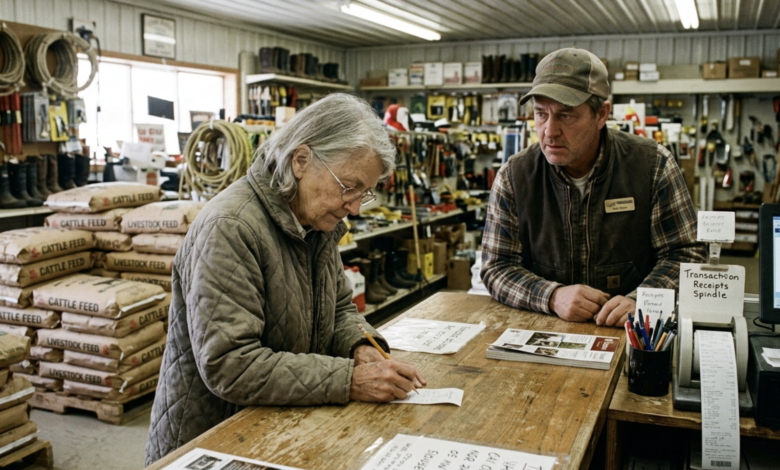
My 74-Year-Old Mother Wrote Six Numbers on a Receipt—And the Store Manager Turned Pale When He Recognized Them
When my 74-year-old mother wrote six numbers on a receipt at the farm supply store, the manager’s face drained of color. He knew those numbers. What none of us fully understood that morning was that they opened a door my father had kept closed for more than three decades.
### The Winter That Started Everything
Thirty-two years earlier, during one of the worst winters our family had faced, cattle were dying, feed shipments were delayed, and the bank was ready to call in the operating loan. The store’s previous owner—the current manager’s father—came to our farm with an idea. He and my father, along with other local farmers, created a quiet agricultural reserve fund. The purpose was simple: buy essential supplies when farmers could not afford them and guarantee feed during shortages. Everyone signed the same agreement. Contributions were made. Records were kept in a thick binder that stayed mostly forgotten.
My father never intended the fund to make anyone rich. He intended it to keep families from having to choose between feeding their cattle and feeding their children.
### The Numbers and the Confrontation
That morning we only needed twenty bags of cattle feed. The manager first told us they were already ours, then said a larger commercial operation had reserved them. Mom wrote the six numbers. The manager recognized the reserve account code his father had established. He protested that the bags belonged to the store. Mom calmly interrupted him.
She explained the fund’s original purpose and pointed to a red-underlined line in the old ledger: *Reserve administrator: transfer authority upon breach of essential-supply agreement.* The manager’s father had anticipated that one day a farmer’s emergency might be valued less than a bigger customer’s profit. By favoring the commercial buyer, the current manager had triggered the very clause his father wrote.
He retreated to his office, returned looking frightened, and handed Mom the phone. The attorney on the other end confirmed the original agreement was still enforceable. Outside, a delivery truck arrived as if nothing had changed. Inside, everything had.
As we left, Mom answered the manager’s shaken question—*How much control do you actually have over this store?*—with a quiet “None. Not yet.”
### A Second Secret Surfaces
A black pickup pulled in. Richard Harlan, representing the largest cattle operation in the county, stepped out with a yellowed document dated the same day as the ledger entry. His grandfather and my father had signed it. Harlan Livestock was to receive priority access during shortages—provided the company maintained its own emergency reserve and continued contributing to the community fund. Abandon those obligations, and the privileges were suspended.
Richard insisted the reverse side of the agreement meant nothing. Mom pointed out that priority never included taking supplies already promised to another farmer simply by offering more money. He left with a warning: if the reserve account was reactivated, she had better know what she was doing. His grandfather had believed it was worth far more than the original contributions.
### The Letter That Brought Her to Town
Mom had not driven into town only for feed. The day before she had received a letter from an attorney reviewing old agricultural agreements. Someone had attempted an unauthorized transfer of the Carter Family Agricultural Reserve assets. As the surviving representative of my father’s contribution, she had been contacted.
The next morning we returned to the store. Attorney Margaret Bennett laid out three folders, bank statements, and a sealed envelope bearing my father’s name. The reserve had grown through contributions, investment returns, and the purchase of agricultural property. Seven parcels had been acquired. Some were sold to finance emergencies; others were leased. Three remained: the land under the farm supply store itself, a small warehouse, and a large tract of farmland that bordered our own place—land I had always assumed belonged to an elderly couple who had long since moved away.
The neighboring farmland had nearly been sold. The attempted buyer was Richard Harlan. A deposit of $280,000 had been accepted. The transfer of administrative authority that allowed him to manage the records had never been properly authorized.
A bank statement showed the last verified balance of the investment account—an amount larger than anything I had ever associated with our family’s name. Some funds appeared to have been moved. Whether the transfers were legitimate remained unknown.
### My Father’s Final Instruction
Margaret handed Mom the sealed envelope. My father had directed that it be opened only if someone tried to misuse the reserve. Inside was a short handwritten letter:
*If you are reading this, then someone has forgotten why we built the reserve.
It was never meant to make our family powerful. It was meant to make sure no family in this county would ever have to choose between feeding its cattle and feeding its children.
If the people entrusted with protecting it begin serving themselves, do not fight for the money.
Fight for the farmers.
The money can be replaced. Trust cannot.*
Mom wiped her eyes, then gave clear instructions: secure the remaining assets, review every transaction, stop any unauthorized sale of the land, and locate every dollar. She still intended to buy the twenty bags of feed—at the listed price, with no special treatment.
As we prepared to leave, the county recorder’s office called. A new claim had been filed against the neighboring farmland. The claimant was my younger brother, Daniel.
### The Threat at the Kitchen Table
Daniel’s claim rested on a document allegedly signed by our father shortly before his death, promising Daniel the right to purchase the land at a discounted price. The signature looked wrong. The document had never appeared in the original estate records. That evening Mom placed a copy in front of him at the kitchen table. His face changed. He said he had received the document from Richard Harlan. He claimed Dad had promised him the land because he had done more physical work on the farm. The accusation contained a piece of truth—Dad had often asked me to handle the books while Daniel worked outside—but it did not make the document genuine.
Mom’s only instruction was simple: do not accuse anyone until the truth is known.
What began with six numbers on a receipt had revealed a decades-old promise, a growing fund, land held in trust, an attempted sale, moved money, and a fracture inside our own family. My father left Mom the authority to decide whether the original agreement had been violated. Someone had already tried to take that responsibility away. The question now is whether the reserve will still serve the farmers it was created to protect—or whether the people closest to it will finish the work of dismantling it.