“At our son’s school fall fair, my ex-husband
“At our son’s school fall fair, my ex-husband
Honestly, sometimes I wonder how I ever found your mother attractive. She has completely let herself go.
A second message appeared beneath it.
At least you won’t have to worry about looking like her. You’ve got me and Annabelle to teach you how to take care of yourself.
Someone in the audience gasped.
I felt the blood drain from my face.
Those weren’t messages Nigel had sent me.
They were messages he had sent Dustin.
My ten-year-old son had been receiving cruel remarks about his own mother from his father, the very person I had spent years defending whenever Dustin came home disappointed.
I turned toward Nigel.
He looked stunned.
“That’s private!” he shouted, taking a step toward the stage.
The principal immediately moved between him and the microphone.
“Dustin, sweetheart,” she said carefully, “do you want to explain what you’re showing us?”
Dustin nodded.
His little hands trembled around the microphone, but his voice was surprisingly steady.
“I didn’t want to do this.”
He glanced at me.
For a moment, our eyes met.
I wanted to run to him, wrap my arms around him, and carry him away from the room. He shouldn’t have had to stand there. He shouldn’t have needed to defend me in front of a crowd.
But I stayed where I was.
Because I understood that this was something he needed to say.
“The next pictures are from my dad’s phone,” Dustin continued. “I didn’t steal them. He showed me some of these messages himself because he thought they were funny. And some were sent to me.”
The screen changed.
Another message appeared.
Your mom acts like she’s some kind of perfect mother, but look at her. She can’t even make an effort.
Then another.
Don’t tell her I said this. She’ll make a big deal out of nothing.
I pressed a hand over my mouth.
I had spent countless nights wondering why Dustin seemed reluctant to leave for his father’s house.
I had blamed myself for every tearful goodbye.I’d wondered whether my divorce had damaged him more than I realized.
Now I understood that while I was trying to protect his relationship with Nigel, Nigel had been teaching our son that humiliating me was a harmless joke.
And Dustin had been carrying that burden alone.
Annabelle suddenly stepped forward.
“Those messages are being taken out of context!” she snapped.
Dustin looked at her.
“No, they’re not.”
The room went quiet again.
He swallowed.
“There’s something else.”
The screen changed once more.
This time, it showed a short video.
The camera shook slightly before settling on a living room. I recognized Nigel’s house immediately. Dustin had recorded the video from behind the armchair where he sometimes sat playing video games.
Annabelle’s voice came through the speakers.
“Honestly, Nigel, you need to stop pretending you care what your ex thinks. She’s never going to look like me, no matter how hard she tries.”
Nigel laughed.
Then Annabelle said something that made my stomach twist.
“Your son is going to have a serious problem if he grows up thinking women like his mother are worth admiring.”
Nigel answered, “He’s ten. He’ll get over it.”
A pause followed.
Then Annabelle laughed again.
“Good. Because the last thing I need is him bringing her bad habits into our future family.”
The video ended.
Nobody spoke.
Annabelle’s face had turned a sickly shade of white.
Nigel stared at the screen as if he could somehow force the words back into his mouth.
Dustin lowered the microphone.
“That’s why I didn’t want to go to Dad’s house last weekend,” he said quietly. “And that’s why I stopped telling him things.”
His voice cracked.
“I thought if I told Mom, she’d be sad. And if I told Dad, he’d say I was being too sensitive.”
He looked directly at Nigel.
“I don’t want to hate you, Dad.”
Nigel’s expression crumpled.
“But I don’t understand why you keep making fun of the person who loves me the most.”
A woman near the back began to cry.
I couldn’t hold myself still anymore.
I hurried toward the stage.
Dustin saw me coming, and the brave expression he had been wearing collapsed. He ran straight into my arms.
I knelt and held him tightly.
“I’m sorry,” he whispered into my shoulder.
My heart broke.
“For what, baby?”
“For making everyone see it.”
I pulled back just enough to look into his eyes.
“Dustin, listen to me. You have nothing to apologize for.”
He shook his head.
“I didn’t want to embarrass Dad.”
I brushed his hair away from his forehead.
“You didn’t do anything wrong by telling the truth.”
Behind us, Nigel finally found his voice.
“Dustin, come here. We need to talk about this.”
Dustin stiffened in my arms.
I felt it immediately.
The instinctive fear in his little body told me more than any screenshot ever could.
“No,” Dustin said.
It was barely louder than a whisper.
Nigel stopped.
“What did you say?”
Dustin took a shaky breath.
“I said no. I don’t want to talk to you right now.”
For the first time in years, I saw Nigel look at our son without the confidence of a man who assumed he could always repair things with a promise and a weekend of fun.
He looked lost.
Annabelle, however, was furious.
She seized his arm again.
“Make him stop!” she hissed. “Do you have any idea what this makes us look like?”
That was when Nigel finally turned to her.
And something in his face changed.
Not anger.
Recognition.
“You knew he could hear us,” he said.
Annabelle blinked.
“What?”
“You knew Dustin was in the living room when you said those things.”
“Oh, don’t start this.”
“You knew.”
She glanced around the room, suddenly aware of the dozens of people watching her.
“He was supposed to be playing in his room!”
Nigel stared at her.
“So you admit you said it.”
Annabelle’s mouth fell open.
For a moment, I thought she might try to deny everything again.
Instead, she turned on him.
“Don’t you dare put this all on me! You were the one who complained about your ex every single weekend. You were the one who sent those messages. You were the one who laughed!”
Nigel flinched.
Because she was right about one thing.
She hadn’t done this alone.
Neither had he.
And no matter how desperately he wanted to make Annabelle the villain of the story, the messages on the screen had come from his own phone.
The principal stepped forward.
“I think it’s time we give this family some privacy.”
The crowd began to disperse slowly, murmuring among themselves. Some parents approached me with sympathetic looks. Others quietly guided their children toward the fair booths.
I barely noticed them.
All I could feel was Dustin’s small hand gripping mine.
Then Nigel approached us.
He looked at Dustin, his eyes shining.
“Son, I never wanted to hurt you.”
Dustin stared at the floor.
“But you did.”
Nigel’s shoulders slumped.
“I know.”
“Do you?” Dustin asked.
His voice was quiet, but it carried more weight than anything he had said into the microphone.
“Because you laughed when she made fun of Mom. And you laughed when I told you I didn’t like it. You said I needed to toughen up.”
Nigel closed his eyes.
“I was wrong.”
Dustin finally looked at him.
“Why?”
Nigel opened his mouth.
Then closed it again.
For once, he didn’t have a clever answer.
He didn’t have an excuse.
And I realized that was the first honest moment I’d seen from him in a very long time.
Annabelle grabbed her purse.
“I’m not staying for this.”
Nigel didn’t turn toward her.
“Then don’t.”
She stared at him as if she’d never heard him speak that way.
“Nigel!”
He finally looked at her.
“Go home, Annabelle.”
Her face twisted with disbelief.
“You are seriously choosing your ex-wife over me?”
“No,” he said, looking at Dustin. “I’m finally choosing my son.”
Annabelle gave a short, bitter laugh.
“Good luck fixing this. He’s never going to forget what happened today.”
She stormed out.
Nigel watched her leave, but he didn’t follow.
For several seconds, none of us moved.
Then he looked at me.
“I don’t expect you to forgive me.”
“Good,” I replied.
He winced.
I wasn’t trying to hurt him.
I was simply too tired to make his guilt easier for him to bear.
“You don’t get to make this about whether I forgive you, Nigel. This is about Dustin. He trusted you, and you made him feel ashamed of loving his own mother.”
Nigel nodded slowly.
“I know.”
“No, you know what the room saw today. I need you to understand what our son has been experiencing for months.”
His eyes filled with tears.
“What do I do?”
I looked down at Dustin.
He was watching his father carefully, not with hatred, but with the wary expression of a child who had learned that promises could be broken.
“Start by listening to him,” I said. “And stop asking him to make you feel better about what you’ve done.”
Nigel looked at our son.
“Can I say something?”
Dustin hesitated.
Then he nodded.
“I’m sorry,” Nigel said. “Not because everyone saw those messages. Not because Annabelle left. I’m sorry because I made you feel like loving your mother was something you had to hide.”
Dustin’s lips trembled.
“I don’t want you to hate Mom.”
“I don’t hate your mom,” Nigel said.
“Then why did you talk about her like that?”
Nigel looked down.
“I think I wanted to convince myself that leaving our marriage meant I had made the right choice. And instead of dealing with my own feelings, I made fun of her.”
He paused.
“That was cruel. And you never should have had to hear any of it.”
Dustin didn’t answer.
He wasn’t ready.
And for once, Nigel didn’t demand one.
The principal quietly asked if we wanted to go to her office, but Dustin shook his head.
“I want to finish the fair.”
I blinked in surprise.
“Are you sure, sweetheart?”
He nodded.
“We still have cupcakes to sell.”
A small, broken laugh escaped me.
“Well, then, we’d better make sure they don’t all go to waste.”
He took my hand.
And together, we walked back toward the pumpkin booth.
Behind us, Nigel remained standing near the stage, alone beneath the bright paper leaves and orange streamers.
For the first time since our divorce, I didn’t feel responsible for helping him find his way back.
He would have to do that himself.
And if he ever wanted to be a father Dustin could trust again, he would have to begin with something much harder than an apology.
He would have to change.
# Final Part: The Woman Behind the Pumpkin Costume
By Monday morning, I had received seventeen messages from parents who had attended the fair.
Some offered sympathy.
Some praised Dustin for being brave.
One mother wrote that she wished she had possessed half his courage when her own family was falling apart.
I appreciated their kindness, but I didn’t respond to most of them.
My son wasn’t a public lesson in courage.
He was a ten-year-old boy who still slept with a stuffed dinosaur and believed chocolate milk tasted better through a straw.
He deserved to be a child again.
On Monday afternoon, I sat across from him at our kitchen table while he worked on his math homework.
He kept glancing at me.
Finally, I set down my mug.
“What’s on your mind?”
He chewed the end of his pencil.
“Are you mad at me?”
The question caught me off guard.
“Why would I be mad at you?”
“Because everyone saw the messages. And now Dad might not come to my basketball game next weekend.”
I felt a familiar ache in my chest.
There it was again.
My sweet boy, trying to carry the consequences of an adult’s choices.
I moved my chair beside his.
“Dustin, your dad’s decisions are his responsibility. Not yours.”
“But I put the messages on the screen.”
“You told the truth about something that was hurting you. I understand why you did it, and I’m not angry with you.”
He stared at his homework.
“Do you think Dad is a bad person?”
I took a breath before answering.
“I think your dad did some very hurtful things. That doesn’t mean I can tell you everything about who he is or who he might become. People can make terrible choices, and sometimes they can learn to make better ones.”
“Even grown-ups?”
“Especially grown-ups. But they have to want to change, and they have to prove it.”
He thought about that for a while.
“Do you think he will?”
“I don’t know, sweetheart.”
It was a difficult answer to give my child.
But I had promised myself that I would never again confuse protecting Dustin with pretending the world was kinder than it was.
He leaned against me.
“I hope he does.”
“So do I.”
That evening, I received a message from Nigel.
I’d like to see Dustin. I understand if you don’t want me to.
I stared at the screen for a long time.
A year earlier, I would have rushed to reassure him.
I would have told him that of course he could see his son, that we needed to put everything behind us, that the important thing was for Dustin to have both parents.
But I had finally learned something I should have understood from the beginning.
Keeping a father in a child’s life was not the same as teaching a child to tolerate being hurt by him.
I replied:
Dustin’s well-being comes first. Please give him space to decide what he’s comfortable with. If you want to rebuild your relationship, you need to do it patiently and consistently. I won’t force him to see you, and I won’t ask him to forgive you before he’s ready.
Nigel responded almost immediately.
I understand.
For once, I didn’t wonder whether he meant it.
I simply waited to see what he would do.
### The First Promise He Kept
Two weeks passed.
Nigel didn’t call Dustin repeatedly. He didn’t show up at my house unexpectedly. He didn’t send gifts with notes asking to be forgiven.
Instead, he sent one short message every few days.
I hope your math test went well.
I saw a basketball jersey in your favorite team’s colors and thought of you.
I’m here whenever you’re ready to talk. No pressure.
Dustin read each message but rarely replied.
I didn’t encourage him to respond.
Then, on a Thursday evening, Dustin came into the living room holding his phone.
“Mom?”
I looked up from my book.
“Yes?”
“Can I call Dad?”
I closed my book.
“Of course. Do you want me to sit with you?”
He considered it.
“Maybe just nearby.”
I nodded and returned to the armchair while he called.
Nigel answered on the second ring.
“Hey, buddy.”
“Hi, Dad.”
There was a long silence.
I could hear the faint sound of traffic through Nigel’s phone.
Then Dustin spoke.
“Are you still coming to my basketball game on Saturday?”
“If you want me there, I’ll be there.”
“Okay.”
Another silence.
Then Dustin asked the question I knew he had been carrying since the fair.
“Are you still dating Annabelle?”
“No,” Nigel replied. “We’re not together anymore.”
“Because of the messages?”
“Partly. But the bigger problem was how I behaved. I kept choosing to laugh at things I knew were hurtful instead of standing up for people. I let someone else’s cruelty become my own.”
Dustin was quiet.
Then he asked, “Would you have stopped if I hadn’t shown everyone?”
I closed my eyes.
I hadn’t realized how badly I wanted to hear Nigel answer that question honestly.
“I don’t know,” Nigel admitted. “And I’m ashamed that I don’t know. You shouldn’t have had to do what you did to make me understand.”
Dustin rubbed his thumb along the edge of his phone.
“Okay.”
“There’s something I want you to know,” Nigel continued. “You never have to protect me from being embarrassed. You don’t have to keep secrets to make me happy. If something I do hurts you, you can tell me.”
Dustin’s voice softened.
“Even if it makes you sad?”
“Even then.”
“Okay, Dad.”
They spoke for another five minutes about basketball, a science project, and a video game Dustin wanted to buy.
Nothing profound.
Nothing dramatic.
Just a father and his son talking about ordinary things.
When the call ended, Dustin looked at me.
“Do you think he meant it?”
I sat beside him.
“I think he meant it tonight.”
He nodded slowly.
“And tomorrow?”
“Tomorrow, he gets another chance to show you.”
For the first time in weeks, Dustin smiled without looking worried about whether he was allowed to.
### The Basketball Game
On Saturday, Nigel arrived fifteen minutes before the game.
He sat alone in the second row.
There was no Annabelle beside him, no exaggerated display of affection, no loud greeting designed to draw attention.
He simply watched.
When Dustin made his first basket, Nigel stood up and clapped.
When Dustin missed the next shot, Nigel didn’t shout advice from the bleachers.
He just clapped again.
After the game, Dustin ran toward him.
“Did you see my last basket?”
“I did! That was fantastic.”
“I almost missed it.”
“But you didn’t.”
Dustin grinned.
Nigel hesitated before asking, “Would you like to get ice cream?”
Dustin glanced at me.
I smiled and nodded.
“Go ahead, sweetheart. I’ll meet you at home later.”
As they walked toward the parking lot, Nigel turned back.
“Thank you,” he said.
I shook my head gently.
“Don’t thank me for letting you be his father. Just be one.”
He accepted that without arguing.
And I realized how much had changed in such a short time.
Not because Nigel had suddenly become a different person.
But because I had stopped doing the emotional work for him.
I no longer explained away his mistakes.
I no longer softened the truth so he could remain comfortable.
And I no longer believed that a peaceful relationship between divorced parents required one person to swallow every hurt.
Sometimes, peace began when someone finally stopped pretending nothing was wrong.
### The Truth I Had Been Hiding From Myself
In the months that followed, Nigel kept showing up.
He attended Dustin’s school events.
He learned to listen without interrupting.
He stopped asking Dustin what I was doing, who I was seeing, or whether I had mentioned him.
When Dustin told him he didn’t like a particular joke, Nigel apologized instead of calling him sensitive.
He also began seeing a counselor.
He never announced this as proof that he had changed. I learned about it only because Dustin mentioned that his dad had been talking to someone about how to handle his anger and insecurity.
Progress was slow.
There were awkward conversations and uncomfortable silences.
But Nigel kept coming back.
And gradually, Dustin began trusting him again.
I was grateful for that.
Not for Nigel’s sake, but for our son’s.
Still, the fair had left a mark on me, too.
For years, I had tried to prove that I was the reasonable ex-wife.
I had swallowed my anger because I didn’t want Dustin to feel torn between us.
I had dressed carefully for school events, smiled through uncomfortable conversations, and pretended I wasn’t hurt when Nigel made little comments about my life.
I had convinced myself that if I were gracious enough, patient enough, and accommodating enough, our divorce would cause Dustin as little pain as possible.
But I had overlooked something important.
Dustin wasn’t learning how to navigate a healthy relationship by watching me endure disrespect.
He was learning that love meant staying quiet.
That realization hurt more than Annabelle’s insults ever could.
One evening, several months after the fair, I stood in front of my bedroom mirror, getting ready for a school fundraiser.
I wore a navy-blue dress I had bought years earlier, before the divorce, before the endless compromises, before I started examining my reflection as though someone else had the final say over whether I was attractive enough to be treated kindly.
My hair was shorter now.
There were faint lines beside my eyes.
I had gained weight during the most difficult months of my life.
For the first time in a long while, I looked at myself without immediately searching for flaws.
I looked tired.
I looked older than I had at twenty-five.
I also looked like someone who had survived something difficult and was slowly finding her way back.
I smiled at my reflection.
Then Dustin appeared in the doorway.
“Mom?”
“Yes?”
He looked me over.
“You look pretty.”
I laughed softly.
“Thank you, sweetheart.”
He walked closer.
“Are you going to wear that?”
“Unless you think it’s terrible.”
“It’s not terrible.” He paused thoughtfully. “It’s actually really nice.”
I put a hand over my heart.
“Such high praise.”
He grinned.
Then his expression became serious.
“Mom, can I ask you something?”
“Anything.”
“Did Dad make you feel bad about yourself before you got divorced?”
I sat on the edge of the bed.
“Sometimes.”
“Why didn’t you tell him to stop?”
I considered giving him the easy answer.
Because I wanted to keep the peace.
Because I didn’t want you to be hurt.
Because I thought I could handle it.
All of those things were true.
But there was another truth, one I wanted my son to understand before he grew old enough to mistake silence for strength.
“Because I was afraid,” I admitted. “I was afraid that standing up for myself would make things harder for everyone. I thought if I stayed calm enough, I could keep our family from falling apart.”
“Did it work?”
I shook my head.
“No, sweetheart. It didn’t.”
He climbed onto the bed beside me.
“Do you wish you had done things differently?”
I thought about the marriage I had tried so hard to save, the nights I had cried in the bathroom so Dustin wouldn’t hear, and the countless times I had apologized for feelings that were perfectly reasonable.
“Yes,” I said. “But I also know I did the best I could with what I understood at the time.”
Dustin leaned against my shoulder.
“I don’t want to be like that when I grow up.”
“Like what?”
“Like someone who laughs when another person gets hurt.”
I kissed the top of his head.
“Then remember this. You don’t have to be cruel to prove you’re strong. And you don’t have to be silent to prove you’re kind.”
He nodded.
I could see him thinking about it.
Then he looked up.
“And you don’t have to wear a pumpkin costume if you don’t want to.”
I burst out laughing.
“Oh, absolutely not. One pumpkin costume was enough for me.”
He laughed, too.
And in that ordinary moment, I felt something inside me finally loosen.
I couldn’t change the marriage I had left behind.
I couldn’t erase the things Dustin had heard.
But I could help him grow into someone who understood that kindness was a choice, that apologies required action, and that loving someone never meant accepting humiliation as the price.
That was something worth passing on.
### The Return to the Fall Fair
A year later, the school announced another fall fair.
When Dustin brought home the permission slip, he placed it on the kitchen table and looked at me with a mischievous expression.
“Mom, do you remember what happened last year?”
I raised an eyebrow.
“Vaguely. I seem to remember a certain ten-year-old taking over the microphone.”
He laughed.
“Well, this year, I have a different idea.”
I eyed him suspiciously.
“Should I be worried?”
“Probably not.”
That answer did not reassure me.
A few days later, Dustin asked whether he could help organize the fair’s opening ceremony.
His teacher had agreed to let students share short speeches about people who had made a difference in their lives.
Dustin wanted to participate.
I helped him practice at our kitchen table.
He wrote the speech himself, changing words whenever they didn’t sound right to him.
He didn’t show me the finished version until the morning of the fair.
When we arrived, the school grounds were full of children in costumes, parents carrying baked goods, and teachers trying to keep the decorations from blowing away in the wind.
I wore a simple burgundy sweater and jeans.
Dustin wore a ridiculous orange hat shaped like a pumpkin.
He had insisted on making it himself.
“Ready?” I asked.
He took a deep breath.
“Ready.”
We found Nigel near the stage.
He had arrived early to help set up chairs.
When he saw us, he smiled.
“Hey, buddy. That’s a fantastic hat.”
“I made it.”
“I can tell. It’s very professional.”
Dustin giggled.
Nigel glanced at me.
“You look nice.”
“Thank you.”
He seemed about to say something else, then stopped.
A year earlier, he might have made the compliment sound like a comparison, a judgment, or an invitation for me to reassure him that we were all getting along.
Now he simply let it be a compliment.
It was a small thing.
But small things, repeated over time, were how trust was rebuilt.
When the speeches began, Dustin climbed onto the stage.
He adjusted the microphone.
The crowd quieted.
I felt my palms grow damp.
Even after all this time, the sight of my son standing alone before a crowd made my heart race.
He unfolded a piece of paper.
“Last year, I used this microphone because I was angry,” he began.
A few adults exchanged glances.
“I was angry because people I loved were saying things that hurt each other. I thought if I showed everyone what was happening, maybe it would stop.”
He paused.
“It did stop some things. But I learned that telling the truth doesn’t always fix everything right away.”
I held my breath.
“Sometimes, telling the truth is just the beginning. After that, people have to decide what they’re going to do with it.”
Nigel sat perfectly still.
Dustin continued.
“I also learned that I don’t have to choose which parent I love. I can love my mom and my dad at the same time. But that doesn’t mean I have to pretend everything is okay when it isn’t.”
My eyes filled with tears.
He looked toward me.
“Mom taught me that being kind doesn’t mean letting people hurt you. She kept being kind even when things were hard. And she never asked me to hate anyone just because she was hurt.”
He turned toward Nigel.
“Dad taught me something, too. He taught me that grown-ups can make mistakes. But he also taught me that saying sorry isn’t enough. You have to do something different afterward.”
Nigel lowered his head.
Not in shame this time.
In understanding.
Dustin glanced down at his paper.
“So I guess what I’m trying to say is that families don’t have to be perfect. But people should try to make them safe places to love each other.”
He folded the paper.
“That’s all. Thank you.”
For one brief second, the crowd was silent.
Then the applause began.
I stood and clapped until my hands hurt.
Nigel was on his feet, too.
He didn’t rush the stage.
He didn’t make the moment about himself.
He simply watched his son with tears running down his face.
When Dustin came down, he ran to me first.
I hugged him tightly.
“You did beautifully.”
He smiled against my shoulder.
“Did I talk too long?”
“Not nearly long enough.”
He laughed.
Then he turned toward Nigel.
His father opened his arms but waited.
Dustin looked at him for a moment.
Then he stepped forward and hugged him.
Nigel closed his eyes.
“I’m proud of you, son,” he whispered.
Dustin leaned back.
“Thanks, Dad.”
It wasn’t a magical reconciliation.
It wasn’t a promise that they would never hurt each other again.
It was something better.
It was a real moment between two people who had been hurt, who were learning how to be honest, and who understood that love required more than wanting things to be different.
It required doing the work.
### What Happened to Annabelle
I heard about Annabelle only once more.
Several months after the first fair, she had contacted Nigel to ask whether he would consider giving their relationship another chance.
He told her no.
He explained that he wasn’t interested in rebuilding a relationship that required him to ignore his own behavior or excuse cruelty toward his family.
According to Nigel, she accused him of becoming weak.
He told her he had spent years mistaking cruelty for confidence and silence for peace.
Then he ended the conversation.
I never met Annabelle again.
I didn’t need to.
For a long time, I had imagined her as the central villain in my marriage’s aftermath.
She had mocked me. She had encouraged Nigel’s worst impulses. She had treated my son’s love for me as an inconvenience.
But the truth was that she had only been able to hurt us as much as she did because Nigel had allowed it.
And Nigel’s behavior had hurt us because I had spent too long trying to compensate for it.
Understanding that didn’t excuse anyone.
It simply helped me stop wasting energy on the wrong questions.
I no longer wondered whether Annabelle thought I was attractive.
I no longer wondered whether Nigel regretted leaving me.
And I no longer needed either of them to agree that I deserved respect.
I already knew.
### The Last Pumpkin Cupcake
That evening, after the fair ended, Dustin and I returned home with a cardboard box containing three leftover pumpkin cupcakes.
He placed them on the kitchen counter.
“Can we eat them for dessert?”
“Of course.”
We sat at the table, our legs swinging beneath the chairs.
Dustin took a bite and immediately got frosting on his nose.
I laughed and wiped it away with a napkin.
He grinned.
Then he looked at me.
“Mom?”
“Hmm?”
“Are you happy now?”
The question was so simple that it almost undid me.
I thought about the woman I had been a year earlier.
The woman who had stood in a crowded gymnasium, humiliated by the laughter of the man she once loved.
The woman who had watched her son take a microphone because he believed he had to defend her.
The woman who had spent so much time trying to make everyone else comfortable that she had forgotten she was allowed to be hurt.
I looked around our little kitchen.
The refrigerator was covered in Dustin’s drawings.
A pile of laundry waited beside the stairs.
My old coffee mug sat near the sink.
Nothing about our life was perfect.
There were still difficult days, awkward conversations, and moments when the past returned unexpectedly.
But I no longer felt as though I were standing on the edge of a life that someone else had the power to ruin.
I had my son.
I had my peace.
And I had finally begun to understand that my worth had never been something another person could take away.
“Yes,” I told him. “I am.”
He smiled.
“Even though Dad and you aren’t together?”
“Even then.”
“Even though last year was really bad?”
I reached across the table and took his hand.
“Especially because we got through last year.”
He thought about that, then nodded.
“Good.”
He finished his cupcake and leaned back in his chair.
“Because I like it when you’re happy.”
My throat tightened.
I squeezed his hand.
“I like it when you’re happy, too.”
Outside, the last leaves of autumn drifted across the pavement.
Inside, the kitchen smelled of cinnamon and pumpkin, and my son was laughing at something on his phone.
I watched him for a moment, grateful for the ordinary beauty of it all.
For so long, I had believed the worst thing that could happen to a family was that it might fall apart.
Now I understood that a family could fall apart long before anyone moved out.
And sometimes, once the pretending ended, something healthier could finally begin.
That fall, a ten-year-old boy had taken a microphone because he couldn’t bear to hear the people he loved hurting one another anymore.
He had exposed a truth that the adults around him had been too afraid, too proud, or too comfortable to confront.
But the most important thing he had done wasn’t embarrassing his father or silencing his father’s girlfriend.
It wasn’t proving that his mother deserved better.
It was showing me that I could stop waiting for other people to recognize my worth.
I could live it.
I could model it.
And I could teach my son that the people who truly loved him would never ask him to sacrifice his dignity to keep their affection.
The last cupcake disappeared.
Dustin hopped out of his chair and wrapped his arms around me.
“Love you, Mom.”
I held him close.
“Love you more, sweetheart.”
He pulled back with a triumphant grin.
“Impossible.”
I laughed.
“That’s what you think.”
And as he ran upstairs, still laughing, I glanced toward the refrigerator.
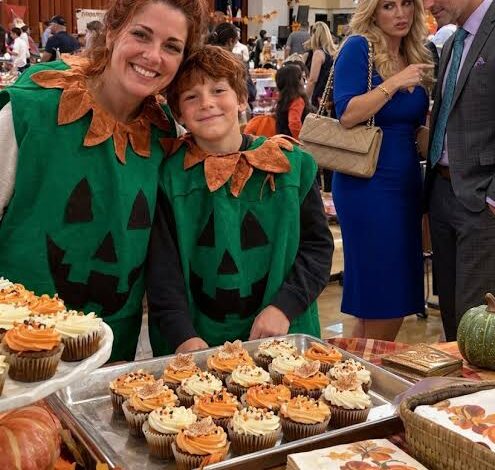
There, held in place by a crooked orange magnet, was a photograph of us from the first fall fair.
Two ridiculous pumpkin costumes.
Two enormous smiles.
A mother and her son, laughing without worrying about who might be watching.
I left the photograph exactly where it was.
Not because I wanted to remember the humiliation.
Not because I wanted to remember Nigel’s betrayal.
But because I wanted to remember the moment everything changed.
The moment my son reminded me that love was never supposed to make us smaller.
That kindness was never supposed to require silence.
And that sometimes, the bravest thing a person could do was stand in front of a crowd, tell the truth, and refuse to be ashamed of loving someone.
I turned off the kitchen light and went upstairs.
For the first time in years, I wasn’t wondering what anyone thought of me.
I was simply looking forward to tomorrow.
And that, I realized, was the happiest ending I could have ever asked for.
THE END