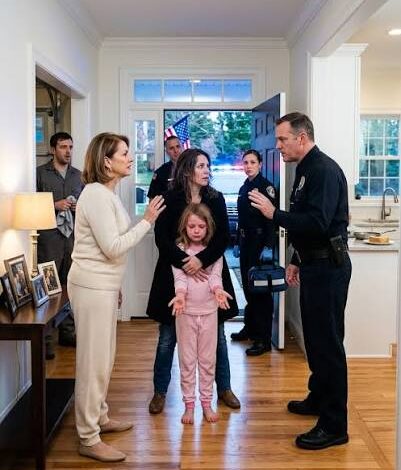
At Sunday dinner at my husband’s parents’ house, my six-year-old climbed into my lap and whispered, “Don’t tell Grandma I told you about the closet.”
At Sunday dinner at my husband’s parents’ house, my six-year-old climbed into my lap and whispered, “Don’t tell Grandma I told you about the closet.” I wiped her mouth. I said, “Eat your peas.”
My husband’s mother laughed and said kids make things up.
She still doesn’t know that two days later her address came across my headset at work.
“Kids make things up, sweetheart.” She said it to me, not to Lily, and she said it smiling. “Don’t make it a thing at the table.”
My husband studied his plate.
My name is Jenna. I’m thirty-six. I answer 911 for Greene County, Ohio, four nights a week. I know what a locked door sounds like on a phone line.
Since March, every Tuesday and Friday, my husband’s mother has had Lily from noon until Kyle gets home at six.
Daycare was $1,140 a month. His mother called that money thrown at strangers and offered to do it for free, for family.
I paid her $200 a week anyway.
I bought the car seat for her Buick.
I switched to the two-to-ten shift so Lily would only be there six hours.
I drove twenty minutes the wrong way every morning so Kyle wouldn’t have to.
In May I told myself the marks on Lily’s wrist were the monkey bars, because Diane said so and because I had a shift at two.
A tired mother will believe anything that gets her to work on time.
Lily started wearing her pink watch to Grandma’s the week after the wrist. It has a location dot and one button that calls my phone.
I had not opened the location history once.
The pot roast came out at 5:40 and Lily would not let go of my sleeve.
“She’s clingy tonight,” my husband’s mother said. “She gets dramatic when she’s tired. She gets it from somewhere.” She looked at me when she said somewhere.
“She’s fine where she is,” I said.
“Lily. Little table, please. Facing the wall, until you remember how we behave at Grandma’s.”
Lily got down. She didn’t argue. She didn’t look at me. She sat at the card table facing the wallpaper like she had done it many times.
Not scared. Not loud. Practiced.
My father-in-law laughed. “Wall time. Worked on Kyle.”
“Jen,” my husband said, to his plate. “Let it go. It’s Sunday.”
The dining room smelled like pot roast and Pledge.
I didn’t cry. I didn’t argue. I didn’t ask her one question.
“Thanks for dinner, Diane,” I said, and I ate.
My hands were cold on the fork. It felt like a latch dropping into place somewhere in my chest. I said, “Okay.”
Dramatic.
Tuesday I dropped her off at noon with the watch charged to 100 percent.
I kissed her head. I said, “Be good for Grandma.” That is the sentence I would take back first.
At 1:58 p.m. I sat down at console three and opened the watch app on my phone under the desk, where phones are not allowed.
The dot was in Diane’s kitchen.
At 2:09 it moved to the hallway and stopped.
At 2:14 the 911 line rang.
“Greene County 911, what’s the address of your emergency?”
It was the address I drive to every Tuesday.
“I’m the neighbor across the street,” a woman said. “There’s a child crying in that house. It’s every Tuesday, and I am done calling the other number and being told she’s napping.”
“What other number, ma’am?”
“The non-emergency one. I called in April. I called in May. A deputy came out both times and the grandmother said the little girl was napping.”
Something in me went very still.
“Stay on the line,” I said.
2:15 I typed the address.
2:16 I sent Unit 41. Marcus. I trained him on his first night four years ago.
2:17 I told my supervisor whose house it was.
She didn’t take the headset off me. “Then you keep it on. I’ll log it.”
2:19 I pulled the address history.
Three prior calls.
Two from the neighbor, April 9th and May, closed the same way.
UNFOUNDED. Grandmother states child napping. Father contacted by phone. Father advises child has behavioral issues and makes things up.
Father contacted.
My husband told a deputy in April that our daughter makes things up, then came home and ate dinner.
Too calm. Too helpful. Too rehearsed.
The third call was older. March. The number belonged to my husband’s sister. Amber has not set foot in that house in four years.
2:23 I texted my sister: Get to Diane’s street. Don’t go in.
2:26 Marcus keyed up. “41, on scene.”
2:29. “41, dispatch. Homeowner is refusing to open. She’s on the phone with somebody. Be advised I can hear a kid inside.”
If Diane opens that door, my daughter walks out of a hallway closet in front of a deputy, and nobody in that family ever says dramatic to me again.
If she doesn’t, Marcus has to decide whether a crying child is enough to go through it.
My husband already has two reports on file that say she cries about nothing.
2:30 my phone lit up on the desk beside the keyboard. Kyle.
I pressed decline. First time in nine years.
2:31 it lit up again. Not Kyle. The pink watch.
I put it to my other ear, Marcus still breathing on the radio, and my daughter, very small, said.
PART 2 — THE CLOSET DOOR
“Mommy?”
Lily’s voice was so quiet I almost thought the connection had failed.
I pressed the pink watch against my ear.
“I’m here, baby.”
Across my headset, Marcus was still breathing on the radio outside Diane’s house.
On my other ear, my six-year-old daughter whispered:
“Grandma turned the light off.”
Every sound in the dispatch center disappeared.
Keyboards.
Radios.
The hum of fluorescent lights.
The dispatcher beside me talking to a caller about a traffic accident.
All of it moved somewhere far away.
I kept my voice flat because that was what I had been trained to do.
Calm keeps people alive.
Even when the caller is your child.
“Okay, sweetheart.”
I swallowed.
“Are you hurt?”
A pause.
“My arm hurts.”
I closed my eyes.
I did not ask why.
Not yet.
Not because I did not want to know.
Because I knew better than to turn a frightened child into her own investigator.
“Can you open the door?”
“No.”
“Is Grandma near you?”
“I don’t know.”
Then Lily began crying.
Not loudly.
That was worse.
Quiet crying belongs to children who have learned noise does not always bring comfort.
My supervisor, Karen, was standing beside me now.
She had one hand on the back of my chair.
I looked at her.
She could hear enough from my expression.
I pointed toward the address screen.
Then whispered:
“She says the door won’t open.”
Karen leaned toward the radio console.
“Unit 41, additional information. Child has contacted mother from inside residence. Child reports she is behind a door she cannot open.”
Marcus answered immediately.
“Copy.”
Then, after a beat:
“I can hear her now.”
My whole body went cold.
Not because he heard Lily.
Because that meant the crying was loud enough to reach him from outside the front portion of the house.
I heard pounding through the watch.
A man’s voice.
Faint.
“Lily?”
Marcus.
My daughter gasped.
“Mommy, somebody’s here.”
“That’s a police officer.”
“Am I in trouble?”
That sentence nearly broke me.
“No.”
My voice cracked.
I forced it steady again.
“No, sweetheart. You are not in trouble.”
“Grandma said if I called you—”
She stopped.
“What?”
I almost asked.
Stopped myself.
“Never mind that right now.”
I was sweating.
“Listen for the officer.”
“Okay?”
Lily sniffed.
“Okay.”
Marcus keyed his radio again.
“Dispatch, homeowner has opened the front door. She is stating child is in disciplinary time-out and does not need assistance.”
My fingers curled around the edge of the console.
Karen spoke before I could.
“Unit 41, child has reported she cannot exit the room.”
“Copy.”
A pause.
Then Marcus:
“I’m entering to check welfare.”
No drama.
No speech.
One sentence.
I heard Diane shouting faintly through the radio.
Something about rights.
Something about family.
Then Marcus disappeared from the channel.
The silence lasted twenty-eight seconds.
I know because the dispatch clock was directly above my screen.
Twenty-eight seconds can become an entire childhood if you are waiting for someone to reach your child.
Then the radio cracked.
“41, dispatch.”
Marcus sounded different.
Controlled.
Too controlled.
“Start EMS.”
My heart stopped.
Karen put her hand on my shoulder.
“Reason?”
“Child located.”
Another pause.
“Conscious and breathing.”
I could breathe again.
Barely.
Then Marcus said:
“Child was inside a hall closet with an exterior latch.”
Everything inside me went still.
Not a bedroom.
Not a “quiet room.”
Not some misunderstanding about a child locking herself in.
An exterior latch.
Someone had closed the door from the outside.
I heard myself say:
“Copy.”
Like Lily belonged to somebody else.
Like this was any Tuesday.
Like I had not sat at Diane’s table two days earlier while she smiled and told me children make things up.
Karen reached down and unplugged my headset.
“Jenna.”
I looked at her.
“You’re done.”
“I can still—”
“No.”
She was already signaling the dispatcher beside me.
“Travis is taking the channel.”
“I need to—”
“You need to go be her mother.”
That was the sentence that finally made me shake.
I stood too quickly.
My knees almost failed.
Karen caught my elbow.
“I’m okay.”
“No, you’re not.”
“I need to get there.”
“We know.”
She took my phone from my hand long enough to look at the watch call.
Still connected.
“Talk to your daughter.”
Then she walked me toward the break room so I could hear Lily without radios around me.
“Baby?”
“I’m here.”
“I can see a policeman.”
Her voice had changed.
Still scared.
Less alone.
“Good.”
“His name is Marcus.”
I almost laughed.
She pronounced it Mar-cuss like she had known him forever.
“Listen to Marcus.”
“Okay.”
Then Marcus came onto the watch.
“Jenna?”
“Yes.”
“She’s with me.”
I put my hand over my mouth.
“She’s alert.”
“She has some redness around one wrist and says her arm hurts.”
“We’re having EMS look at her.”
“Diane is separated from her.”
Separated.
Good.
“Do not question Lily about what happened when you get here.”
“I know.”
“I know you know.”
His voice softened.
“I’m saying it because you’re her mom right now, not dispatch.”
That nearly undid me.
“My sister is on the street.”
I said.
“Nora.”
“I see her.”
“Keep her outside.”
“Already did.”
Good.
Nora would have gone through Diane’s front window if I had not warned her.
I loved her for that.
I needed her not to.
Kyle called again while I was grabbing my coat.
I declined.
Then a text appeared.
WHAT DID YOU DO?
Not:
Is Lily okay?
Not:
Why are police at Mom’s?
What did you do?
I stared at it.
Something inside me hardened.
Then another:
Mom says you sent cops over a timeout. Jenna, call me NOW.
A timeout.
The word looked obscene.
I screenshot both messages.
Then forwarded them to myself at work email because training lives in the bones.
Preserve.
Do not edit.
Do not argue.
Nora drove me to Diane’s house.
Karen would not let me drive.
She was right.
I remember almost none of the twenty minutes.
Only pieces.
Nora gripping the steering wheel.
My phone vibrating.
Kyle.
Diane.
Kyle.
An unknown number.
Then the pink watch location dot moving from the hallway to the front yard.
I stared at it the entire way.
Moving.
Lily was moving.
That mattered.
Three emergency vehicles were outside when we arrived.
One ambulance.
Two sheriff’s units.
Mrs. Carol Benson, the neighbor across the street, stood on her porch with both hands pressed to her chest.
The woman who called.
The woman who had called before.
Twice.
I saw her face and felt shame so sharp I almost turned away.
A stranger had noticed a pattern in my child’s crying before I did.
But shame is useless if it keeps you staring at yourself while your child needs you.
So I kept walking.
Marcus met me at the sidewalk.
“Before you go in—”
“Where is she?”
“With EMS.”
“She’s stable.”
“Can I see her?”
“Yes.”
Then he blocked my path gently.
“One thing.”
I stopped.
“The closet has been photographed.”
“The exterior latch is still there.”
“Diane says Lily goes in voluntarily to calm down and that the latch is only used because Lily ‘runs out before time is over.’”
My stomach turned.
“How long?”
“We don’t know.”
Do not ask the child repeatedly.
I knew.
“Okay.”
Marcus continued.
“She has a small plastic cup of water inside.”
I closed my eyes.
“And a folded towel on the floor.”
Not a bed.
A towel.
“Any bathroom access?”
“No.”
I looked past him toward the house.
The dining-room curtains were still open.
Two nights earlier, I had eaten peas beneath those windows.
Then I saw Lily.
She was sitting on the back step of the ambulance with a blanket around her shoulders.
Tiny.
So tiny.
Her pink watch was still on her wrist.
When she saw me, she did not run.
She froze.
For one terrible second, I thought she was afraid of me too.
Then her face collapsed.
“Mommy.”
I crossed the distance.
She jumped into my arms.
I held her.
Nothing else.
No questions.
No:
What happened?
No:
How many times?
No:
Did Grandma hurt you?
I buried my face in her hair.
“I’m here.”
“I’m here.”
“I’m here.”
Sometimes those are the only words a child needs from you before professionals take over the rest.
Lily whispered into my shoulder:
“I pushed the button.”
“I know.”
“I’m sorry.”
I pulled back.
“No.”
Her eyes widened.
“Never apologize for calling me.”
“Grandma said—”
I touched my forehead gently to hers.
“We’ll talk about that with the people helping us.”
She looked confused.
Good.
Let the trained interviewer ask later.
I kissed her hair.
“You did the right thing.”
Diane was standing in the front yard with another deputy.
She looked furious.
Not ashamed.
Not frightened.
Furious.
When our eyes met, she shouted:
“You are destroying this family over discipline!”
Marcus stepped between us immediately.
I did not answer.
Not because I had nothing to say.
Because anything I said then would have been for me.
Lily needed the scene to stay small.
So I turned my back on Diane.
That was the first boundary.
Simple.
Physical.
No speech required.
Kyle arrived six minutes later.
He pulled in too fast.
Stopped crooked beside the curb.
Got out before the engine was fully quiet.
“Jenna!”
I stood beside the ambulance.
Lily sat inside now while a paramedic checked her wrist.
Kyle tried to come closer.
Marcus stopped him.
“What the hell is this?”
Kyle demanded.
I watched him.
His mother was standing ten yards away.
Our daughter was inside an ambulance.
And the first emotion on his face was anger at me.
That answered one question.
Not all of them.
Enough for that moment.
“Kyle.”
I said.
“Did you know your mother locked Lily in that closet?”
His face changed.
Very slightly.
Then:
“It’s not a closet.”
I stopped breathing.
Marcus looked at him.
So did the other deputy.
Kyle realized too late.
I had not told him which room Lily was found in.
Not by phone.
Not by text.
Not in front of him.
Yet his first defense was not:
What closet?
It was:
It’s not a closet.
I stared.
“What is it, Kyle?”
He rubbed his face.
“It’s the hall storage room.”
“That is a closet.”
“It has ventilation.”
I almost laughed.
Not because anything was funny.
Because my husband had apparently prepared technical specifications for locking our six-year-old behind a door.
“Did you know?”
“I knew Mom used quiet time.”
“In the closet?”
“When Lily got out of control.”
My hands went cold.
“She is six.”
“She has tantrums.”
“All children have tantrums.”
“You don’t see what she’s like over here.”
There.
Over here.
As though another version of our daughter lived inside Diane’s house.
A version I had no right to meet.
I heard Nora say something behind me.
Marcus raised one hand.
Not now.
Good.
I looked at Kyle.
“How long?”
He shook his head.
“Jenna, this is not the place.”
“It became the place when deputies found our child behind an externally latched door.”
His face hardened.
“You’re making it sound like Mom put her in a dungeon.”
I stared at him.
“Do you hear yourself?”
He did not answer.
The child-protection worker arrived before sunset.
Her name was Angela Ruiz.
She spoke to me privately.
Then to Kyle separately.
She did not interview Lily in detail at the house.
Instead, she arranged for a medical evaluation and a child-advocacy-center interview with a trained forensic interviewer.
Exactly right.
One careful interview.
Not five adults asking the same frightened child to prove herself over and over.
Angela explained that because of the concerns about Diane’s conduct and Kyle’s prior knowledge, a safety plan would be needed before Lily returned home.
My chest tightened.
“What does that mean?”
“It means we need to determine who can safely supervise her tonight.”
“I can.”
Angela nodded.
“We have no allegation that you harmed Lily.”
“However, Kyle’s knowledge of the discipline practice needs clarification.”
I looked at my husband.
He stood near his car staring at us.
“Can he come home?”
Angela hesitated.
“We’re asking that he stay elsewhere tonight and have no unsupervised contact with Lily pending the initial assessment.”
Kyle overheard.
“What?”
His face reddened.
“You cannot kick me out of my own house.”
Angela remained calm.
“This is a voluntary safety plan at this stage.”
“If you do not agree, we may need to seek an emergency order.”
Silence.
Kyle looked at me.
“You’re okay with this?”
My answer came easily.
“Yes.”
His face changed.
For years, I had measured decisions against the possibility of upsetting him.
That habit died on Diane’s lawn.
At the hospital, Lily sat on the paper-covered exam table swinging her legs.
They checked her wrist.
No fracture.
Thank God.
Some tenderness.
Bruising.
A few faint older marks that needed documentation.
Mild dehydration.
Nothing catastrophic.
That word gave me no comfort.
Children should not need catastrophic injuries before adults believe something is wrong.
The physician asked Lily only what was necessary for immediate medical care.
Then stopped.
The details belonged to the child-advocacy interview.
I loved that woman for not needing Lily to perform pain to earn treatment.
While Lily colored beside me, Angela sat in the hallway with Kyle.
I could hear only pieces.
“Discipline.”
“Mom raised us that way.”
“She’s dramatic.”
“She lies when she doesn’t get her way.”
Each sentence landed like a door closing.
The same language from the prior reports.
Father advises child has behavioral issues and makes things up.
Not new.
Rehearsed.
At eight-thirty that night, I brought Lily home.
Kyle went to his brother’s apartment.
He was furious.
He sent me nine texts before midnight.
I answered none.
At 9:47:
You are blowing this up because you hate my mother.
At 10:03:
Lily needs consistency, not you teaching her every rule is abuse.
At 10:26:
Mom never hurt us and she won’t hurt Lily.
Then:
You’re letting your job make you paranoid.
My job.
The same job that taught me what a locked door sounds like on a phone line.
I screenshot everything.
Lily slept in my bed.
At two in the morning, she woke crying.
Not screaming.
She sat straight up and whispered:
“I have to go back.”
“No.”
I turned on the lamp.
“Not tonight.”
“Friday?”
“No.”
Her shoulders dropped.
Not disappointment.
Relief.
She lay back down.
That was all I needed.
The child-advocacy interview was Thursday morning.
I did not sit in the room.
Neither did Kyle.
That was one of the hardest hours of my life.
I wanted to be beside Lily.
Instead, I sat in a waiting room holding terrible coffee while a trained interviewer spoke with my daughter in a child-friendly room.
Angela was there.
A detective observed remotely.
The interview was recorded according to protocol.
One conversation.
Careful.
Neutral.
No one feeding her answers.
No one calling her dramatic.
Afterward, nobody gave me every detail immediately.
Good.
This was an investigation now.
Not family gossip.
But Angela told me enough for safety planning.
The closet had been used repeatedly.
Tuesday and Friday.
Not every visit.
Often enough.
Usually when Lily “talked back,” cried for me, refused food, asked to go home, or would not sit facing the wall.
Sometimes ten minutes.
Sometimes longer.
Lily did not know time.
Six-year-olds measure punishment through fear, not clocks.
She said Grandma sometimes set a kitchen timer.
She said the longest ones happened when “Daddy said I had to learn.”
I stopped breathing.
“What does that mean?”
Angela held my gaze.
“We’re looking into that.”
Not more.
Yet.
The wrist marks were not from restraints.
I need to say that because my frightened mind had imagined worse.
According to Lily, Diane grabbed her wrist firmly when she tried to run toward the front door.
That was consistent with what the doctor had seen but not proof by itself.
The closet was the central issue.
The repeated confinement.
The external latch.
The fear.
The attempts to conceal it.
The prior welfare calls.
And the adults telling everyone that Lily made things up.
Diane was interviewed separately.
She called the closet a “calming room.”
Then a “quiet space.”
Then a “discipline nook.”
It had shelves.
Winter coats.
A vacuum.
Cleaning products stored above Lily’s reach.
No window.
One air vent.
A towel.
A plastic cup.
The name did not change the door.
She insisted Kyle knew.
Kyle insisted he knew only about “short quiet time.”
That difference became very important.
Because one version made him negligent.
The other made him something worse.
We did not know which yet.
Then came Amber.
Kyle’s sister.
She called me Thursday night.
I almost did not answer.
We had spoken maybe four times in seven years.
Amber had cut contact with Diane after a fight nobody would explain clearly.
Family story:
Amber was unstable.
Dramatic.
Ungrateful.
Funny how often that word appeared around women and children Diane did not want believed.
I answered.
“Jenna?”
“Yes.”
She started crying immediately.
“I’m sorry.”
My stomach tightened.
“For what?”
“I should have called you.”
“You called in March.”
Silence.
“You found that?”
“Yes.”
Amber breathed shakily.
“I heard Lily.”
“How?”
“Dad called me.”
George.
My father-in-law.
“He wanted me to come to Easter.”
“I said no.”
“While we were talking, I heard a kid crying in the background.”
“I asked if Lily was there.”
“He said yes.”
“Then Mom came on the phone and told him to hang up.”
Amber paused.
“The crying sounded like me.”
I closed my eyes.
“What does that mean?”
Another silence.
Then:
“Mom used the pantry with Kyle and me.”
My hand tightened around the phone.
Not the exact closet.
A pantry in their childhood home.
Same principle.
External latch.
“Quiet time.”
Amber said Kyle had always defended it.
Even as an adult.
He remembered it as strict parenting.
Amber remembered scratching at the door.
That disagreement eventually became part of why she stopped visiting Diane.
Four years earlier, Diane joked during a family argument that Amber “still hadn’t gotten over twenty minutes in a pantry forty years ago.”
Amber left.
Never went back.
The family called her dramatic.
Of course.
“When I heard Lily crying,” Amber said, “I called.”
“A deputy went out.”
“I know.”
“Dad called Kyle.”
My chest tightened.
“What did Kyle say?”
“That Lily lies when she’s overtired.”
“That Mom would never do anything dangerous.”
I closed my eyes.
“And you didn’t call me?”
Amber began sobbing.
“I should have.”
“Why didn’t you?”
“Because Kyle told me if I contacted you, he would tell everyone I was trying to destroy his family because I hated Mom.”
I said nothing.
That was not enough excuse.
Amber knew.
She knew too.
Not everything.
Enough to call law enforcement.
Enough that she should have called me.
“I’m sorry.”
she said.
I believed her.
I was still angry.
Those truths could coexist.
“Why did you call only once?”
“I didn’t.”
I went still.
“What?”
“I called the non-emergency number later too.”
My heart dropped.
That call was not in the 911 history I pulled.
Different system.
Different record.
Angela obtained it the next day.
June 3.
Amber reported concern that Diane used isolation as punishment with a six-year-old granddaughter.
The call was documented.
A deputy attempted follow-up by phone.
Who did he reach?
Kyle.
Again.
Kyle told the deputy:
Family member making retaliatory claims due longstanding dispute with mother. No safety concern. Child supervised and well cared for.
Two separate people.
Mrs. Benson.
Amber.
Two warning paths.
Both ended at my husband.
I stared at that report until the words blurred.
He had not simply failed to tell me.
He had positioned himself between concerns and me.
Gatekeeper.
Filter.
Every alarm reached him.
And he decided which version I was allowed to hear.
Friday morning, Angela called.
“We need to talk in person.”
That sentence never brings cookies.
I went to her office.
A detective named Sean Wallace sat beside her.
He placed several printed pages on the table.
“We obtained consent to examine Diane’s phone and produced records from Kyle’s device through the appropriate process.”
My stomach tightened.
“What did you find?”
Sean looked at Angela.
Then at me.
“Messages.”
Of course.
The first was from April 9.
The date Mrs. Benson first called.
Diane to Kyle:
Neighbor called cops again because Lily was screaming. Tell them she has tantrums.
Kyle:
Already did.
My fingers went numb.
Then Diane:
She hates closet time but it works.
Kyle:
Then keep using it. She needs to learn you mean what you say.
I stopped breathing.
The room tilted.
Not short quiet time.
Not ignorance.
Not misunderstanding.
Then keep using it.
Another message.
May 14.
Two days before I noticed Lily’s wrist marks.
Diane:
She tried running to front door today. Had to grab her. You need to talk to her.
Kyle:
Don’t tell Jenna. She’ll make this into a federal case.
My hand covered my mouth.
Angela said nothing.
She did not need to.
Then the final one.
Tuesday.
The day Lily called me from the closet.
12:47 p.m.
Less than ninety minutes after I dropped her off.
Diane:
Already acting up. Says she wants Mommy and keeps asking when she can leave.
Kyle replied three minutes later:
Closet if she won’t settle. Leave her in there until she understands crying doesn’t get her out of rules.
I stared.
There was no sound in the room.
No dispatch radio.
No Lily.
No excuses.
Just my husband’s words on white paper.
The father of my child had not merely known.
He had authorized it.
Encouraged it.
And the sentence beneath his name was worse than the locked door itself because it told me exactly what he believed our daughter needed to learn:
That crying would not bring anyone.
That asking for me would not open the door.
That adults could decide her fear was manipulation and call it discipline.
I looked at Angela.
My voice barely worked.
“What happens now?”
She folded her hands.
“Now we make sure Lily never has to learn that lesson again.”
And for the first time since Sunday dinner, I understood that the closet was only part of what had to open.
The rest was my marriage.
PART 3 — THE DOOR SHE LEARNED SHE COULD OPEN
For almost a full minute after Detective Wallace placed Kyle’s messages in front of me, I could not move.
Closet if she won’t settle. Leave her in there until she understands crying doesn’t get her out of rules.
My husband had typed that sentence.
Not Diane.
Kyle.
The man who packed Lily’s lunches on Mondays.
The man who carried her asleep from the car after fireworks.
The man who cried when she was born.
The man who kissed her forehead every night and told her monsters were not real.
He had known she was being locked in a closet.
And instead of opening the door, he had instructed his mother to keep it closed.
I looked at Angela.
“What happens now?”
She repeated what she had just said.
“Now we make sure Lily never has to learn that lesson again.”
I nodded.
Then I asked the harder question.
“What happens to Kyle?”
Detective Wallace answered carefully.
“That depends on several processes.”
“Child-protection findings.”
“The family court.”
“The prosecutor’s review.”
“Potential criminal charges.”
“Those are related, but they are not all the same thing.”
Good.
I needed someone to speak in categories because my brain had become one giant alarm.
“Can he come home?”
“No.”
Angela’s answer was immediate.
“At least not under the current safety plan.”
I swallowed.
“Can he see her?”
“Not unsupervised.”
“What if he asks?”
“He already has.”
Of course.
My stomach tightened.
“What did you tell him?”
“That all contact has to follow the plan.”
I looked down again at his messages.
“Does he know you found these?”
“Yes.”
My heart changed rhythm.
“What did he say?”
Detective Wallace glanced toward the door.
“He said the language looks worse without context.”
I laughed.
A tiny, ugly sound.
“Context.”
There was always context when someone needed plain words to become harmless.
The context, according to Kyle, was that Diane had raised him with strict discipline and he believed it worked.
He said Lily’s tantrums had been getting worse.
He said she screamed when told no.
Refused food.
Asked to go home.
Cried until adults gave in.
He said he did not know how long Diane kept her in the closet.
He thought five minutes.
Maybe ten.
He never imagined an hour.
Never imagined her crying hard enough for the neighbor to call.
Never imagined a deputy outside.
Never imagined me hearing her whisper:
Grandma turned the light off.
That was Kyle’s defense.
He imagined less.
As though the moral line depended on minutes.
I asked:
“Did he admit telling Diane to use the closet?”
“Yes.”
“Did he admit telling her not to tell me?”
“Yes.”
That answer hurt more.
Because no amount of childhood normalization explained that.
If Kyle truly believed the closet was harmless, why hide it from me?
He knew exactly what I would say.
No.
That was why I was never asked.
Angela slid the pages away from me.
“You don’t have to keep reading them.”
“I do.”
“No.”
Her voice stayed gentle.
“You need the information necessary to make decisions.”
“You do not need to injure yourself by rereading every sentence.”
I looked at her.
My job had trained me to listen to other people’s worst minutes and keep functioning.
I did not know what to do when the emergency was mine.
So I let her take the pages.
That may have been the first useful surrender I made all week.
I filed for temporary custody orders the next morning.
Not because I wanted revenge.
Because a voluntary safety plan is not a long-term parenting arrangement.
My attorney, Bethany Cole, explained every step.
Kyle would have notice.
He could respond.
The court would consider the child-protection information, the messages, Diane’s conduct, Lily’s medical records, and the safety recommendations.
Nothing about being Lily’s mother allowed me to simply declare Kyle no longer her father.
Good.
I hated that the process took time.
Still good.
At the temporary hearing, I saw Kyle for the first time since the messages were uncovered.
He looked terrible.
Unshaven.
Wrinkled shirt.
Eyes swollen.
For nine years, part of me would have immediately moved toward him.
Asked whether he had eaten.
Whether he was sleeping.
Whether he needed anything.
I stayed beside Bethany.
That was harder than I expected.
Love leaves muscle memory.
Even after trust dies.
Kyle’s attorney argued that he had not personally confined Lily.
True.
That he had never physically hurt her.
No evidence he had.
That he misunderstood what Diane meant by “closet time.”
Partly contradicted by the messages.
That he believed the practice was short and intended to calm Lily.
Possible.
That he now understood it was inappropriate.
Too late to erase what happened.
Still relevant to what happened next.
The judge listened.
Then kept the temporary arrangement in place.
Lily would remain primarily with me.
Kyle’s contact would be supervised.
Diane would have no contact with Lily while the investigation and child-protection process continued.
The court ordered evaluations and parenting-related services before any expansion of Kyle’s access would be considered.
No dramatic loss of parental rights.
No forever order in ten minutes.
Safety first.
Process after.
Kyle looked at me when the judge finished.
Not angry.
Broken.
I looked away.
That sounds cruel.
It wasn’t.
I had spent too many years reading his face before reading my own daughter’s fear.
For once, his feelings could wait.
Lily started therapy the following week.
Her therapist was named Dr. Olivia Chen.
She specialized in young children.
Her office had puppets.
Blocks.
Art supplies.
A small play kitchen.
No desk between Lily and the world.
During the first appointment, Dr. Chen explained something I needed desperately.
“Do not make Lily responsible for your reassurance.”
I frowned.
“What does that mean?”
“It means you may want to ask her whether she’s okay.”
“Whether she knows you believe her.”
“Whether she forgives you for not noticing.”
I felt my eyes fill.
“Yes.”
“Those questions would make sense.”
“But they would also ask Lily to comfort you.”
I looked down.
She was right.
Again.
Professionals were becoming very irritating.
“So what do I say?”
Dr. Chen answered:
“You tell her she is safe.”
“You tell her adults are responsible for adult choices.”
“You tell her she did the right thing by calling.”
“And then you let her play.”
Simple.
Brutal.
Useful.
For weeks, Lily barely mentioned the closet at home.
At first, that terrified me.
I thought she was burying it.
Dr. Chen told me not to interpret every silence.
Children process differently.
Some talk.
Some draw.
Some play the same scene with dolls until the ending changes.
Lily played restaurant.
Over and over.
One doll got sent to “the little table.”
Another doll said:
“No, she can sit here.”
That was all.
I did not ask what it meant.
I sat on the floor and let the dolls eat plastic peas.
Nighttime was harder.
Lily wanted every door open.
Bedroom.
Bathroom.
Hall closet.
Pantry.
If I accidentally closed the linen closet, she noticed.
If the bathroom latch clicked, she froze.
For a while, I stopped shutting anything.
Then Dr. Chen told me we could help Lily regain control instead of building the entire house around fear.
So we practiced.
Small things.
Lily closed her bedroom door herself.
Opened it.
Closed it.
Opened it.
She learned how the latch worked.
Then I stood outside and asked:
“Can I come in?”
She said:
“No.”
My first instinct was to laugh because she was six and obviously enjoying this.
I stopped.
“Okay.”
She opened the door ten seconds later.
“Now.”
I entered.
That became a game.
Then a rule.
Knock.
Ask.
Wait.
Privacy was no longer something adults gave when convenient.
It became something Lily could control.
The hardest sentence for me remained one I had said myself.
Be good for Grandma.
I heard it every time I dropped Lily at school.
Every time I kissed her forehead before a babysitter came over.
Every time I said:
“Listen to your teacher.”
I started becoming afraid of ordinary authority.
Dr. Chen noticed.
Of course.
She told me:
“You do not have to raise Lily to distrust every adult because some adults failed her.”
“So what do I say?”
“Try something more specific.”
So I did.
Instead of:
Be good.
I said:
“Have fun.”
“Use your words.”
“If something feels wrong, tell me.”
“You can always call.”
Better.
Not perfect.
Children do not need perfect mothers.
They need mothers willing to revise the sentence.
Mrs. Benson, the neighbor, came to my house once.
Carol.
The woman across the street.
The caller whose persistence finally broke through everyone’s explanations.
She brought banana bread.
Of course she did.
People bring food when language feels inadequate.
We sat at my kitchen table.
I wanted to thank her.
Instead, I started crying.
“I should have noticed.”
Carol shook her head.
“Don’t do that.”
“I saw the wrist.”
“You saw what they told you to see.”
“I heard Lily whisper about the closet Sunday.”
“And you acted Tuesday.”
“Too late.”
Carol leaned forward.
“No.”
Her voice was firm.
“Later than you wish.”
“That’s different.”
I stared at her.
That sentence stayed with me.
Later than I wish.
Not too late.
Lily was home.
Safe.
Talking.
Playing.
Later than I wish.
Carol apologized too.
“For what?”
“I should’ve called 911 in April.”
“You called the non-emergency line.”
“I let them convince me it was handled.”
I looked at her.
Two women sitting at a kitchen table, each carrying a different version of:
I should have known.
Maybe that is how these things survive.
Everyone gets handed just enough doubt to blame themselves instead of the person closing the door.
I reached across.
“You called again.”
Carol nodded.
“So did you.”
That was enough.
George—my father-in-law—was interviewed.
He did not know how often the closet was used.
At least investigators found no messages showing he directed it.
But he knew about “wall time.”
He knew Diane used isolation as punishment.
He had heard Lily crying before.
He had laughed at Sunday dinner.
Worked on Kyle.
When questioned about that, he said:
“It was how we parented.”
There it was.
The old family religion.
Survival as evidence of harmlessness.
Kyle lived through it.
Therefore it was fine.
Amber lived through it and spent four years refusing to enter the house.
Apparently she counted less.
George eventually called me.
I did not answer.
He left a voicemail.
“I should have stopped it.”
That was all.
No explanation.
I saved the message.
Not because I forgave him.
Because it was the first adult in that family saying the correct sentence without adding:
But.
Amber became part of Lily’s life slowly.
Very slowly.
I was angry with her.
She had heard enough to call authorities and still never called me.
She accepted that anger.
No excuses after the first apology.
She told investigators what Diane had done during their childhood.
She provided old journals she had kept as a teenager.
Not because anyone needed to prove Diane had been a bad mother forty years earlier.
Because patterns can explain why adults normalized something that should have stopped.
Amber started therapy too.
She told me once:
“I thought leaving Mom meant I had escaped it.”
Then she looked at Lily playing across the room.
“I didn’t realize silence could keep it alive for somebody else.”
That was one of the saddest things anyone said to me.
Diane’s case moved slowly.
The prosecutor reviewed the confinement, the repeated nature of it, the external latch, the witness calls, Lily’s forensic interview, Diane’s admissions, and the messages with Kyle.
No one needed me to demand a specific charge.
I stopped trying to predict every outcome.
Eventually Diane resolved the case through a plea to offenses reflecting the unlawful and harmful confinement and endangerment of Lily.
She did not receive some enormous prison sentence from a television drama.
There were legal penalties.
Supervision.
Court-ordered treatment.
Restrictions on contact.
And a no-contact order protecting Lily for the period the court required.
The exact punishment mattered less to me than one thing:
The official record no longer said UNFOUNDED.
It said something happened.
My daughter had been telling the truth.
Diane wrote a letter.
Not to Lily directly.
The court and therapist would never have allowed her to simply pour adult guilt onto a child.
She sent it through counsel.
For me.
I waited two months before reading it.
Most of the first page made me angry.
She wrote about discipline.
Generational differences.
How difficult Lily could be when overtired.
I almost stopped.
Then halfway down page two, the language changed.
I kept believing that because I had raised two children, I knew better than anyone what a child needed. When Jenna disagreed with me, I treated disagreement as disrespect. When Lily cried, I treated fear as manipulation. I understand now that I was protecting my authority instead of protecting her.
I read that sentence twice.
Then:
I called the closet a calming room because calling it a closet would have forced me to hear what I was doing.
That one hurt.
Truth often does.
I never responded.
Not then.
Kyle’s consequences were different.
He was Lily’s father.
That meant the system could not treat him like a grandmother whose access could simply end.
Nor should it.
He had responsibilities.
Rights too.
And a child who loved him.
That complicated everything.
For three months, he saw Lily only under supervision.
At first, visits were terrible.
Not dangerous.
Sad.
Lily would run to him.
Then become quiet.
Watch his face.
Ask whether Grandma was coming.
Kyle cried the first time.
The supervisor redirected him.
Correctly.
Lily was not there to manage his guilt.
He learned.
Slowly.
No dramatic apology to a six-year-old.
No:
Daddy failed you.
No:
Can you forgive me?
Instead:
“I’m glad to see you.”
“You are safe.”
“You get to tell me if you want a break.”
Simple.
Age appropriate.
Harder than speeches.
Kyle completed parenting education.
Individual therapy.
A psychological evaluation.
He confronted his childhood.
That was the part I thought would destroy him.
He had spent his whole life insisting the pantry was normal.
Amber finally told him what she remembered.
Scratching the door.
Holding her pee because Diane would not let her out.
Kyle said he remembered none of that.
Amber believed him.
Memory can protect people too.
But she asked him:
“Do you remember laughing at me afterward?”
He did.
That broke something.
Good.
Some things need breaking before they can be rebuilt honestly.
Kyle called me one evening after therapy.
Supervised contact only.
No emergencies.
So I nearly declined.
Then answered.
“What?”
His voice sounded different.
“Can I say something without asking you to do anything with it?”
I was suspicious.
“Go ahead.”
He took a breath.
“I knew Mom used the closet.”
“I know.”
“I knew you would say no.”
“I know.”
“That’s why I hid it.”
Silence.
Then:
“I kept telling myself you were overprotective.”
“That your job made you see danger everywhere.”
“I made your instincts into a character flaw because it was easier than disagreeing with my mother.”
My eyes filled.
He continued.
“When the neighbor called, I did not check.”
“I defended Mom.”
“When Amber called, I did not check.”
“I attacked Amber.”
“When Lily cried, I decided she was manipulating adults.”
His voice broke.
“I made every woman around me unreliable except the one person I needed to question.”
Diane.
I closed my eyes.
That was the first apology that reached the actual wound.
Then Kyle said:
“I am sorry.”
I did not answer.
He continued.
“I am not asking you to forgive me.”
Good.
“I just need you to know I finally understand that I didn’t fail because I didn’t know.”
“I failed because I refused to know.”
I cried after we hung up.
Not because I wanted him back.
Because the man I had married had finally arrived at the truth after the marriage was already too damaged to survive it.
Some growth comes too late for reconciliation.
That does not make the growth meaningless.
I filed for divorce six weeks after the closet incident.
Kyle did not fight the divorce itself.
He fought over time with Lily.
At first.
Then his own attorney, therapist, and the court process taught him that demanding normal parenting time before Lily felt safe would only prove he still prioritized adult entitlement over her needs.
So he stopped pushing for a schedule that looked fair to him.
Started asking what could be safely expanded.
That mattered.
By the time the divorce became final, Kyle had moved from supervised visitation to short unsupervised daytime visits under clear conditions approved through the family court.
No Diane.
No corporal punishment.
No confinement.
No delegation of childcare without agreed safeguards during that phase.
Therapy continued.
Lily had her own therapist.
Kyle had his.
I had mine.
We became the most professionally supervised family in Greene County.
There are worse things.
Lily still loved him.
That was hard for me at first.
I am ashamed to admit that.
A small, injured part of me wanted her to understand what he had done.
Then Dr. Chen reminded me:
“Understanding is not Lily’s job right now.”
She was six.
Then seven.
Her father had failed her.
He was also the man who built blanket forts and knew exactly how she liked pancakes.
Children do not divide people cleanly.
Adults barely can.
So I stopped waiting for Lily to validate my anger.
That was not her work.
Diane had no contact for a long time.
Years, eventually.
Not because I personally decided forever.
Because legal restrictions, professional recommendations, and Lily’s needs all pointed in the same direction.
When the formal order eventually expired, Diane requested therapeutic consideration for future contact.
Not direct access.
Not a surprise birthday appearance.
A request.
Through proper channels.
Lily was older then.
Nine.
Dr. Chen asked whether she wanted to talk about Grandma.
Lily said:
“Not yet.”
That answer ended the discussion.
For that year.
No guilt.
No family pressure.
No:
But she’s your grandmother.
Not yet was enough.
I changed jobs too.
Not immediately.
I loved dispatch.
Still do.
But returning to console three after Lily’s call was brutal.
The first time a child whispered on the line, my hands went numb.
Karen saw.
She pulled me off for ten minutes.
I hated needing that.
Then remembered something I told callers constantly:
Needing help is not failing.
So I stayed.
Therapy.
Peer support.
Gradual return.
Eventually the headset became a headset again.
Mostly.
Some sounds never become ordinary.
But they stop owning the room.
Marcus remained a friend.
The first anniversary of the call, he sent me one message.
Tell Lily Unit 41 says hello.
I showed her.
She grinned.
Then asked:
“Is he the policeman who found me?”
“Yes.”
She thought.
“He listened.”
Two words.
I had to look away.
Children can summarize entire moral systems without trying.
We never called the room at Diane’s house a “calming room.”
Never “quiet space.”
Never “nook.”
Closet.
It was a closet.
Naming matters.
Not because words alone create justice.
Because euphemisms often protect the adult more than the child.
Diane and George eventually sold the house.
I heard through Amber.
I expected that news to feel important.
It didn’t.
A different family bought it.
Maybe they removed the latch.
Maybe they gutted the hallway.
Maybe the closet held coats again.
I did not care.
The house had stopped being the center of Lily’s story.
That mattered more.
The pink watch lasted another year.
Then the screen cracked.
I offered to replace it.
Lily said no.
“Why?”
“I’m older.”
“You still might want a way to call me.”
She rolled her eyes.
“I have the kid phone now.”
Of course.
Seven going on seventeen.
I almost threw the watch away.
Then could not.
It had been the line between a locked closet and my voice.
So I put it in a drawer.
Not on an altar.
Just a drawer.
Beside dead batteries and old charging cables.
Healing, again, was making something ordinary.
Three years after the closet, Lily came home from school angry.
She was nine.
A friend had told another friend a secret.
Catastrophic.
She stomped upstairs.
Slammed her bedroom door.
The sound hit me like a body blow.
I was standing in the kitchen.
For half a second, I was back at console three.
2:31.
Pink watch.
Grandma turned the light off.
My hand moved toward the stairs.
Then stopped.
I breathed.
Lily had closed the door herself.
From the inside.
Different.
So different.
I waited five minutes.
Then walked upstairs.
Knocked.
“Go away.”
I almost smiled.
“Okay.”
I went back downstairs.
Twenty minutes later, she came into the kitchen.
Eyes red.
“Can I have grilled cheese?”
“Yes.”
I did not ask why she slammed the door.
She told me eventually.
Because she wanted to.
That was the point.
Kyle remarried years later.
A woman named Rachel.
Teacher.
Calm.
When he told me, I expected something sharp inside myself.
Nothing.
Maybe mild concern.
Mostly logistics.
We met before Rachel ever supervised Lily alone.
Not because I controlled Kyle’s new marriage.
Because our parenting plan required certain notice and because after everything, Kyle understood why transparency mattered.
Rachel asked thoughtful questions.
She did not say:
I would never hurt Lily.
People always think reassurance starts there.
Instead she asked:
“What helps her feel safe?”
Better.
Kyle became a better father.
I wish that sentence were simpler.
It does not erase what he did.
Growth is not retroactive innocence.
But yes.
He became better.
He listened more.
Used fewer commands.
Stopped calling tears manipulation.
When Lily said:
“I don’t want to hug Grandma,” years later during a therapeutic discussion, Kyle did not persuade her.
He said:
“Okay.”
I heard about it from Dr. Chen.
I cried in my car.
Because once, Kyle had told Diane to leave our crying child behind a locked door until she learned crying did not work.
Years later, he learned that a child’s no does not have to become a negotiation.
That change mattered.
Even though it came after our marriage.
Diane eventually wrote Lily a letter when Lily was ten.
Not sent directly.
Through Dr. Chen.
Lily decided whether to read it.
She waited six months.
Then did.
I never asked what every line said.
She told me only one part.
“Grandma said the closet was wrong.”
I nodded.
“How do you feel?”
Lily shrugged.
“Good.”
Then:
“I’m still mad.”
“You’re allowed.”
She looked at me.
“Do I have to forgive her?”
“No.”
“Ever?”
“No.”
She thought.
“Okay.”
Then went outside to ride her bike.
That was it.
No violin music.
No reconciliation montage.
A ten-year-old asking permission to keep an honest feeling.
And getting it.
I saw Diane once after that.
At a courthouse hallway during a procedural review.
She looked older.
Smaller.
She approached only after her lawyer confirmed it was allowed.
“Jenna.”
I stopped.
She looked at me.
For years, I had imagined what I would say.
You called her dramatic.
You locked her away.
You taught your son to distrust her tears.
In the end, I said nothing.
Diane whispered:
“I am sorry.”
I nodded.
Then she said:
“I thought being obeyed meant I was right.”
That was the closest she ever came to explaining herself.
I answered:
“Lily is not responsible for making you feel forgiven.”
Diane cried.
“I know.”
Good.
Then I walked away.
George died when Lily was eleven.
Heart attack.
Sudden.
That created a new kind of complication.
Lily remembered him fondly in places.
His jokes.
Fishing in the backyard pond.
The way he slipped her extra rolls at dinner.
She also remembered him laughing about wall time.
Grief does not clean people up either.
She attended the funeral.
Her choice.
Kyle sat with her.
I sat three rows behind.
Diane was there.
Lily did not hug her.
Nobody forced it.
That may have been the healthiest moment that family ever had inside a church.
Years later, Amber told me something George said near the end of his life.
“I thought if I admitted Diane went too far with the kids, I would have to admit I stood there.”
That stayed with me.
Enabling often survives through self-protection.
If George named Diane’s behavior as wrong, he had to name his own laughter too.
So he called it discipline.
Tradition.
Normal.
Anything but what it was.
I understood without forgiving.
That became a theme in my life.
Understanding is information.
Forgiveness is separate.
Access is separate again.
People confuse all three because boundaries feel easier if everything comes in one package.
It doesn’t.
Lily is thirteen now.
Tall.
Funny.
Still dramatic, if by dramatic you mean alive enough to have opinions.
She hates peas.
That remained.
Sometimes I make pot roast on Sundays.
Not because I want to reclaim anything from Diane.
Because pot roast is food.
It did not lock the closet.
And I refuse to let fear own recipes too.
The first time I made it after everything, Lily stared at the peas.
Then looked at me.
“Do I have to?”
I smiled.
“No.”
She ate two anyway.
Progress.
The pink watch is still in the junk drawer.
The battery is dead.
The strap too small for her wrist.
Sometimes I see it while looking for tape.
I do not cry every time anymore.
Mostly I think:
That little thing worked.
A six-year-old pressed one button.
An operator answered.
A deputy listened.
A supervisor took over.
A neighbor refused to stop calling.
A detective read messages.
A therapist helped a child put fear back into the past.
No single person saved Lily.
A chain of people finally believed her.
That is how safety often happens.
Not through one hero.
Through enough adults refusing to look away at the same time.
For years, I carried guilt about Sunday dinner.
Lily in my lap.
Don’t tell Grandma I told you about the closet.
And me:
Eat your peas.
I thought a good mother would have stood up right then.
Demanded the truth.
Taken her daughter home.
Maybe she would have.
I did not.
I was tired.
Confused.
Conditioned by years of Diane telling me I was overreacting.
By Kyle telling me everything was fine.
By the ordinary pressure to get through dinner without becoming “the difficult one.”
I cannot change that.
So I stopped asking the past to give me a different mother.
I became the mother Lily needed next.
That was still available.
One evening last month, Lily knocked on my bedroom door.
“Yes?”
She opened it.
“Can I talk to you?”
“Always.”
She sat beside me.
Thirteen now.
Almost my height.
She said:
“Do you remember when I called you from Grandma’s?”
My heart tightened.
“Yes.”
“I used to think you already knew.”
I looked at her.
“Knew what?”
“About the closet.”
“No.”
“I know now.”
She picked at the edge of my blanket.
“When I was little, I thought adults knew everything.”
I laughed softly.
“Terrible news.”
“We don’t.”
She smiled.
Then became serious.
“I was mad at you for a while.”
The words hurt.
I kept breathing.
“Okay.”
“You didn’t come sooner.”
There it was.
The sentence I had been waiting years to hear.
Not from a therapist.
Not from myself.
From her.
I wanted to explain.
The call history.
Kyle.
Work.
Distance.
None of it mattered first.
So I said:
“I’m sorry.”
Lily nodded.
“I know.”
Then:
“But you came.”
My eyes filled.
“Yes.”
She leaned against me.
“You came.”
That was all.
No absolution.
No verdict.
Just truth.
Later than I wish.
Still came.
When Lily left my room, she closed the door behind her.
Softly.
The latch clicked.
For a second, I listened.
Then smiled.
A closed door.
Nothing more.
No crying.
No timer.
No adult on the other side deciding when a child had suffered enough.
Just a thirteen-year-old wanting privacy.
She could open it whenever she wanted.
And if she called my name, I would answer.
That was the promise I could actually keep.
Not that nothing bad would ever happen.
Not that I would always know.
Not that every adult would deserve her trust.
Only this:
Her voice would never again have to become louder than someone else’s authority before I believed it mattered.
The closet door had closed on her once.
Years later, her own bedroom door closed gently between us.
And this time, I did not rush to open it.
Because now she had the handle on her side.
THE END STORIES! THANK YOU FOR READING GOOD LUCK !❤️