Erika Kirk Opens Up About Her Viral Hug with JD Vance and the Grief Behind It!
What began as a fleeting moment of comfort quickly became a viral spectacle that few people fully understood. For Erika Kirk, a widowed mother of two navigating profound personal loss, a brief hug at a public event was never meant to be anything more than human connection in a moment of overwhelming grief. Instead, that embrace with Vice President JD Vance was slowed down, dissected, and debated across social media platforms, transformed into a national talking point divorced from its emotional reality.
Only weeks earlier, Erika’s life had been shattered. Her husband, Charlie Kirk, a well-known conservative commentator and activist, was killed in a tragic attack at Utah Valley University on September 10. Overnight, she went from being a private individual supporting her husband’s work to a grieving widow thrust into the public eye. Cameras followed her through memorial services, speeches, and moments that should have remained private, capturing every expression as content for commentary.
On September 21, she stood before supporters at a memorial honoring Charlie, trying to maintain composure while the weight of loss pressed visibly on her shoulders. Less than two months later, her responsibilities grew heavier still. In late October, Erika traveled to the University of Mississippi to be formally introduced as the new CEO of Turning Point USA, the conservative organization her husband had helped build from the ground up. The role carried not only professional pressure, but emotional symbolism: stepping into a space shaped by the man she had just lost.
The October 29 event was meant to project stability, continuity, and resilience. Vice President JD Vance had been invited to speak, a decision Erika later explained she prayed over carefully. It was not a casual invitation, but one rooted in shared values, political alignment, and a desire to honor Charlie’s legacy while continuing forward. When JD Vance joined her on stage, the atmosphere was heavy with emotion long before they exchanged a word.
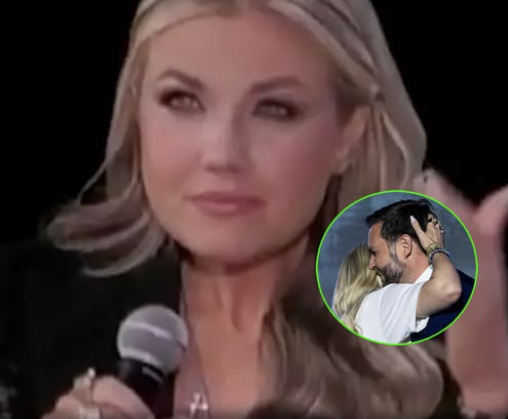
As they embraced, the moment lasted only seconds. To those in the room, it looked like exactly what it was: two people acknowledging grief, responsibility, and the difficulty of standing upright in front of an audience while carrying private pain. To the internet, however, it became something else entirely.
Clips circulated rapidly. The footage was cropped, muted, replayed in slow motion. Viewers fixated on Erika’s hand briefly resting on the back of JD Vance’s head, on the placement of his arms, on the length of the hug. Comment sections filled with speculation, judgment, and accusations. A moment of mourning was reframed as scandal.
Weeks later, speaking at a sold-out “Megyn Kelly Live” event in Phoenix on November 22, Erika addressed the controversy directly. Calm, composed, and visibly tired, she explained that the gesture many found controversial was not unusual for her. Touch, she said, is how she expresses care. Placing her hand on the back of someone’s head is something she associates with blessing, comfort, and faith. It was instinctive, not performative.
She reminded the audience that the people who know her personally understand this about her. They have seen her hug friends, family members, and colleagues in the same way during moments of pain. For her, physical reassurance is not a signal of romance or impropriety; it is a language of compassion.
Erika also offered a quiet but pointed observation: people who feel compelled to attack a hug might be revealing more about their own unhappiness than about her intentions. In a culture driven by outrage cycles, emotional projection, and social media algorithms designed to reward conflict, empathy often becomes collateral damage.
Beyond the hug itself, Erika used the event to share deeper layers of her grief. At just 37 years old, she is raising two young children while carrying the expectations of leadership, public scrutiny, and unresolved loss. She spoke openly about her hope, before Charlie’s death, that she might be pregnant. The couple had dreamed of a larger family, of four children, of a future that now exists only in memory. That longing, she explained, intensified the emotional volatility of the weeks following his death.
When she stood on stage beside JD Vance, she wasn’t simply a political figure or a CEO participating in a high-profile event. She was a woman bracing herself in public while her private world remained fractured. Praise, encouragement, and applause could not undo that reality.
The online response did not soften even after her explanation. Commentators continued to speculate about JD Vance’s marriage to his wife, Usha, despite no evidence of strain. Some went further, predicting future divorce or inventing narratives of secret relationships, all based on a few seconds of video stripped of context. It was an example of how quickly digital culture turns human moments into entertainment, especially when they involve grief, power, and recognizable names.
In the midst of the speculation, a professional lip reader, Nicola Hickling, was asked to analyze the footage. Her interpretation aligned closely with Erika’s account. According to Hickling, JD Vance appeared to tell Erika he was proud of her during the embrace. Erika’s response, she concluded, was not flirtatious or suggestive, but devastatingly honest: “It’s not going to bring him back.” The exchange, as interpreted, underscored loss rather than intimacy.
While public attention remained fixated on the hug, Erika attempted to redirect focus to what mattered most to her: accountability and justice. She has been vocal about the upcoming trial related to her husband’s killing, arguing that if her life and grief are subject to public examination, then the legal process surrounding Charlie’s death should be transparent as well. Her call for media access to the courtroom reflects frustration with selective visibility — where suffering is broadcast, but accountability remains obscured.
For many observers, especially older Americans accustomed to a time when grief was not endlessly replayed online, the episode feels emblematic of a broader cultural shift. Private sorrow has become public content. Gestures of comfort are scrutinized through political lenses. Viral narratives often overpower reality.
Inside the Phoenix venue, away from the noise of social media, Erika’s message was grounded and restrained. She did not ask for absolution or agreement. She simply explained who she is, what she lost, and why that hug meant something very different to her than it did to strangers online.
Her story sits at the intersection of grief, media ethics, political culture, and modern celebrity. It highlights the cost of living through tragedy in an age of constant surveillance and instant judgment. It also serves as a reminder that behind every viral clip is a person navigating a reality far more complex than a headline, hashtag, or trending debate can convey.
In a digital economy built on attention, moments like Erika Kirk’s hug with JD Vance reveal how easily humanity is flattened into controversy. Yet beneath the noise remains a simple truth: grief does not follow scripts, and comfort does not always look the same to everyone. Sometimes, what the world calls scandal is simply a human being reaching for stability while everything familiar has fallen away.