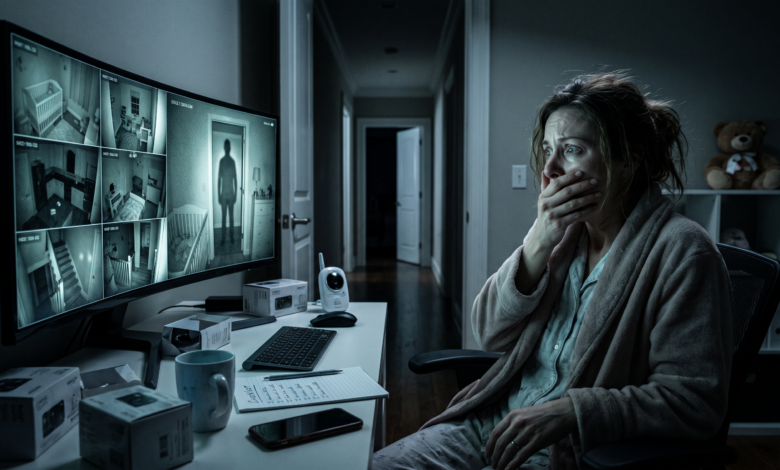
I hid 26 cameras to catch my lazy nanny, but at 3:…
I hid 26 cameras to catch my lazy nanny, but at 3:00 a.m., I saw my husband enter the baby’s room wearing black gloves. The nanny wasn’t sleeping. She was hiding inside the closet, covering my son’s mouth so he wouldn’t cry. And right behind my husband came my mother-in-law carrying a medical bag.
“Mom…”
The word came through the camera speaker so softly that for one second I thought my mind had invented it.
The little boy in the basement was sitting inside a rusty crib like an animal someone had forgotten to release.
His hair was dark.
His face was thin.
His pajamas were too small at the wrists.
But his eyes…
God.
His eyes were Matthew’s eyes.
My eyes.
I stared at the phone until the screen blurred.
Behind me, Matthew was crying in Rosa’s arms.
Spencer whispered my name.
“Valerie.”
I turned slowly.
No one moved.
Not Spencer.
Not Eleanor.
Not the doctor.
Not Rosa.
The nursery, with its pale blue walls and expensive white furniture, suddenly looked like a stage set built over a grave.
“What is that?” I asked.
My voice did not sound like mine.
Spencer lifted both hands.
“Valerie, listen to me.”
I stepped back.
“No. What is that?”
Eleanor closed the medical case with a sharp click.
“That,” she said coldly, “is what happens when weak women are told too much.”
Rosa tightened her arms around Matthew.
“Run, ma’am.”
But my legs would not move.
The little boy on the screen pressed both hands to the bars of the crib.
His lips trembled.
“Mom… please…”
Something broke inside me.
Not fear.
Not confusion.
Something older.
Deeper.
A pain I had carried without knowing its name.
Five years earlier, I had woken in a private hospital room with my body empty and my husband sitting beside me, crying into his hands.
He told me our baby had been stillborn.
A boy.
He said I had almost died.
He said the doctors had done everything they could.
He said Eleanor had handled the funeral because I was too fragile to see him.
I never held him.
I never saw his face.
I was told it would destroy me.
For years, I dreamed of a baby crying somewhere beneath the floor.
Spencer called those dreams trauma.
Eleanor called them hysteria.
A psychiatrist Spencer hired called them postpartum psychosis.
And now, on my phone, a five-year-old boy with my eyes was whispering Mom from a basement I was never allowed to enter.
I looked at Spencer.
“What did you do?”
His face crumpled.
“Valerie, I can explain.”
“No.”
I pointed at the screen.
“You told me he died.”
The doctor moved toward the door.
Rosa raised the knife.
“Don’t.”
The man froze.
Eleanor’s expression sharpened.
“You stupid maid,” she hissed.
Rosa’s cheek was red from the slap, but her eyes did not lower.
“I’m done being scared of you.”
Spencer turned on her.
“You were paid to help with the baby, not destroy this family.”
Rosa laughed through tears.
“Family? You keep one child locked in a basement and bring needles for the other.”
Matthew screamed again.
The sound snapped me back into my body.
I lunged toward Rosa and took my baby from her arms.
He clung to me so hard his little fingers dug into my nightgown.
His face was wet.
His breath came in tiny panicked hiccups.
I pressed him to my chest and backed toward the hallway.
“Move,” I said.
Spencer stepped in front of me.
“Valerie, don’t make this worse.”
“Worse?”
I almost choked on the word.
“My dead baby is alive in your basement.”
Eleanor’s voice cut through the room.
“Because he was never supposed to survive.”
Silence.
Even Spencer flinched.
The doctor shut his eyes.
Rosa whispered, “Jesus.”
I stared at Eleanor.
She looked calm now.
Almost relieved.
Like the mask had finally become too heavy and she was grateful to take it off.
“What did you say?” I asked.
Eleanor looked at Matthew.
Then at me.
“You Montgomery women are chosen for beauty, not strength. That was your purpose. Give the family heirs. Smile beside my son. Keep the bloodline clean.”
My stomach turned.
“Bloodline?”
“Spencer was born with a condition,” she said.
“Mother,” Spencer warned.
But Eleanor ignored him.
“A rare one. Manageable with the right treatment. Expensive, private, inconvenient. We controlled it for years.”
The doctor whispered, “Mrs. Montgomery, stop talking.”
She snapped her head toward him.
“You stopped having morals the day you accepted my money, Dr. Voss.”
Dr. Voss went pale.
I looked at Spencer.
“What condition?”
He did not answer.
“What condition, Spencer?”
His mouth opened.
Nothing came out.
Eleanor answered for him.
“A blood disorder. Degenerative. His bone marrow began failing again six years ago.”
My arms tightened around Matthew.
I understood before she finished.
No.
No.
No.
“Our first child was conceived because he was a match,” Eleanor said.
My knees weakened.
Rosa stepped close behind me as if ready to catch me.
“You had a baby with me to use him as a donor?”
Spencer’s face twisted.
“I loved you.”
I recoiled.
“You made me carry a child for parts.”
“No,” he said desperately. “No, it wasn’t supposed to be like that. We only needed cord blood at first. That was safe. It was supposed to be safe.”
Eleanor’s lips thinned.
“But the first boy was weak.”
I looked at the camera feed.
The child in the basement gripped the crib bars.
Weak.
Not dead.
Weak.
“What is his name?” I whispered.
No one answered.
I screamed it.
“What is his name?”
Rosa spoke softly.
“Oliver.”
The name hit me like a memory I had been forbidden to keep.
Oliver.
I had chosen that name when I was seven months pregnant.
Spencer said it was old-fashioned.
Eleanor said Montgomery boys needed strong names.
But I loved it.
I used to whisper it when I was alone.
Oliver.
My first son had a name.
And someone had kept it alive.
“How do you know that?” I asked Rosa.
She looked toward Eleanor with pure hatred.
“Because he told me. Because I feed him when they forget. Because I clean him when they leave him sick. Because I was not hired for Matthew first.”
I stared at her.
“What?”
Rosa’s eyes filled.
“I was hired three years ago for the basement.”
The room spun.
“You knew?”
“I didn’t know at first,” she sobbed. “They told me he was a relative’s child. They told me he had severe developmental issues and could not be seen. Then he started calling for you. He had a blanket with your initials. He knew songs you said you sang when you were pregnant.”
I could barely breathe.
“I tried to tell you,” she said. “But they watched me. They threatened my family. They took my passport for months even though I’m a citizen. They said they’d ruin my brother’s immigration case. I started recording everything because I knew one day I’d need proof.”
Eleanor rolled her eyes.
“Poor little Rosa. Always so noble.”
Rosa pointed the knife at her.
“You starved him.”
“He is alive.”
“You call that alive?”
Eleanor’s gaze turned icy.
“He served his purpose.”
I made a sound I did not recognize.
Spencer stepped toward me.
“Valerie, listen. Oliver’s cord blood helped me. It worked for a while. But then I relapsed. Dr. Voss said another compatible sibling could help.”
I looked down at Matthew.
My six-month-old baby.
The hospital bracelet.
Donor Patient.
The syringes.
The commitment papers.
Everything clicked into place.
“You were going to take Matthew.”
Spencer’s eyes filled.
“I was dying.”
“You were going to take my baby in the middle of the night.”
“It wasn’t going to kill him.”
The doctor spoke, voice shaking.
“The procedure was unauthorized. I told them the risk increased without hospital oversight.”
I turned on him.
“And yet you came with a medical bag at 3:00 a.m.”
He looked away.
Coward.
All of them.
Cowards wrapped in wealth.
Eleanor lifted her chin.
“You are being dramatic. Matthew would recover. Spencer would live. The family would continue.”
“And me?”
She smiled faintly.
“You were going to rest somewhere safe.”
“The commitment papers.”
Spencer reached for me.
I jerked away.
“You were going to lock me away.”
“Only until you stabilized.”
“Until I stopped asking questions.”
He cried then.
Actually cried.
“Valerie, I was scared. My mother handled things. She said it was the only way.”
I stared at the man I married.
The man who kissed my forehead while planning to steal our baby from his crib.
The man who watched me mourn a son he knew was alive.
The man who let me believe grief had broken my mind.
“You let me bury air,” I whispered.
His face collapsed.
“They told me you couldn’t handle it.”
“You told me my baby died.”
“I was trying to protect you.”
“No,” I said. “You were protecting yourself.”
That was when Eleanor moved.
Fast.
She grabbed the silver medical case and swung it toward Rosa’s hand.
The knife clattered to the floor.
Dr. Voss bolted for the hallway.
Rosa lunged after him.
Spencer reached for Matthew.
I screamed.
The next seconds shattered into pieces.
Rosa tackling Dr. Voss near the nursery door.
Matthew wailing against my chest.
Eleanor shouting for security as if this were a board meeting and not a crime scene.
Spencer grabbing my wrist.
Me twisting away.
The phone falling.
The basement feed still glowing on the screen.
Oliver watching everything through the hidden camera.
Then a voice boomed from the hallway.
“Beverly Hills Police! Hands where I can see them!”
For one stunned second, everyone froze.
Three officers rushed in.
Then two more.
Behind them was a woman in a dark blazer holding up a badge.
“FBI.”
Eleanor’s face drained of color.
Rosa collapsed against the wall, sobbing.
Spencer released me instantly.
I stumbled backward with Matthew.
An officer stepped between us.
“Ma’am, are you Valerie Montgomery?”
I nodded, shaking so hard I could barely stand.
“Your nanny called 911 and an emergency child endangerment tip line thirty minutes ago. We also received live video evidence.”
Rosa.
Rosa had not just recorded.
She had acted.
The FBI agent looked at Eleanor, Spencer, and Dr. Voss.
“No one leaves.”
I grabbed her sleeve.
“The basement,” I gasped. “My son is in the basement.”
The agent’s eyes sharpened.
“Where?”
I pointed toward the hallway.
“There’s a locked service staircase behind the wine room.”
Eleanor laughed suddenly.
A brittle, insane sound.
“You have no warrant.”
The FBI agent looked at her.
“Ma’am, we have probable cause, exigent circumstances, live evidence of a child confined in the residence, and a crying infant wearing a donor label in an unauthorized medical setting. I would choose silence carefully.”
For the first time since I had known her, Eleanor Montgomery shut her mouth.
The house exploded with movement.
Officers spread through the hallway.
One stayed beside me.
Another cuffed Dr. Voss.
Rosa kept repeating, “The boy is downstairs. Please hurry. He gets scared when strangers come.”
I followed them.
They tried to stop me, but I screamed until the FBI agent looked at me and said, “Let her come, but keep her behind us.”
Matthew was still in my arms.
I should have handed him to someone.
I could not.
Not after seeing the bracelet.
Not after seeing the needles.
I carried him down the marble stairs, past the wine room Spencer always said was temperature-controlled and private.
There was a keypad hidden behind a framed photograph of Spencer’s grandfather.
The agent ordered Eleanor to give the code.
She refused.
An officer brought a battering ram.
The first hit shook the wall.
The second cracked the frame.
The third broke the door inward.
The smell hit us first.
Damp air.
Bleach.
Medicine.
Old food.
A child’s trapped breath.
The basement corridor was narrow and white, lit by harsh fluorescent lights.
Not a storage room.
Not a wine cellar.
A hidden clinic.
There were cabinets.
A small hospital bed.
A rolling tray.
A refrigerator with medical labels.
And at the far end, behind a half-open door, the rusty crib from the camera feed.
The little boy was standing inside it, clutching the bars.
His eyes locked on me.
He did not run.
He did not cry.
He simply whispered again:
“Mom?”
My legs gave out.
The officer caught my elbow.
Matthew cried.
The little boy stared at the baby in my arms.
Then at my face.
I stepped forward slowly.
“Oliver?”
His mouth trembled.
No one had called him that in front of me for five years.
“Oliver,” I said again, breaking.
“My baby.”
His face crumpled.
“Mom.”
I reached the crib and tried to lift him.
He flinched.
That nearly killed me.
My own child flinched from his mother because he had learned that hands meant pain.
I stopped immediately.
“It’s okay,” I whispered. “I won’t hurt you.”
Rosa came behind me, crying.
“Sweetheart, it’s okay. She’s your mom. I told you she was real.”
Oliver looked at Rosa.
Only then did he release one bar.
“Rosa stays?” he asked.
Rosa covered her mouth.
“Yes,” I said. “Rosa stays.”
I handed Matthew to the FBI agent without even thinking.
Then I reached slowly for Oliver again.
This time, he let me touch his arm.
He was so thin.
Too thin.
His bones felt like bird bones beneath the sleeve of his faded pajamas.
I lifted him out of the crib.
He weighed almost nothing.
Five years old.
My son.
My firstborn.
Alive.
I pressed him to my chest and made a sound that did not belong to language.
Oliver stiffened at first.
Then his tiny hands clutched my nightgown.
“Mom smells like flowers,” he whispered.
I broke completely.
Because when I was pregnant with him, I used lavender oil every night.
I thought no one remembered.
But some part of him had.
Some part of my baby had remembered me from before the lie.
The officers searched the basement.
They found files.
Blood type charts.
Procedure schedules.
Sedation logs.
Pediatric restraints.
Photos of Oliver as an infant with medical tubes attached to him.
A birth certificate I had never seen.
And a death certificate.
Both with his name.
Oliver Matthew Montgomery.
Born alive.
Declared deceased two days later.
No burial record.
No body.
No grave.
Just paper.
Paper that let rich people turn a living baby into a secret.
Dr. Voss began talking before they even got him into the car.
Cowards always do when the powerful stop protecting them.
He said Eleanor arranged everything.
He said Spencer consented.
He said the first procedure was done shortly after birth.
He said Oliver had complications afterward, so they kept him hidden.
He said Eleanor feared scandal.
He said Valerie was emotionally fragile and would not understand.
I heard pieces while wrapped in a blanket on the front steps, holding one son while a paramedic examined the other.
Emotionally fragile.
That phrase again.
The label they had prepared for any woman who might object to having her child stolen.
Spencer was brought outside in handcuffs.
He looked at me like a drowning man.
“Valerie.”
I did not move.
Oliver hid his face in my shoulder.
Matthew slept against a paramedic’s chest, exhausted from crying.
“Valerie, please,” Spencer said. “I didn’t want it to happen like this.”
I stared at him.
“How did you want it to happen?”
He wept.
“I wanted to live.”
“And Oliver?”
He looked at our son.
Our son.
The child he had sacrificed, hidden, and used.
“I loved him,” Spencer whispered.
Oliver began trembling.
I covered his ear.
“No,” I said. “You loved what he could do for you.”
Spencer shook his head desperately.
“I was sick.”
“So was he.”
“Mother said—”
I stepped closer.
For a moment, I saw not my husband, but a frightened boy raised by Eleanor Montgomery to believe survival mattered more than morality.
But pity was not forgiveness.
And sickness was not innocence.
“You let me mourn him.”
Spencer sobbed.
“You let me think I failed as a mother.”
“I’m sorry.”
“You were going to do it again to Matthew.”
He had no answer.
An officer guided him toward the car.
Eleanor passed next.
Still elegant.
Still upright.
Still trying to look above disgrace.
When she saw Oliver in my arms, her mouth curled.
“That boy would have had nothing without this family.”
I kissed Oliver’s hair.
“He had nothing because of this family.”
Her eyes cut into me.
“You think you can raise them alone?”
Rosa stepped beside me.
“She won’t be alone.”
Eleanor looked at Rosa as if she were dirt.
“You ruined yourself for a woman who would never have noticed you.”
Rosa lifted her bruised chin.
“She noticed tonight.”
The FBI agent put Eleanor into the car.
The door closed.
For the first time in years, the house went quiet.
Not peaceful.
Never peaceful again.
But the kind of quiet that comes after a scream has finally been heard.
At the hospital, Oliver refused to let anyone touch him unless Rosa was in the room.
I did not resent it.
I wanted to.
God help me, for one painful second I wanted to be the person he trusted most.
But I had not been there.
Not because I abandoned him.
Because they stole him.
Still, his body did not know that yet.
His body knew Rosa’s hands.
Rosa’s whispered songs.
Rosa sneaking him fruit.
Rosa standing between him and the doctor.
So I sat beside his bed and learned my son slowly.
He liked apple juice but only if the straw was blue.
He hated white blankets.
He counted ceiling lights when he was scared.
He knew some letters because Rosa had taught him with cereal boxes.
He thought outside meant the garden visible from a small basement window.
He had never seen the ocean.
He had never had birthday candles.
He had never slept in a room where the door stayed open.
Matthew was admitted too, checked thoroughly, protected under emergency custody procedures.
The hospital placed security outside both rooms.
A social worker came.
Then another.
Then a child trauma specialist.
Then lawyers.
Then detectives.
The world that had ignored Oliver for five years suddenly crowded around his bed with clipboards.
He hated it.
So I made a rule.
No one entered without telling him their name.
No one touched him without permission.
No one called him “the child from the basement.”
His name was Oliver.
I said it every chance I got.
Oliver wants water.
Oliver is tired.
Oliver said no.
Oliver needs Rosa.
Oliver is my son.
On the second night, after Matthew finally fell asleep in a bassinet beside me, Oliver woke screaming.
Not crying.
Screaming.
His thin body arched off the hospital bed as if invisible hands were holding him down.
“No bag! No bag! I’ll be quiet!”
I ran to him.
Rosa was already there.
She climbed onto the bed and held out her hands, not grabbing him.
“Oliver, look. Look at me. No bag. No procedure. No basement.”
His eyes were wild.
Then they found me.
He froze.
“Mom?”
“I’m here.”
“Is she coming?”
“No.”
“Grandmother?”
The word made my stomach turn.
“No. Eleanor will never touch you again.”
He stared at me, trying to decide if mothers could make promises stronger than locked doors.
“Promise?”
I wanted to say yes without hesitation.
But I had already learned what false safety costs.
So I said:
“I promise I will fight every day to keep you safe. And there are police outside. And Rosa is here. And Matthew is here. And you can scream if you’re scared. No one will punish you for screaming.”
His lower lip trembled.
“I can be loud?”
I broke.
“Yes, baby. You can be loud.”
He inhaled.
Then he screamed.
Not from terror this time.
From testing the world.
A loud, sharp, furious scream.
No one came to hurt him.
No one covered his mouth.
No one opened a medical bag.
Rosa started crying.
I did too.
Oliver screamed again.
Then he laughed.
It was small and strange, like a sound his body had forgotten how to make.
Matthew woke and began crying.
Oliver stopped immediately, frightened.
I picked Matthew up.
“He’s okay. Babies cry.”
Oliver watched him.
“They don’t take him?”
“No.”
“Even if he cries?”
“Especially if he cries. Crying means he needs us.”
Oliver looked down at his own hands.
“When I cried, she said I was bad.”
I sat beside him, holding Matthew.
“You were never bad.”
His eyes filled.
“I was loud.”
“Good.”
He looked confused.
I smiled through tears.
“Montgomery boys are allowed to be loud now.”
For the first time, Oliver smiled at me.
Just a little.
But it was enough to keep me breathing.
The investigation became national news within forty-eight hours.
Beverly Hills heiress discovers presumed-dead son hidden in basement.
Private doctor accused in illegal pediatric procedures.
Montgomery family under federal investigation.
Billionaire household donor child scandal.
They used words that sounded too clean.
Scandal.
Case.
Allegations.
They did not smell the basement.
They did not feel Oliver flinch when someone dropped a metal tray.
They did not see Matthew’s hospital bracelet with Donor Patient taped over his name.
They did not know what it was to stare at your living child and remember the funeral you were never allowed to attend.
My lawyer, Dana Whitcomb, told me not to watch the news.
I watched anyway.
I watched Eleanor’s friends say she was a generous philanthropist.
I watched Spencer’s attorney describe him as a critically ill man manipulated by medical desperation.
I watched Dr. Voss’s clinic issue a statement about patient privacy.
Then Rosa appeared on the screen.
Not in person.
Through leaked audio from one of her recordings.
Eleanor’s voice filled the broadcast.
“The mother will sign the commitment papers. Once she is declared unstable, custody becomes Spencer’s. The infant can be transferred without interference.”
Then Spencer’s voice:
“And Oliver?”
Eleanor:
“Oliver has already been dead for five years.”
I turned off the television.
The room was silent.
Oliver was asleep.
Matthew too.
Rosa sat in a chair by the window, hands folded tightly in her lap.
“You saved us,” I said.
She shook her head.
“I waited too long.”
“No.”
“I was scared.”
“So was I.”
“I thought you were like them at first.”
That hurt.
But I deserved to hear it.
“I understand.”
“You never came downstairs.”
“I didn’t know there was a downstairs like that.”
“They told me you were fragile. That you didn’t want to remember the first baby. That if Oliver saw you, you would collapse.”
I swallowed.
“They told me he was dead.”
Rosa nodded.
“I know that now.”
She looked at Matthew.
“I started getting careless on purpose.”
“What do you mean?”
“The dirty kitchen. Sleeping on the couch. The trash bags.”
I stared at her.
“You wanted me to suspect you.”
“I needed you to put eyes in the house. I couldn’t place cameras everywhere without them noticing. But you could.”
The black trash bag.
The baby monitor.
The missing blankets.
The couch.
“You were trying to make me catch you.”
She smiled faintly.
“I was trying to make you look.”
I covered my mouth.
All my anger at her.
All my suspicion.
And she had been baiting me toward the truth.
“What was in the trash bag?”
“Medical wrappers. Bloody gauze. A vial label. I wanted you to demand to see it, but Spencer came home early.”
“And the blankets?”
“I took some to Oliver. He was cold.”
I looked at the sleeping boy.
His thin shoulders under the hospital blanket.
“Thank you.”
Rosa’s eyes filled.
“You may hate me later for not telling you sooner.”
“No.”
“You might.”
“Maybe,” I said honestly. “Maybe grief will make me angry at everyone. But I know this: you stood in front of my son with a kitchen knife while his own father came for him with gloves.”
Rosa started sobbing.
I crossed the room and held her.
Not like an employer.
Not like a savior.
Like two women who had survived the same monster from different rooms of the house.
The hardest part was not the police.
Not the lawyers.
Not even the media.
The hardest part was learning how to be a mother to a child who had known me only as a whispered hope.
Oliver did not call me Mom every day.
Sometimes he called me Ms. Valerie because that was what Rosa had called me.
Sometimes he called me nothing.
Sometimes, when he was tired, he called me the wrong thing.
Nurse.
Lady.
Please.
That one hurt most.
Please, as if my name were a request for mercy.
The trauma specialist told me not to rush him.
“Biology is not the same as trust,” she said.
I wanted to hate her for saying it.
But she was right.
So I became patient in ways I had never been before.
I learned to sit near him without asking for touch.
To place food on the table and let him decide when to eat.
To warn him before turning off lights.
To leave doors open.
To let him hide.
To let him come back.
Matthew adjusted faster because he was still a baby.
He reached for me.
Needed me.
Cried for me.
Oliver watched every time.
One afternoon, while I fed Matthew, Oliver stood in the doorway.
“Did you feed me like that?”
The bottle nearly slipped from my hand.
“When you were born?”
He nodded.
I looked at him.
My chest ached.
“I wanted to.”
His face changed.
Not enough.
“Did you hold me?”
“They told me you died before I woke up.”
He looked down.
“Oh.”
I placed Matthew gently in his bassinet and opened a drawer beside the bed.
Inside was the only thing I had from my first pregnancy that Eleanor had not managed to destroy.
A small blue knitted hat.
I had packed it in my hospital bag.
No one had used it.
For five years, I kept it in a box because I thought grief needed one physical object to live inside.
I held it out.
“I made this for you.”
Oliver stared at it.
“For me?”
“Yes.”
He took it carefully, like it might disappear.
“It’s too small.”
“You were too small then.”
He touched the little uneven stitches.
“You kept it?”
“Every day.”
His eyes lifted.
“You didn’t throw me away?”
I dropped to my knees.
“No. Never. Oliver, I thought you were gone, and I still loved you every day.”
His face crumpled.
He came to me then.
Not fully.
Not like a child running into his mother’s arms.
But he leaned forward until his forehead touched my shoulder.
I stayed still.
I barely breathed.
Then his arms went around my neck.
Small.
Frail.
Real.
I held him and silently promised the dead version of myself—the woman who had cried over an empty grave—that I would never let anyone take this child from my arms again.
Spencer tried to call me from jail.
I refused every call.
Then letters came.
Dana read them first.
Most were apologies.
Some were excuses.
A few were manipulations wearing apology’s clothes.
I was dying.
I was afraid.
My mother controlled everything.
You know I loved you.
Please let me see my sons.
My sons.
I burned that one in the sink.
Later, when the criminal case moved forward and I had to face him in court, I thought I would shake.
I did not.
Spencer looked thinner.
Sicker.
His expensive suit hung loose at his shoulders.
For a moment, I saw the man from our wedding.
Handsome.
Soft-spoken.
Smiling as if I had saved him from loneliness.
Then I remembered Oliver in the crib.
Matthew’s donor bracelet.
The commitment papers.
And whatever tenderness remained turned to ash.
He pleaded guilty to several charges after Dr. Voss cooperated.
Not all.
Rich men rarely plead to everything.
But enough.
Eleanor fought harder.
She denied.
She blamed Spencer.
She blamed the doctor.
She blamed Rosa.
She blamed me.
At one hearing, her attorney suggested I had been unstable after Oliver’s birth and that the family had made “difficult private decisions under medical pressure.”
My lawyer stood up.
Then the prosecutor played the basement video.
Oliver, five years old, whispering Mom into the hidden camera.
No one spoke after that.
Not for several seconds.
Even the judge looked down.
Eleanor did not cry.
She never cried where it did not benefit her.
She only stared at the screen with annoyance, as if Oliver had embarrassed her by surviving on camera.
That was the moment I stopped fearing her.
Eleanor Montgomery had wealth, influence, lawyers, and a spine made of ice.
But she had no love.
And people without love always underestimate those who have it.
Rosa testified for three days.
She wore a simple navy dress.
Her hands shook when she described the basement.
She admitted she had stayed too long.
She admitted she had been afraid.
Then she described sneaking Oliver peaches from the kitchen.
Teaching him letters.
Recording Eleanor.
Hiding Matthew in the closet.
Standing with a knife because she had no other weapon.
When the defense attorney tried to paint her as a disgruntled employee seeking money, Rosa looked at him and said:
“If I wanted money, I would have stayed quiet. That house pays very well for silence.”
The jury believed her.
So did I.
After the arrests, I sold the Beverly Hills house.
People thought I would keep it because it was worth a fortune.
I never wanted to see it again.
The basement was sealed by investigators for months.
When I finally had to walk through it one last time, Oliver did not come.
He did not need to.
I went alone with Dana and a detective.
The crib was gone.
The medical bed removed.
The cabinets emptied.
But the room still felt alive with what had happened there.
I stood in the center of it and let myself hate.
Not forever.
Just enough.
Enough to honor the baby I never got to hold.
Enough to honor the boy who survived.
Enough to honor the mother I had been before they called me fragile.
Then I walked out and never returned.
With the money from the sale and assets frozen from Spencer’s accounts, I bought a smaller house near the coast.
Not tiny.
I will not pretend we became poor.
But warm.
Open.
Full of windows.
No basement.
That was my only non-negotiable demand.
No basement.
Oliver chose the color of his room.
Green.
Not pale green.
Loud green.
“Like outside,” he said.
So we painted it the brightest green the store had.
Matthew’s nursery was next door.
Rosa took the room at the end of the hall.
At first, she refused.
“I can’t live with you forever, ma’am.”
I said, “First, stop calling me ma’am.”
She cried.
Then she moved in.
Not as a nanny.
As family, though paperwork took longer than love.
Oliver asked if Rosa was his aunt.
Rosa said, “Only if your mother agrees.”
I said, “Your Aunt Rosa has terrible taste in coffee but excellent survival instincts.”
Oliver laughed.
A real laugh.
The house began to learn our sounds.
Matthew banging toys on the floor.
Oliver screaming just because he could.
Rosa singing in the kitchen.
Me crying in the pantry when the grief came too hard, then wiping my face and coming back out because my sons needed to see that mothers can cry and still return.
Therapy became part of our schedule.
So did court dates.
So did pediatric visits.
Oliver had scars.
Some visible.
Some hidden.
His body had been used before it had been loved properly.
That truth will never stop enraging me.
But his body also healed.
He gained weight.
His hair grew thicker.
His cheeks softened.
He learned the ocean was not a painting.
The first time we took him to the beach, he refused to step on the sand.
Too open.
Too loud.
Too much sky.
So we sat in the parking lot for forty minutes.
Then on a bench.
Then at the edge of the sand.
Then one day, weeks later, he ran straight toward the water and screamed when the waves chased his feet.
A happy scream.
Matthew laughed from my arms.
Rosa filmed it.
I watched Oliver run beneath a sky no one could lock, and I thought:
This is what they stole.
Not just years.
Firsts.
Sunlight.
Cake.
Sand.
Noise.
The ordinary miracles of being a child.
So we gave them back as best we could.
We celebrated every birthday Oliver had missed.
Not all at once.
That would have overwhelmed him.
One month, his first birthday.
A small cake.
One candle.
The next month, his second.
Two candles.
He asked why we were doing it.
I told him, “Because every year you lived matters.”
By the fifth cake, he blew out the candles and said, “Now I’m caught up.”
I smiled.
“Not caught up. Celebrated.”
He thought about that.
Then he said, “Can Matthew have cake too?”
“Matthew has no teeth.”
“Then he can look at cake.”
So Matthew looked at cake.
Very seriously.
As if offended by his own gums.
Life moved forward in pieces.
Some days were beautiful.
Some days were brutal.
Oliver sometimes hoarded food under his bed.
Rosa told me not to shame him.
“Just make the food safe to keep,” she said.
So we placed a small basket in his room with sealed snacks.
One day, months later, he brought it to the kitchen himself.
“I don’t need this today.”
I placed it on the counter.
“Okay.”
He hesitated.
“Maybe tomorrow.”
“Then it’ll be here tomorrow.”
He nodded.
Control, I learned, could be given back in crumbs.
A door left open.
A light kept on.
A snack basket.
A question before a hug.
A choice between blue pajamas and dinosaur pajamas.
People who have never had control taken from them do not understand how holy small choices become.
Matthew grew into a chubby, loud toddler who adored Oliver.
Oliver did not know what to do with that at first.
“Why does he follow me?”
“Because he loves you.”
“He doesn’t know me.”
“He knows enough.”
Matthew’s first word was not Mama.
It was Ollie.
Oliver pretended to hate it.
Then cried in the bathroom.
I sat outside the door.
“Do you want me to come in?”
“No.”
“Do you want me to stay outside?”
A pause.
“Yes.”
So I stayed outside.
After a while, he opened the door.
His eyes were red.
“He said my name.”
“Yes.”
“What if they take him because he likes me?”
I pulled in a breath.
“They won’t.”
“You don’t know.”
He was right.
Children who have known betrayal do not accept easy promises.
So I said, “I have lawyers, police reports, locks, cameras we all know about, and Aunt Rosa’s kitchen knives.”
From the hallway, Rosa shouted, “And I sharpen them.”
Oliver laughed through tears.
Good.
Let him learn that safety could have humor.
Let him learn adults could protect without lying.
The trials ended over two years.
Dr. Voss lost his license and went to prison.
Spencer received a sentence that people argued about online.
Some said too harsh.
Some said too light.
I thought no number of years could equal Oliver’s basement.
Eleanor was convicted on multiple counts.
She remained elegant until the end.
At sentencing, she looked at me and said:
“You would have been nothing without the Montgomery name.”
I stood holding a victim impact statement in both hands.
My voice did not shake.
“The Montgomery name gave me a mansion where my child was hidden beneath my feet. I am raising my sons without it.”
Oliver was not in court.
I would never put him in that room.
But I spoke his name.
Many times.
Oliver.
Matthew.
My sons.
Not donors.
Not heirs.
Not medical opportunities.
Sons.
Afterward, I legally changed their last names to mine.
Valerie Hart.
Oliver Hart.
Matthew Hart.
Rosa joked that we sounded like a family from a children’s book.
Oliver liked it.
“Heart means love,” he said.
“Hart with an A means deer,” Rosa corrected.
Oliver shrugged.
“Then we are fast love.”
We kept it.
Years later, people still asked how I knew to install the cameras.
I always told them the truth.
“I thought I was catching the wrong woman.”
That answer usually made them uncomfortable.
Good.
It should.
Because suspicion can be manipulated.
Because abusers love to point your fear at the person trying to help you.
Because Rosa had been made to look lazy, careless, strange, and guilty while the real monsters wore wedding rings and family pearls.
On the third anniversary of the night everything changed, Rosa, the boys, and I sat in our bright kitchen making pancakes for dinner.
Oliver was eight by then.
Matthew was three.
The pancakes were misshapen.
The floor was covered in flour.
Rosa accused me of ruining breakfast foods.
I accused her of being dramatic.
Matthew wore syrup in his hair.
Oliver laughed so hard he fell off his chair.
The sound filled the house.
Loud.
Messy.
Alive.
Later that night, after Matthew fell asleep, Oliver came to my room carrying the small blue hat I had knitted before he was born.
He kept it on a shelf now.
Not hidden.
Displayed.
“Mom?”
I looked up from folding laundry.
“Yes, baby?”
He crawled onto the bed beside me.
“Did you really hear me on the camera?”
I set the towel down.
“Yes.”
“What if you didn’t?”
My chest tightened.
We had talked about this before.
Trauma asks the same questions many times because the body needs more than one answer.
“Then Rosa would have kept trying. And I would have kept feeling something was wrong. And we still would have found you.”
He thought about that.
“But you did hear me.”
“Yes.”
“Because I said Mom.”
I touched his hair.
“Yes.”
He leaned against me.
“I didn’t know if you were real.”
“I didn’t know you were alive.”
“That’s sad.”
“Yes.”
He looked up.
“But now we both know.”
I smiled through tears.
“Now we both know.”
He stayed quiet for a while.
Then he whispered:
“I’m glad I was loud.”
I pulled him close.
“Me too.”
Down the hall, Matthew snored softly through the baby monitor.
A normal monitor.
Visible.
Discussed.
Chosen by all of us.
No hidden teddy bear cameras anymore.
No secret feeds.
No locked doors.
No medical bags in the night.
Just a mother listening.
A son breathing.
Another son learning to trust the dark.
And a house that belonged to no dynasty, no bloodline, no cruel old woman’s plan.
It belonged to us.
Sometimes, even now, I wake at 3:00 a.m.
My body still remembers.
I reach for my phone.
No alerts.
No motion detected.
No basement feed.
Then I get up anyway.
I check Matthew.
I check Oliver.
I check the hallway.
Not because I am paranoid.
Because I learned the hard way that mothers are often called unstable when they are simply noticing what everyone else wants hidden.
Oliver sleeps with his door half-open.
Matthew sleeps with one foot outside the blanket.
Rosa sleeps down the hall with a baseball bat beside her bed because she says old habits deserve practical furniture.
I stand there in the quiet and let the truth settle around me.
My husband did not save me.
His money did not protect me.
His family name nearly destroyed my children.
The woman I suspected turned out to be the only adult in that house brave enough to fight.
I had hidden twenty-six cameras to catch a lazy nanny.
Instead, they caught a father in black gloves.
A grandmother with a medical bag.
A doctor without a conscience.
A baby labeled as a donor.
And a child who had been buried alive in a basement beneath my grief.
But they also caught something else.
A maid becoming a shield.
A mother waking from a lie.
A stolen son saying one word into the dark.
Mom.
That word found me.
It cut through five years of false mourning, six months of gaslighting, a mansion full of locked doors, and every diagnosis they had prepared to silence me.
It reached me.
And I came.
Not perfectly.
Not soon enough.
But I came.
And when I lifted Oliver from that rusty crib, I understood something no Montgomery would ever understand.
Children are not heirs.
They are not donors.
They are not proof of a family’s power.
They are not tools to keep sick men alive or cruel women in control.
They are souls.
They are voices.
They are little hands gripping the bars of darkness, waiting for someone to believe they are still there.
My son waited five years.
My baby almost became the next sacrifice.
And Rosa, the woman I had been ready to fire, stood between them and the monsters with nothing but a kitchen knife and the truth.
So when people ask me why I trust her with my children now, I tell them:
Because when everyone else in that house wanted my sons silent, Rosa was the one who made sure I heard them.
And every night, before I sleep, I walk past my boys’ open doors and whisper the same promise.
“You can cry here.”
“You can scream here.”
“You can be loud here.”
“And I will always come.”