I Took Mom’s Card to the Bank, Then Saw Richard’s Monthly Deposits
My mother had to use the bank card Richard gave her, and I still hate that I didn’t make her do it sooner.
I was with her when the teller checked the balance. I watched her squeeze the edge of the counter like she was trying not to slide down onto the floor. The teller said there wasn’t $3,000 in the account, then disappeared into the back.
I thought Richard had taken the money. I was already reaching for my mother’s arm when the manager came back with an envelope.
The card had been sitting in a shoebox for five years. That was the part I knew. I didn’t know what Richard had been doing with it.
I was 39 when my parents divorced. Mom was 65 last spring, five years after the divorce, and my brother Daniel and I both had families of our own. I tell myself that explains some things. It doesn’t explain all of them.
The envelope in the shoebox had my mother’s name on it in Richard’s handwriting. It was the first thing I noticed when he gave her the card in the family court hallway.
That hallway smelled like burnt coffee and wet coats. I remember the copier making a grinding noise behind the clerk’s desk. My mother had the divorce papers folded under one arm, and Richard was already walking toward the elevators.
He pressed the bank card into her hand. “This should keep you alive for a few months.”
I was close enough to hear him. I was also close enough to say something useful, and I didn’t. I looked down at the papers because I couldn’t think of a sentence that wouldn’t make a bad scene worse.
Mom closed her fingers around the card. Richard didn’t turn around.
I told myself the card was something. It had $3,000 on it, and Mom had nowhere ready to go. But I also watched her face when he said “keep you alive,” and I knew that money felt less like help than a final insult.
She had spent 37 years with him. She remembered his prescriptions, his work shirts, the names of his cousins, and which bills had to be paid before the late fee. She’d raised us while Richard worked long hours and then heard him call her spending “careless” if she bought herself new shoes.
I knew all that. I still let the card become a thing none of us talked about.
Mom moved into a room above a garage on the West Side. The landlord’s house was out front, and the train rattled the window enough to make the glass click in its frame. I carried her boxes upstairs and said she could stay with us if she wanted.
She said she didn’t want to crowd me.
I said she wouldn’t.
She said, “I’ll be all right, Emily.”
That was our whole talk. I had a toddler then, a job with early shifts, and a husband who was already making tired faces whenever my family needed something. I’m not proud of how quickly I let “I’ll be all right” stand in for a plan.
The first time I saw the shoebox after the divorce, Mom had put it on the kitchen table while I was helping her sort papers. The card was inside a faded envelope with her name written in Richard’s square letters.
I asked if she’d used it.
“No.”
“Not even once?”
“No.”
She didn’t say it sharply. That made it worse. She kept sorting the papers as if the question was about a store coupon.
I offered to take the card to the bank for her. She shook her head and put it back in the box. I didn’t push. At the time, I thought pushing would sound like I was telling her to take money from a man who’d just left her.I also didn’t ask what she’d rather do instead.
The next few years were small problems that kept turning into money problems. Mom cleaned kitchens and bathrooms. She sat with an older woman on weekends. If there was enough left after rent, groceries, and bus fare, she bought the shoes or the medicine she’d been putting off.
I sent grocery gift cards when I could. Daniel paid her phone bill twice. We both knew the help wasn’t enough, but neither of us knew how to ask without making Mom feel watched.
She had a way of making a hard thing sound ordinary. If I asked whether she had lunch, she’d say she’d eaten early. If I asked about her prescription, she’d say she was waiting to see if the pain passed.
One afternoon I stopped by with groceries and found her eating crackers softened in hot water.
She covered the mug with a dish towel, though I’d already seen it.
“I’m just using up what I have,” she said.
I could have asked why she hadn’t called me. Instead, I unpacked the groceries and made a joke about the crackers being older than my son. She smiled. We left it there.
I don’t know why I remember the dish towel. It had a little orange stripe down one side, and Mom had used it since I was a kid. That’s the sort of thing my mind kept. Not the right question.
Richard was still around town. He’d call about paperwork or a box of old tax forms, and Mom would answer. He didn’t come by the garage. He didn’t ask me what she needed. As far as I knew, the $3,000 on the card had been all he meant to give her.
I’d stopped thinking about the card as money. It was an argument they’d already had without us. I figured Mom would use it when she was ready, or throw it out when she wasn’t.
Five years passed. The shoebox stayed on the shelf above her closet.
Then Mom fainted at her front door.
I was at work when the neighbor called. The neighbor said she’d heard the keys hit the concrete and found Mom sitting against the wall. I drove to the hospital, where a nurse checked her blood pressure and asked when she’d last eaten a full meal.
Mom gave the nurse a careful answer. I gave a less careful one.
“She barely eats when money gets tight,” I said.
Mom looked at me. I felt awful, but I didn’t take it back.
The doctor said her blood pressure needed attention and told her not to put off follow-up care. He gave her a prescription and a sheet of instructions. Mom held the paper with both hands, trying to read the small print.
On the drive home, she said the prescription would cost too much.
“I’ll pay for it,” I said.
“You’ve got kids.”
“I know.”
“I don’t want you doing that.”
I was tired, and scared, and I answered too fast. “Then use the card.”
She turned toward the passenger window. I heard myself sounding like Richard, like money was a way to end the conversation.
At home, she went straight to the closet. She pulled down the shoebox and opened the lid. The card was still there, under the divorce papers and two school photos of Daniel and me.
She took it out, looked at the raised numbers, and rubbed one corner with her thumb.
“I can go with you,” I said.
“I know how to use a bank.”I nodded. I didn’t argue.
The next morning she put on her cleanest sweater and tucked the card into her purse. I drove her to the branch because I didn’t want her taking the bus while she was still weak. She said she could manage the bus. I said I was going that way anyway.
We both knew I wasn’t.
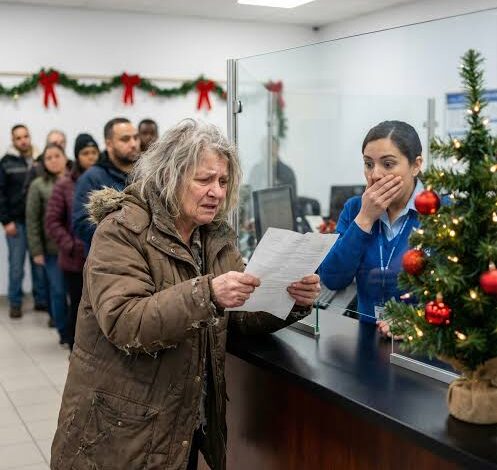
At the bank, the air felt too cold after the car. Mom’s shoes squeaked on the tile. A clock above the lobby showed 10:42 when she joined the line, and I remember because she kept looking at it instead of at the other people.
She’d brought her hospital papers in the same purse as the card. The corners were bent from being folded and unfolded.
When it was her turn, she handed the card to a young teller and asked to withdraw the whole balance. The teller smiled, typed, then stopped smiling.
She turned the card over. She asked Mom to confirm her full name and checked her ID.
“Ma’am, there isn’t $3,000 here.”
Mom’s fingers tightened around the strap of her purse.
“How much is there?” she asked.
The teller didn’t answer right away. She looked toward the manager’s office and called for help.
I was already thinking about Richard. I thought he’d drained it years ago and left the card with Mom because he wanted to make her feel safe for a few weeks. That was the worst version, and I believed it before I had proof.
Mom kept her eyes on the little flag beside the pen cup. I reached for her sleeve. She moved her arm away, not hard, just enough to tell me she didn’t want comforting yet.
The manager came out holding a sealed envelope. My mother’s name was written across it.
I looked at the envelope, then at Mom. She looked smaller than she had in the hallway five years earlier, but she was still the one deciding whether to take it.The manager set it beside the card. He said Richard had opened the account at that branch and left the envelope with the bank. He’d asked them to give it to Mom if she ever came in to use the card.
It was an odd thing to arrange. The manager said the bank had kept it in the account file, not as any special service, just because Richard had been clear that it was meant for her. He’d also said not to call her.
Mom looked at the envelope but didn’t touch it.
“Did he take the money?” I asked.
The manager said he’d check the account. He went back to his desk, and the teller turned her screen slightly so he could see it. I couldn’t read anything from where I stood.
Mom leaned close to me. “I didn’t want to come here.”
“I know.”
“I kept thinking it was all I was worth.”
I had no answer for that. I wanted to tell her she was worth more, obviously. But “obviously” wouldn’t change what Richard had put in her hand.The manager came back. He said the original $3,000 was there, along with regular deposits made over the past five years. The balance was $20,486.31.
Mom looked at the card again. I heard myself say, “He’s been putting money in?”
The manager nodded. Every month, on the same date, a deposit had gone into the account. Richard had made the first one a month after the divorce. He had not used the card.
Mom sat down in the chair beside the counter. She kept her purse in her lap and the card in her hand. She didn’t cry. Her mouth moved once before she spoke.