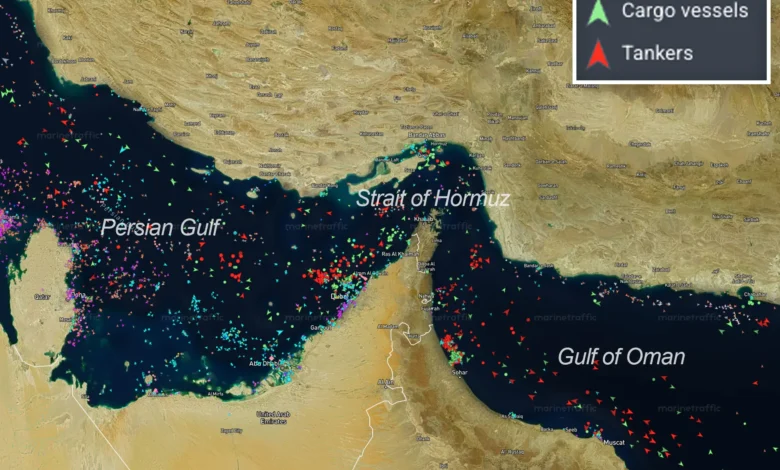
Iran declares the Strait of Hormuz closed again after US lifts blockade
Iran re-closed the Strait of Hormuz Friday instead of coming to Switzerland to engage in nuclear negotiations, citing Israel’s refusal to leave Lebanon and US forces’ ongoing presence in the region.
In a statement read over maritime radio channels, the Islamic Revolutionary Guard Corps said the US was in violation of the memorandum of understanding between the two countries, which President Trump and Iranian President Masoud Pezeshkian signed Wednesday.
“Since Israel’s withdrawal from Lebanon, the complete lifting of the naval blockade, and the withdrawal of American terrorist forces from the Persian Gulf and the region are among the main conditions of the agreement between Iran and the United States, the Strait of Hormuz will remain closed until these conditions are met,” it said. “All ships are requested, for the sake of their security and safety, not to approach the Strait of Hormuz. Any vessel that defies this directive will be targeted.
TEHRAN — In a dramatic escalation that has sent shockwaves through global energy markets, Iran has officially reversed its decision to open the Strait of Hormuz, declaring the vital maritime chokepoint closed once again. The move comes less than 24 hours after Tehran briefly relaxed restrictions, citing the United States’ refusal to lift its ongoing naval blockade on Iranian ports as the primary reason for the reversal.The Iranian Joint Military Command issued a stern warning to international shipping, stating that control over the waterway has “returned to its previous state under strict management and control of the armed forces.” Tehran emphasized that no commercial traffic will be allowed free passage until Washington completely halts its aggressive naval operations targeting Iranian trade.
A Fragile Truce UnravelsThe brief window of hope opened when Iranian authorities announced that the Strait of Hormuz would be accessible to commercial vessels to coincide with a separate ceasefire agreement. However, the goodwill gesture quickly collapsed.According to reports from Al Jazeera, the U.S. administration clarified that its strict naval blockade—instituted by United States Central Command (CENTCOM) to intercept cargo heading to and from Iran—would “remain in full force” until a comprehensive, finalized peace deal is reached.Tehran immediately condemned the continued U.S. presence, labeling the blockade an act of “maritime piracy” and a direct violation of the fragile diplomatic understandings brokered by international mediators in Pakistan.Statement from Iranian Military Command: > “The Islamic Republic will not tolerate a one-sided arrangement where our economic lifelines are choked while global commerce enjoys unhindered access. The Strait of Hormuz will remain closed to any vessel linked to the U.S. and its allies until our ports are freed from foreign encirclement.”Economic Chokehold and Global ImpactThe Strait of Hormuz is widely considered the world’s most critical energy transit route, carrying roughly 20% of the world’s petroleum and liquidity of liquefied natural gas (LNG).
The sudden re-closure threatens to trigger another volatile spike in global oil prices, which have already seen unprecedented fluctuations since the onset of the 2026 regional conflict.Shipping firms and maritime insurers are bracing for renewed instability. Several merchant ships attempting to approach the strait have reported receiving aggressive warnings from the Iranian Revolutionary Guard Corps (IRGC), forcing multiple tankers to drop anchor or completely divert their courses.MetricEstimated Impact of ClosureGlobal Petroleum Transit~20% of world supply haltedStranded Shipping TrafficHundreds of commercial vessels delayed in the Persian GulfMarket ReactionImmediate volatility in Brent Crude and LNG futuresDiplomatic Push Continues Amidst TensionsDespite the volatile back-and-forth in the waters of the Persian Gulf, diplomats involved in the mediation efforts state that high-level talks are not entirely dead. Mediators are scrambling to align the timelines of a U.S. blockade lift with an official Iranian stand-down in the strait.However, with both Washington and Tehran holding firm to their respective red lines, the maritime standoff remains a highly dangerous flashpoint capable of plunging the region back into an open military confrontation.