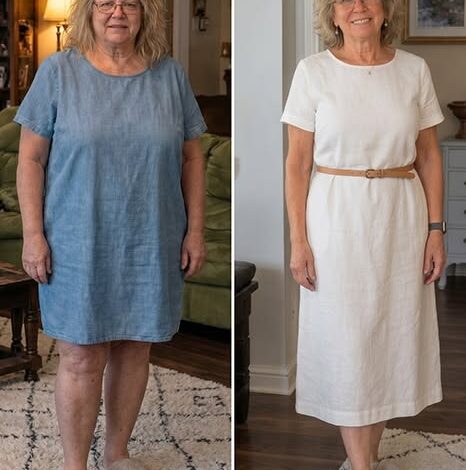
My 70-Year-Old Mom Had Surgery for Her Birthday—But When She Came Home, She Discovered Dad Had Removed Every Mirror from Their Bedroom.
For years Evelyn had lived with back and shoulder pain. By sixty she could not stand long at the kitchen counter. By sixty-eight buying a bra had become an ordeal that left deep grooves in her shoulders. She had talked about breast reduction for a long time but always found a reason to wait. Shortly before her seventieth birthday she decided she had waited long enough.
Her husband Thomas objected at once. “You’re perfect the way you are.” Evelyn lost patience. She was not doing it because she thought she was ugly. She wanted to garden without aching shoulders and make dinner without sitting down halfway through. She was not trying to look thirty. She was trying to enjoy being seventy.
The surgery went smoothly. Two nights later her daughter brought her home. Thomas met them in the driveway, unusually attentive, asking if the seat belt hurt, if she was dizzy, if she needed water. When they reached the bedroom Evelyn stopped. The large mirror above the dresser was gone. So was the full-length mirror beside the closet. Even the small oval vanity mirror she had owned since before they married had disappeared.
Thomas said she did not need the mirrors yet. The surgeon had warned her she would be bruised and swollen; more tissue had come from the left side. He did not want her to come home, see herself, and panic.
Then her sister Joanne appeared—unannounced, an hour away, looking worried. Evelyn sat on the edge of the bed and demanded the truth.
While her daughter was driving to the hospital, the surgeon’s office had called Thomas. The tissue removed during the reduction had been sent routinely to pathology. One area from the left breast looked unusual enough to need closer testing. There was no diagnosis. No one had said cancer. They simply needed more time.
Thomas had heard only that something unusual had been found. He panicked. He called Joanne. He searched an old box of family photographs. And he took down every mirror.
He showed Evelyn a picture of her own mother, Margaret, after a mastectomy when Evelyn was seventeen. No one had explained anything to the daughters then. Relatives whispered in the kitchen and stopped talking whenever the girls walked in. Evelyn had learned the truth only by walking into her mother’s bedroom while she was changing. Everyone thought they were protecting them.
Thomas had looked at that photograph and imagined Evelyn seeing the asymmetry after surgery and immediately thinking of her mother. Removing the mirrors, he believed, might give her a little time.
Evelyn asked for the small oval mirror. Thomas hesitated. She cut him off. “Don’t look. Don’t ask. Don’t worry. Let somebody else decide what you can handle.” She was seventy years old. She wanted the mirror.
She looked. The difference was noticeable. Bruising. Bandages. One side slightly smaller. “It looks awful,” she said. Joanne shrugged: she had had surgery two days ago; she was allowed to look awful. Evelyn laughed, then cried. “I look like her.”
She had spent her whole life wondering if she would get it too. She had gone to every screening calmly and treated mammograms like ordinary appointments. Fear did not always look frightened. Sometimes it looked practical. Sometimes it looked like never speaking about the thing that scared you most.
Thomas crouched in front of her. When the office called, all he could think about was her mother. Evelyn told him he could not protect her from being scared. He needed to be scared with her, not for her, and then decide what she was allowed to know.
The next morning she called the surgical office herself, notebook open, asking exactly what pathology had found, why more testing was needed, and what would happen if it turned out malignant. The answer was the same for everyone: they wait.
Four days later the call came. Benign. Evelyn closed her eyes. “Thank you.”
That evening Thomas rehung every mirror. Evelyn placed her mother’s photograph beside the little oval one on the dresser. For decades the picture had lived in a shoebox and represented everything cancer could take away. Now it reminded her of everything that could still come afterward: swimming that summer, the garden, dancing at Joanne’s wedding in a blue dress, complaining about her daughter’s cooking for another twenty years.
Weeks later the swelling had gone down. Evelyn stood in front of the dresser, rolled her shoulders, and smiled. Her back was better—enough that she was annoyed she had waited so long. Thomas no longer told her she was perfect or beautiful or what she should see. He simply asked how she felt.
“Like I’m seventy,” she said. “And like I finally did something good for myself.”
Beside her reflection sat the old photograph of Margaret after her mastectomy, smiling between her daughters. The picture had not changed. What it meant had. And Thomas had finally learned that love was not hiding every frightening reflection before someone had the chance to see it. Sometimes love was simply standing beside them while they looked—and refusing to turn away.