My In-Laws Gave Their Other Three Children $20,000 for Houses and Gave Us Only a Card Two Years Later, We Bought the Old Miller Place for $41,500
The envelopes were tucked under the Easter plates. One at every place setting. Each with a name written on it in my mother-in-law’s round schoolteacher handwriting.
Kim opened hers first.
She’s the oldest. Divorced two years. Raising two boys in a rented trailer behind the grain elevator. She looked at what was inside the envelope and put her hand flat over her mouth.
Then Jeff opened his. He’d been laid off from the Caterpillar plant in the fall. He was driving a propane truck part-time now. He read his, and he looked up at his father, and he couldn’t get a single word out.
Then Stacy. The baby of the family. Twenty-six years old, with her nursing school loans. She started crying into her napkin.
“Twenty thousand dollars each,” Ron said from the head of the table.
He had his hand resting on the back of Judy’s chair.
“Toward a house. Your mother and I sold the forty acres down by the creek. We want to see you kids settled while we’re still alive to see it.”
Everybody was up out of their chairs and hugging. The ham was getting cold. Kim’s boys wanted to know what was happening, and Kim couldn’t even tell them.
Nate and I had one envelope between us.
I slid my thumb under the flap.
It was a greeting card. It had a bluebird on the front.
Inside, Judy had written:
You two have always been so capable. We never worry about you. Love, Mom and Dad.
There was nothing else in the envelope.
I looked. I’m a hospital billing clerk. I check things twice for a living. So I checked twice.
I passed the card to Nate under the edge of the tablecloth.
He read it. He read it a second time, slower. Then he folded it once and put it in his shirt pocket.
And his ears went red. The way they do when a bolt shears off in his hand, or a customer calls him son.
Ron lifted his coffee cup toward us across the table.
“That’s the truth, you two,” he said. “That’s a compliment. You never gave us one day’s worry. Either one of you.”
Judy was beaming at me.
She meant it. That was the thing I understood, sitting there in the smell of ham and scalloped potatoes and Easter lilies. She’d picked that card out special. She really thought she was handing us the best thing in the room.
“Thank you,” I said. “It’s a lovely card.”
I could’ve asked why. The question was right there in my mouth.
But you can’t ask for a gift. A gift is the one thing in this world you’re never allowed to ask for. And it was Easter Sunday. And that woman had been on her feet since five in the morning cooking for all of us.
So I thanked her. And I passed the rolls to Kim.
And I was glad for Kim. I want that written down. I was glad for all three of them. Kim’s two boys were sleeping in one bed.
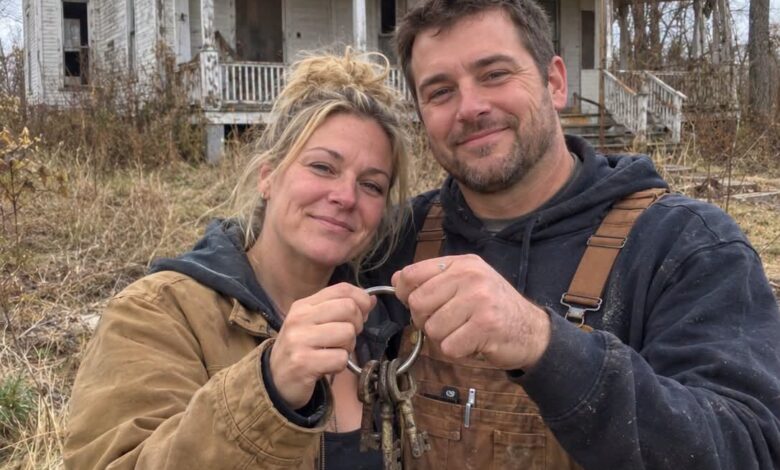
My name is Emily Schafer. I was thirty-three that Easter. Nate was thirty-four.
Nate didn’t say one word against his parents at that table.
He ate his dinner. He helped his father carry the folding chairs back down to the basement. He kissed his mother on the cheek at the door on our way out.
He didn’t say anything in the truck either. Not until we were past the city limits sign and the fields opened up black on both sides of the road. Freshly worked. Waiting on corn.
“How much have we got?” he said.
“Six thousand two hundred,” I said.
I didn’t have to look it up.
“What’s rent again?”
“Seven twenty-five.”
He drove a while without talking.
Nate is a diesel mechanic. He thinks the way he works. You find out what’s actually wrong before you ever pick up a wrench.
“I’m not mad at Kim,” he said.
“I know.”
“I’m not even mad at them. They think they said something nice.”
“They did say something nice.”
“Yeah.”
He took the card out of his shirt pocket and set it on the dashboard. Bluebird side up.
“I’d just like to be worried about one time,” he said. “Just to see what it’s like.”
I laughed.
And then I wasn’t laughing anymore. And I looked out my window so he wouldn’t have to watch me.
“Then we need second jobs,” he said. “I’ll take harvest calls. Field service. Guys will pay cash to get a combine running at ten o’clock at night.”
“I’ll take the diner,” I said. “Patty’s been after me for a year to wait tables out at the truck stop.”
“You’re on your feet all week.”
“I sit all week,” I said. “That’s the trouble with billing.”
That was the whole meeting.
We never had another one.
So for two years, I billed insurance companies at the hospital from seven-thirty to four o’clock, Monday through Friday.
And on Friday nights, Saturday nights, and Sunday mornings, I carried plates at the truck stop out on the highway.
I learned to carry four dinners up one arm. I learned which of the seed corn salesmen tipped well, and which ones left a religious tract instead. I learned that a tired woman can actually sleep standing up next to the pie case for about forty seconds. If she hooks one elbow over the top of it.
Nate worked his regular shift at the truck shop.
And then, from September to Thanksgiving, he drove out to whatever field somebody’s combine was broke down in.
He replaced a feeder house chain by flashlight in a sleet storm. He rebuilt an injection pump on the tailgate of his truck at midnight.
One night he came home at two in the morning with three hundred dollars cash in his coverall pocket. And a whole pumpkin pie a farm wife had made him take.
He ate half of it standing at the kitchen sink.