My Sister Broke My $80,000 Grandfather’s Violin 20 Minutes Before My Biggest Performance—Then She Begged Me to Save Her Future
**My Sister Broke My $80,000 Grandfather’s Violin 20 Minutes Before My Biggest Performance—Then She Begged Me to Save Her Future**
How could I explain that my mother had watched it happen and then allowed Vanessa to walk away wearing my dress?
“Claire?” Adrian asked again. “Talk to me.”
“My violin is broken.”
There was a brief silence.
“What do you mean, broken?”
“My sister destroyed it.”
I heard him inhale sharply.
“Is it repairable?”
“I don’t know.”
“Are you hurt?”
“No.”
“Then listen to me carefully. Don’t touch the strings or try to force the neck back into place. Put every piece somewhere safe. I’ll have someone contact a restoration specialist tonight.”
His calmness nearly broke me.
I pressed my fingers against my forehead.
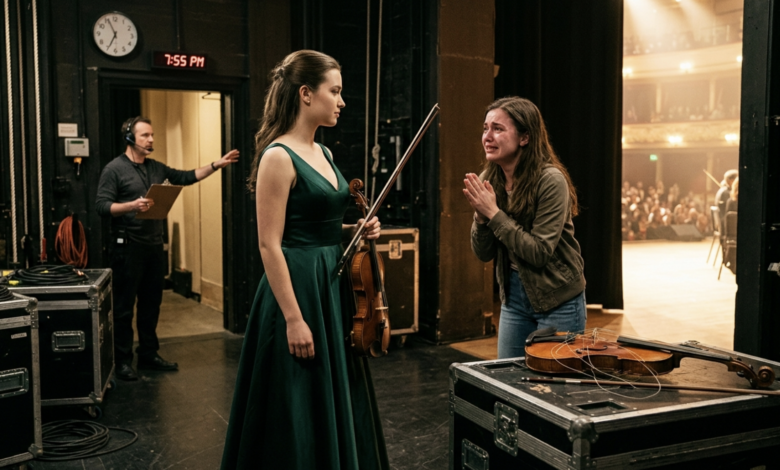
“Maestro, the performance starts in twenty minutes. I don’t have another instrument.”
“Can you borrow one?”
“I don’t know anyone who has a concert-quality violin nearby.”
“Then we’ll find someone who does.”
I glanced at the clock.
Seventeen minutes.
“Claire, are you still there?”
“Yes.”
“Do you want to perform tonight?”
The question seemed almost absurd.
For years I had practiced until my fingertips were sore. I had missed birthday parties, school dances, and weekends away because I needed to prepare. I had spent countless nights repeating the same four measures until my teacher finally nodded. I had endured auditions where judges barely looked up from their papers. I had watched other musicians receive scholarships while wondering whether I would ever be good enough.
And now, on the night when everything I had worked toward was finally within reach, my sister had tried to erase it all because I refused to lend her a dress.
“Yes,” I whispered.
“Then get backstage. I’ll handle the violin.”
He hung up.
Vanessa had been listening.
She folded her arms across her chest.
“Unbelievable. You’re actually going to make everyone deal with your little emergency?”
I picked up the violin case.
“Move.”
She blinked.
“What did you say?”
“I said move, Vanessa.”
For a moment we stared at each other.
I had spent most of my life avoiding direct confrontations with my sister. I knew how quickly she could turn a simple disagreement into a family crisis. I knew how she could cry at exactly the right moment, how she could make my parents believe that her cruelty was a reaction to something I had done.
But that evening I no longer cared whether she thought I was difficult.
I walked past her.
My mother followed me into the corridor.
“Claire, wait.”
I kept walking.
“Claire!”
I stopped near the elevator.
She caught up with me, her heels clicking against the polished floor.
“Your sister didn’t mean for this to become such a disaster.”
I slowly turned toward her.
“Mom, she picked up an $80,000 instrument and deliberately broke it because I wouldn’t give her a dress.”
“She was angry.”
“So was I. I didn’t destroy anything.”
Mom glanced toward the dressing room, making sure Vanessa couldn’t hear us.
“Please don’t embarrass the family tonight. There are important people attending this performance. We don’t need a scandal.”
I stared at her.
That was what mattered to her.
Not Grandpa’s violin.
Not the years I had spent preparing.
Not the fact that her daughter had committed a deliberate act of destruction.
The scandal.
“You’re worried about what people will think?” I asked.
“I’m worried about your future.”
“No. You’re worried about Vanessa’s reputation.”
Her face tightened.
“Don’t speak to me that way.”
I turned back toward the elevator.
“Then stop asking me to protect someone who has never protected me.”
The doors opened.
I stepped inside.
For the first time in my life, I didn’t wait for my mother to follow me.
I pressed the button for the backstage level and watched the doors close between us.
As the elevator descended, I looked down at the violin case in my hands.
I couldn’t bring myself to open it again.
I knew what I would see.
The instrument Grandpa had held so carefully.
The instrument he had once allowed me to carry only after making me promise never to leave it unattended.
The instrument he had trusted me to protect.
My eyes filled with tears.
“I’m sorry, Grandpa,” I whispered.
And for the first time since Vanessa had broken it, I let myself cry.
But only for a moment.
Because the elevator doors were opening.
And I still had a performance to give.
—
The backstage corridor was already crowded when I arrived.
Musicians hurried past with instrument cases. Stage assistants carried folders and checked their headsets. Somewhere beyond the thick curtains, the audience was settling into its seats. The sound of people talking drifted through the walls. I could hear the faint clinking of glasses from the reception area.
Everything was proceeding as planned.
Everyone except me.
A young stage assistant approached me.
“Claire? Maestro Cole asked me to bring you directly to him.”
I nodded.
She glanced at the violin case.
“Is everything okay?”
I couldn’t answer.
She seemed to understand that something was wrong and led me down the corridor.
Adrian was standing near the orchestra’s instrument storage room, speaking with a man I recognized as the concertmaster, Daniel Reeves.
Both men turned when they saw me.
Adrian walked toward me immediately.
“Show me.”
I opened the case.
Daniel’s expression changed.
He bent down slightly, examining the damaged instrument without touching it.
“Oh, my God.”
Adrian closed his eyes for a moment.
“Claire, I’m so sorry.”
I swallowed.
“Can it be repaired?”
Daniel looked at Adrian before answering.
“Possibly. But not quickly. The body is split, the neck is damaged, and we’ll need a specialist to determine the extent of the structural damage. Don’t attempt to play it.”
I nodded.
I already knew that.
Still, hearing someone else say it made the destruction feel final.
“There’s no way I can use it tonight?”
“No,” Daniel replied gently. “And I wouldn’t risk further damage.”
Adrian placed a hand on my shoulder.
“We have another problem. The orchestra’s reserve instruments are already assigned to students whose own instruments are being serviced. I can probably find you something, but it may take a few minutes.”
“How many?”
He checked his watch.
“Ten, perhaps.”
Ten minutes.
The audience was waiting.
The program had already announced my name.
I could imagine the questions that would follow if I failed to appear.
Was I ill?
Had I withdrawn?
Had I panicked?
Would the conservatory directors remember my absence more clearly than they remembered any of my previous performances?
I forced myself to breathe.
“I’ll wait.”
Adrian nodded toward a small room beside the storage area.
“Sit down. Drink some water. Don’t think about the audience yet.”
I sat on a folding chair and placed the closed case beside my feet.
Daniel left to make calls.
Adrian stayed with me.
For a while neither of us spoke.
Then he pulled another chair closer.
“Claire, may I ask you something?”
I looked up.
“Of course.”
“Did you know your grandfather personally?”
I almost laughed at the question.
“He taught me to play.”
“I know that. But I mean, did you spend much time with him outside music?”
“All the time.”
I looked at the violin case.
“He lived with us when I was little. My parents worked long hours, so Grandpa used to pick me up from school. He made terrible sandwiches, and he always forgot where he put his glasses.”
A small smile appeared on my face despite everything.
“He would spend an hour looking for them before realizing they were on his head.”
Adrian chuckled softly.
“That sounds familiar.”
“He taught me music because he said it was a way to tell the truth without having to explain yourself.”
My voice faltered.
“When I was twelve, I asked him why he never bought a newer violin. He told me that an instrument wasn’t valuable because it was old or expensive. It was valuable because of the music people had trusted it to carry.”
I wiped my eyes.
“He made me promise that if I ever became a professional musician, I would never let money or applause become more important than the music.”
Adrian looked at the case.
“He would be proud of you.”
I shook my head.
“I couldn’t even protect his violin.”
“Claire, protecting an object and honoring the person who gave it to you are not the same thing.”
I looked at him.
He continued.
“Your sister made a choice. That choice belongs to her. You didn’t make her do it, and you couldn’t have prevented it simply by giving her a dress. If you’d given her the dress, perhaps she would have found something else to demand next time.”
His words settled into the silence.
I had spent years believing that if I could become patient enough, generous enough, and accommodating enough, my family would finally treat me with the same consideration they gave Vanessa.
But there had always been another demand.
Another sacrifice.
Another reason why my feelings could wait.
Maybe Adrian was right.
Maybe I had spent too long trying to protect a peace that existed only because I kept surrendering.
A knock sounded at the door.
Daniel returned, holding a black violin case.
“I found one.”
My heart jumped.
He set the case on the table and opened it.
Inside lay a beautiful modern violin with a warm, reddish-brown finish.
It wasn’t Grandpa’s violin.
It didn’t have the little scratch beside the chin rest.
It didn’t carry decades of memories.
But it was intact.
Daniel lifted it carefully.
“This belongs to a former orchestra member who lives about ten minutes away. She keeps it here whenever she’s rehearsing with us. I reached her by phone, and she gave us permission to use it tonight.”
I stared at the instrument.
“Will it work for Sibelius?”
“It should. It’s a good instrument. You’ll need a moment to adjust to its response, but it’s certainly capable of handling the piece.”
He handed it to me.
My fingers trembled as I lifted it beneath my chin.
I drew the bow across the strings.
The first note sounded brighter than I expected.
I tried another.
The sound was unfamiliar, but clear.
I adjusted the bow pressure and played a short passage from the opening section of the concerto.
Daniel listened.
“Good. A little more weight on the lower strings, but you’ll adapt.”
I played the passage again.
This time the sound settled.
For a few seconds the room disappeared.
There was only the instrument, the bow, and the music I had practiced for years.
Then Adrian checked his watch.
“Eight minutes.”
I lowered the violin.
“I can do this.”
He smiled.
“Yes, you can.”
Daniel helped me secure the damaged instrument in its case. We placed the case in a locked storage room so no one could accidentally disturb the broken pieces.
Then I took the borrowed violin and followed Adrian toward the stage entrance.
—
I was almost there when I heard a familiar voice.
“Claire!”
I stopped.
Vanessa was hurrying toward us.
She was still wearing my emerald dress, but her face had changed. Her makeup was smudged beneath her eyes, and her hands were shaking.
My mother followed close behind her.
“Claire, thank goodness,” Mom said. “You need to help your sister.”
I looked at Vanessa.
“What happened?”
She opened her mouth, but no words came out.
For the first time that evening, my older sister looked genuinely frightened.
And whatever had frightened her, it had nothing to do with my violin.
Vanessa grabbed my wrist.
“Claire, please. You have to do something.”
I pulled my hand away.
“What are you talking about?”
She glanced toward the stage entrance, then back at me.
“It’s the performance.”
I stared at her.
“What about it?”
She swallowed.
“Someone found out.”
My mother hurried forward.
“Claire, listen to me. This is a misunderstanding.”
I looked between them.
“What misunderstanding?”
Vanessa’s eyes filled with tears.
“The dress.”
I almost laughed.
“You mean the dress you’re wearing right now?”
She looked down at herself as if she had forgotten what she was wearing.
Then she whispered, “It’s not mine.”
“No. It isn’t.”
“Claire, please. Just listen.”
I tightened my grip on the violin.
“I have to perform in a few minutes. Whatever you need, it can wait.”
“No, it can’t!” she cried.
Her voice was loud enough to draw the attention of two stage assistants passing nearby.
Vanessa lowered her voice immediately.
“Please. I know what I did was wrong, but you have to help me.”
I looked at her for a long moment.
Twenty minutes earlier she had stood over the broken pieces of my grandfather’s violin and told me my big night was over.
Now she was asking me to save hers.
“What exactly do you want me to do?” I asked.
She hesitated.
Then she said the words that changed everything.
“Tell them you gave me the dress.”
I stared at her.
She rushed on.
“If you tell them you lent it to me, everything will be fine. Nobody will blame me. We can say you offered it because you had another outfit.”
“Why would I do that?”
“Because you’re my sister!”
The familiar demand rang through the corridor.
Not an apology.
Not an acknowledgment of what she had done.
A demand.
My mother stepped between us.
“Claire, your sister has an important opportunity tonight. She was invited to meet several people from the foundation sponsoring the orchestra. She was supposed to attend the reception afterward.”
I looked at Vanessa’s dress.
Then at my mother.
“Why does any of that involve me?”
Mom lowered her voice.
“Because Vanessa told them the dress belonged to her. She said it was a designer piece she had purchased for the occasion.”
I stared at her.
“You’re joking.”
“She didn’t think it would become a problem.”
“What problem?”
Vanessa’s face crumpled.
“The designer.”
For a moment I couldn’t understand what she meant.
Then I remembered the small label inside the dress.
The emerald-green dress had been a limited release from a designer whose work I had followed for years. I had purchased it from an authorized boutique, and the store had included a certificate of authenticity because the fabric came from a special collection.
I had planned to wear it for the reception after the performance.
I had saved for months to buy it.
Vanessa knew all of that.
She also knew that the designer’s representatives would be attending the event.
“What did you tell them?” I asked.
She wiped her cheeks.
“I said I had bought it from the designer’s private collection.”
“Why?”
“Because I wanted them to take me seriously.”
“Seriously as what?”
My mother answered before Vanessa could.
“She’s trying to build a career in fashion communications. She hoped to meet the designer’s representatives and introduce herself.”
I looked at Vanessa.
“You lied about buying my dress to impress people at a reception you hadn’t even been invited to attend?”
“I was invited!”
“By whom?”
She hesitated.
Then she looked away.
I understood.
She had probably used my invitation, my performance, and my connection to the orchestra as an opportunity to place herself in a room where she could pretend she belonged.
It was the same pattern I had known since childhood.
Vanessa wanted something.
She decided she deserved it.
And when the truth threatened to catch up with her, she expected me to help her escape the consequences.
“What happened?” I asked again.
This time Vanessa answered.
“One of the designer’s assistants recognized the dress. She asked me where I bought it. I told her it was from a private sale, but she said the designer’s office had records of every dress from that collection.”
My stomach tightened.
“And?”
“She asked for the certificate.”
I closed my eyes briefly.
Of course.
The certificate was in the small pocket of my handbag, which I had left in the dressing room.
Vanessa had taken the dress but hadn’t known about the document.
“When she couldn’t produce it,” my mother continued, “the assistant became suspicious. She asked Vanessa to wait while she contacted the boutique.”
I looked at Vanessa.
“And now you’re worried they’ll discover you lied.”
She began crying harder.
“They’ll never take me seriously again.”
I could barely believe it.
She had destroyed an irreplaceable family heirloom and then stolen my dress to advance her own ambitions.
Yet somehow she still believed her future was the emergency.
I glanced at the stage entrance.
The orchestra manager was signaling to Adrian.
Four minutes.
“I need to go.”
Vanessa caught my arm again.
“Claire, please! You can tell them I gave you permission to wear it. You can tell them I borrowed it from you. It doesn’t have to be a big deal.”
I looked directly into her eyes.
“You broke Grandpa’s violin.”
She flinched.
“I know.”
“You didn’t even apologize.”
“I said I was sorry!”
“No, you didn’t. You said my performance was over.”
Her lips trembled.
“I was angry.”
“So was I.”
“Claire, please!”
I stepped back.
“You wanted me to lose something important because I wouldn’t give you what you wanted. Now you’re afraid of losing something important yourself, and you want me to protect you.”
I shook my head.
“That isn’t how being sisters works.”
My mother looked furious.
“How can you be so heartless?”
I turned toward her.
“Heartless?”
“Yes! Your sister is terrified. She made a mistake, and you could help her fix it with one sentence.”
I stared at her.
“One sentence won’t make her tell the truth. It will only make me responsible for another lie.”
“Claire—”
“No.”
The word came out quietly.
But it was final.
“I won’t lie for her.”
Vanessa stared at me as though I had slapped her.
Then a woman’s voice sounded from the far end of the corridor.
“Miss Vanessa?”
A tall woman in a black suit approached us, carrying a tablet.
Beside her walked a man I recognized from the event program: the representative of the fashion house whose dress Vanessa was wearing.
The woman stopped a few feet away.
“I’m afraid we need to resolve this matter before you enter the reception.”
Vanessa went pale.
My mother immediately stepped forward.
“I’m sure there’s been a misunderstanding.”
The woman glanced at the emerald dress.
“Perhaps. But we need to verify the ownership of the garment and the information provided to our representative.”
She turned toward me.
“Miss Claire?”
I nodded.
“Yes.”
“Are you the purchaser of this dress?”
Vanessa looked at me desperately.
My mother shook her head almost imperceptibly.
They were both waiting.
For the familiar surrender.
For the moment when I would make myself smaller so Vanessa could escape the consequences.
I took a breath.
“Yes,” I said. “I purchased it.”
The woman nodded.
“Do you have the purchase documentation?”
“Yes. It’s in my handbag in the dressing room.”
“Would you be willing to show it to us?”
“Of course.”
Vanessa made a strangled sound.
“Claire, don’t.”
I turned toward her.
“Don’t what?”
She couldn’t answer.
I looked back at the representative.
“I can show you the receipt and certificate of authenticity. I can also explain exactly how the dress came to be in my sister’s possession.”
The corridor fell silent.
My mother stared at me.
Vanessa looked as though she had just realized that, for the first time in her life, I wasn’t going to rescue her.
The representative nodded.
“Thank you. That’s all we’re asking.”
I glanced at the stage entrance one final time.
Adrian was waiting.
The orchestra was ready.
And somewhere inside that concert hall, hundreds of people were waiting to hear music that had nearly been silenced before the first note.
“I’ll explain everything,” I said. “But first, I have a performance.”
The representative stepped aside.
“Of course.”
I walked toward the stage.
Behind me I heard Vanessa whisper my name.
I didn’t turn around.
Because the truth was, I had spent years turning around whenever she called.
And tonight, for the first time, I had something more important to do.
I had music to play.
And I was going to play it.
—
The moment I stepped onto the stage, the audience rose into a soft wave of applause.
Hundreds of faces turned toward me beneath the warm concert lights. I could see the orchestra members taking their places, the conductor lifting his baton, and several distinguished guests sitting in the front rows.
For a moment I forgot how to breathe.
This was the performance I had dreamed about for years.
And I was standing there without my grandfather’s violin.
I held the borrowed instrument beneath my chin and closed my eyes.
In my mind I saw Grandpa sitting in his favorite armchair, his silver hair slightly untidy, his glasses resting at the end of his nose.
I remembered the way he used to tap his finger against the music stand whenever I rushed a passage.
“Music isn’t a race, Claire. You don’t have to arrive before everyone else. You just have to know why you’re going.”
When I was younger I thought he was talking about tempo.
As I grew older I realized he had been talking about life.
I took a slow breath.
Then I looked at Maestro Adrian Cole.
He gave me a small nod.
I lifted my bow.
The first notes of Sibelius’s Violin Concerto rose into the concert hall.
And everything else disappeared.
There was no Vanessa.
No emerald dress.
No broken violin.
There was only the music.
I played the opening passage with a restraint that surprised even me.
The borrowed violin responded differently from Grandpa’s instrument. Its tone was brighter, its resistance unfamiliar, and its sound carried a slightly different character.
But the notes were there.
Every measure I had practiced.
Every difficult transition I had repeated until my fingers seemed to know it without my permission.
Every moment of frustration, exhaustion, and doubt that had brought me to that stage.
I played through the first section, listening carefully to the orchestra.
When the music grew more intense, I allowed the sound to expand.
The instrument vibrated against my collarbone.
My right arm moved almost instinctively, and the melody climbed above the orchestra.
Then, in the middle of a particularly demanding passage, I remembered Grandpa’s hands.
He had once taken my small fingers in his and shown me how to relax my wrist.
“Never fight the instrument,” he had told me. “Listen to it. It will tell you what it needs.”
I listened.
I adjusted my bow.
And I continued.
By the time I reached the final movement, the fear that had followed me backstage was gone.
I was no longer trying to prove that Vanessa hadn’t defeated me.
I was no longer trying to demonstrate that I could survive the worst night of my life.
I was simply playing the music.
And somehow that made the performance more powerful than anything I had imagined.
When the final notes rang through the hall, the last chord seemed to hang in the air.
For one extraordinary second, nobody moved.
Then the audience erupted.
People rose from their seats.
Applause thundered through the hall.
I lowered my bow, stunned by the sound.
Maestro Cole turned toward me, smiling broadly, and gestured for me to acknowledge the audience.
I bowed once.
Then again.
As I straightened, I saw something that made my throat tighten.
In the front row, beside one of the conservatory directors, sat an elderly woman with silver hair.
She was holding a white handkerchief.
She was crying.
I didn’t recognize her at first.
Then she stood, and I noticed the small silver brooch pinned to her jacket.
A violin.
I had seen that brooch in photographs many times.
It belonged to Evelyn Hart, one of the most respected violin restoration specialists in the country.
She had known my grandfather.
And, as I would learn later, she had been one of the last people he had spoken to about his instrument.
But at that moment, all I could do was bow and try not to cry myself.
The applause continued for what felt like an eternity.
I had done it.
Despite everything, I had done it.
And my grandfather’s music had survived the night.
—
Backstage, Maestro Cole embraced me.
“That was extraordinary.”
I laughed through my tears.
“I thought I was going to fall apart.”
“You didn’t.”
“I almost did.”
“But you didn’t.”
He stepped back and studied my face.
“Do you know what I heard out there?”
I shook my head.
“I heard someone who had every reason to be angry and every reason to be frightened, yet chose to make music instead.”
I looked down at the borrowed violin.
“I wish Grandpa could have heard it.”
Adrian’s expression softened.
“Perhaps the important part is that you heard him.”
Before I could answer, Daniel hurried into the corridor.
“Claire, Evelyn Hart wants to speak with you.”
I stared at him.
“Evelyn Hart?”
He nodded.
“She’s waiting in the greenroom. She said she knew your grandfather.”
My heart began beating faster.
I carefully returned the borrowed violin to its case and followed Daniel.
Evelyn stood beside a small table covered with refreshments. Up close she looked older than she had in the photographs I remembered, but her eyes were bright and attentive.
When she saw me, she reached for both my hands.
“You look so much like him.”
I swallowed.
“You knew my grandfather?”
“Very well.”
She glanced toward the violin case Daniel was carrying.
“I heard what happened to his instrument. Adrian told me the essentials.”
My face fell.
“I’m sorry. I should have protected it.”
Evelyn gently squeezed my hands.
“Your grandfather would have been far more concerned about whether you were all right than whether you protected a piece of wood.”
“But it was his violin.”
“Yes. And it was a remarkable instrument. But he never confused the instrument with the musician.”
She paused.
“May I ask you something? When you realized it was broken, what did you do?”
“I called my conductor. I found another violin. I performed.”
“Exactly.”
She smiled.
“Your grandfather once told me that he hoped you would become the kind of musician who could lose everything familiar and still find the music.”
My eyes filled.
“He said that?”
“He did.”
Evelyn reached into her handbag and removed a small envelope.
“I’ve been carrying this for several years. Your grandfather asked me to give it to you when I believed you were ready to understand it.”
I stared at the envelope.
It was yellowed with age, and my name was written across the front in Grandpa’s unmistakable handwriting.
*Claire.*
Nothing more.
My fingers trembled as I accepted it.
“What’s inside?”
“I don’t know,” Evelyn replied. “He sealed it himself. He told me not to open it and not to give it to you simply because you were old enough. He wanted you to receive it when you understood something important about music and life.”
I looked at the envelope.
“What did I need to understand?”
Evelyn smiled sadly.
“That being a good person doesn’t mean allowing people to hurt you. And that forgiveness, if you ever choose it, should never require you to lie about what happened.”
I stared at her.
Those words sounded so much like Grandpa that, for a moment, I felt as if he were standing beside us.
I opened the envelope carefully.
Inside was a handwritten letter and a small photograph.
The photograph showed Grandpa standing outside a modest music school, holding his violin case. A much younger Evelyn stood beside him.
On the back he had written:
*For Claire, who will one day understand that music is not the instrument, but the courage to begin again.*
I unfolded the letter.
My eyes moved across the page.
*My dearest Claire,*
*If you are reading this, then I hope you have discovered something I spent most of my life learning.*
*People will sometimes tell you that love means giving everything away. They may tell you that being kind means staying silent when you are hurt. They may even tell you that keeping the peace is more important than telling the truth.*
*Please remember that none of these things is always true.*
*You can love someone and still say no.*
*You can forgive someone without trusting them again.*
*You can be generous without allowing yourself to be used.*
*And you can lose something precious without losing the person you are.*
I stopped reading.
My tears fell onto the paper.
I had heard Grandpa say versions of those words before, but never quite like this.
I continued.
*I am leaving you my violin because I want you to have something that connects you to the music I loved. But if the day ever comes when you cannot play it, I hope you will not believe that the music has abandoned you.*
*The violin is wood, strings, and craftsmanship. Its value is not in its price or its history alone. Its value is in what it helps you express.*
*If it breaks, grieve for it. Repair it if you can. Remember it always.*
*But never believe that someone else has the power to destroy the music inside you.*
*With all my love,*
*Grandpa.*
I pressed the letter against my chest.
For the first time that evening, the pain I had been carrying felt different.
It was still there.
My grandfather’s violin was still broken.
My sister had still done something cruel and deliberate.
My mother had still failed to defend me.
But I finally understood that none of those things had the power to take away the years Grandpa and I had shared.
Vanessa had broken an instrument.
She hadn’t broken my childhood memories.
She hadn’t erased his lessons.
And she hadn’t taken away my ability to make music.
Evelyn waited quietly until I had finished reading.
Then she asked, “May I see the instrument?”
I nodded.
Daniel brought the case from the storage room.
When Evelyn opened it, her expression became serious.
She examined the broken body, the damaged neck, and the fragments of wood.
For several minutes she said nothing.
Finally she looked up.
“This is serious damage. It will require painstaking work, and I can’t promise that it will ever return to its former playing condition.”
My heart sank.
“But?”
She gave me a thoughtful look.
“But I have restored instruments in worse condition. Some take months. Some take years. We will need to assess every piece carefully, and there may be limits to what can be repaired without compromising the instrument.”
“Would you try?”
Evelyn smiled.
“Your grandfather was one of my oldest friends. I would be honored to examine it properly.”
I closed my eyes in relief.
“Thank you.”
“Don’t thank me yet. Restoration requires patience. And you must understand that the violin may never sound exactly as it did before.”
I nodded.
“I understand.”
She gently closed the case.
“Then we’ll begin with an honest assessment. No promises we can’t keep.”
For the first time since Vanessa had broken the violin, I felt a small flicker of hope.
Not because everything would return to the way it had been.
But because something precious might still be saved.
—
I had barely finished speaking with Evelyn when my phone began vibrating.
Messages flooded the screen.
Friends congratulated me on the performance.
My former teacher sent a string of exclamation marks followed by a message that made me laugh.
*You magnificent girl. Call me tomorrow.*
There were messages from musicians I hadn’t spoken to in years, people who had watched the livestream, and several strangers who wanted to tell me how deeply the performance had affected them.
Then a message arrived from my mother.
*Where are you? We need to talk.*
Another followed.
*Vanessa is in trouble. Please don’t make this worse.*
I stared at the screen.
Not one message asked whether I was all right.
Not one mentioned Grandpa’s violin.
I turned the phone facedown.
A few minutes later Adrian returned with a woman wearing a dark blue suit.
“Claire, I’d like you to meet Dr. Margaret Lewis, the director of the Hartwell Conservatory’s scholarship program.”
My heart skipped.
I recognized her from the front row.
Dr. Lewis smiled and extended her hand.
“Congratulations on your performance. You handled a difficult situation with remarkable composure.”
“Thank you.”
“I understand that you had to use a borrowed instrument at the last minute.”
“Yes.”
“That couldn’t have been easy.”
I considered the question.
“It wasn’t. But I had practiced the music for years. The instrument changed, but the work I had done was still there.”
She nodded thoughtfully.
“That’s an excellent answer.”
She opened a folder.
“I won’t pretend that one performance determines an entire career. It doesn’t. But tonight you demonstrated something we value greatly in our fellowship candidates: the ability to respond to an unexpected challenge without abandoning your responsibilities.”
My fingers tightened around the envelope containing Grandpa’s letter.
“We would like to invite you to a formal audition for our advanced performance fellowship.”
I stared at her.
“The fellowship?”
“Yes. It includes funding for further study, access to our master classes, and the opportunity to work with several internationally recognized musicians. If you are selected, the program can also help connect you with performance opportunities.”
I couldn’t speak.
I had dreamed of opportunities like this for years.
But I had never expected one to arrive on the night when everything seemed to be falling apart.
“When would the audition be?” I finally asked.
“In six weeks.”
Six weeks.
Enough time to prepare.
Enough time to learn from tonight’s experience.
Enough time to remember that my future didn’t depend on whether everything went according to plan.
“I would be honored to audition,” I said.
Dr. Lewis smiled.
“Excellent. We’ll send you the details tomorrow.”
After she left, Adrian gave my shoulder a gentle squeeze.
“See? The night isn’t over.”
I looked at Grandpa’s letter.
“No,” I whispered. “It isn’t.”
—
Unfortunately, the night wasn’t over for Vanessa either.
When I finally returned to the corridor outside the dressing rooms, I found my mother sitting on a bench.
Vanessa stood beside her, still wearing my dress.
The fashion representative was speaking quietly with another staff member.
When Vanessa saw me, she hurried forward.
“Claire, please.”
I stopped several feet away.
“What now?”
Her face was streaked with tears.
“They want me to leave the reception.”
I said nothing.
“They’re saying I misrepresented the dress and gave them false information about how I obtained it.”
“Did you?”
She looked down.
“Yes, but—”
“Then what do you want me to do?”
“I want you to explain that I borrowed it from you.”
I studied her face.
“Would that change the fact that you told them you purchased it?”
She swallowed.
“Maybe if you explain—”
“No.”
Her eyes widened.
“You haven’t even heard me out!”
“I heard you out in the dressing room. I heard you out backstage. And I’ve heard you out just now.”
I paused.
“You want me to tell the truth about the dress, and I will. You want me to lie about your intentions, and I won’t.”
My mother stood.
“Claire, enough. You have made your point.”
I looked at her.
“Have I?”
“Your sister has apologized.”
Vanessa opened her mouth, but I raised my hand.
“No. She hasn’t.”
Mom’s expression hardened.
“Don’t be cruel.”
“Mom, I am not the person who broke Grandpa’s violin. I am not the person who took someone else’s property without permission. And I am not the person who lied to the event organizers.”
I turned toward Vanessa.
“You can tell them the truth yourself.”
She looked as though she couldn’t believe what she was hearing.
“And what am I supposed to do about the violin?” she demanded suddenly.
I stared at her.
“What?”
She threw up her hands.
“I said I’m sorry! What else do you want from me?”
I felt a cold sadness settle over me.
“Do you really want to know?”
She nodded impatiently.
“I want you to understand that what you did was wrong even if nobody ever finds out. I want you to stop treating other people’s belongings as things you can destroy whenever you’re angry. I want you to stop expecting me to clean up every mess you make.”
I paused.
“And I want you to understand that an apology doesn’t automatically restore trust.”
Vanessa’s face tightened.
“So you’re never going to forgive me?”
“I didn’t say that.”
“Then what are you saying?”
“I’m saying that forgiveness isn’t something you can demand from me while refusing to take responsibility for what you’ve done.”
She looked away.
For once she had no immediate response.
The fashion representative approached.
“Miss Vanessa, we need the dress returned to its owner.”
Vanessa looked at me.
I nodded.
“Please give it to them.”
She slowly began unzipping the back.
My mother gasped.
“Vanessa, what are you doing?”
“What she asked me to do!”
I stepped forward.
“Wait.”
Vanessa froze.
For one brief moment hope appeared in her eyes.
Then I continued.
“There’s a changing room over there. You can change privately. I don’t want you walking through the building half-dressed.”
Her expression crumpled again.
I wasn’t doing it to save her from the consequences of her actions.
I was doing it because I didn’t want to become someone who enjoyed another person’s humiliation.
There was a difference.
The representative escorted Vanessa to the changing room.
A few minutes later she returned wearing her own black dress.
The emerald gown was carefully placed in a garment bag and handed back to me.
The representative apologized for the disruption and explained that the organization would document the incident internally.
There was no shouting.
No dramatic public announcement.
No crowd gathering to watch Vanessa being punished.
Just a clear record of what had happened and a decision that she would not be admitted to the private reception that evening.
It was enough.
Vanessa had lied, and her lie had been exposed.
She had tried to use my success to advance her own ambitions, and now she had to face the consequences.
As she passed me, she whispered, “I hope you’re happy.”
I looked at her.
“I’m not happy about any of this.”
“Then why won’t you help me?”
“Because helping you doesn’t mean helping you lie.”
She shook her head and walked away with our mother.
I watched them disappear around the corner.
For the first time, I didn’t chase after them.
—
The next morning my father called.
I almost didn’t answer.
But I had avoided enough difficult conversations in my life, and I knew that silence alone would not solve anything.
“Hello, Dad.”
“Claire.”
His voice sounded tired.
“Your mother told me what happened last night.”
I waited.
“She says Vanessa was upset, that things got out of hand, and that you refused to help her afterward.”
I closed my eyes.
Of course that was how the story had been told.
“Did she tell you why Vanessa was upset?”
“She said you wouldn’t lend her a dress.”
“And did she tell you what she did to Grandpa’s violin?”
There was a pause.
“She said there was an accident.”
I stared at the wall.
“An accident?”
“She said she was trying to put it back in the case and—”
“Dad, she deliberately broke it. She bent it over her knee while I begged her to stop.”
Silence.
I heard him breathe.
“Are you sure?”
I felt something inside me sink.
“Yes, Dad. I was there.”
Another silence followed.
Then he said, “I didn’t know.”
I almost told him that he should have known.
That he should have asked me before accepting Vanessa’s version.
That I was tired of having to produce evidence before anyone believed my feelings mattered.
But I was too exhausted to argue.
“Well, it’s done now,” he said. “The important thing is that your performance went well.”
I stared at the phone.
“Is that all?”
“What do you mean?”
“Are you going to ask Vanessa to pay for the damage? Are you going to tell her what she did was wrong? Are you going to stop telling me that I have to share everything with her?”
He sighed.
“Claire, she’s your sister.”
“And I’m your daughter.”
He said nothing.
I continued.
“I have spent my entire life being told that I’m the one who has to understand. I’m the one who has to give in. I’m the one who has to forgive first because Vanessa gets emotional.”
My voice trembled, but I continued.
“Last night she destroyed something Grandpa left me. And Mom’s first concern was that I shouldn’t make a scene.”
“Your mother was trying to keep things calm.”
“By asking me to pretend nothing happened.”
“That’s not what she meant.”
“Then what did she mean, Dad?”
He didn’t answer.
For the first time I heard something in his silence that I had spent years refusing to acknowledge.
He didn’t know how to defend what had happened.
He had spent so long avoiding conflict that he had mistaken the absence of arguments for the presence of peace.
Finally he spoke.
“What do you want us to do?”
I took a breath.
“I want you to stop asking me to sacrifice my dignity to protect Vanessa from consequences.”
He exhaled slowly.
“And the violin?”
“Evelyn Hart is going to assess the damage. I’ll send you the restoration estimate when I have it.”
“Your mother says the instrument was insured.”
“It was. The insurance covers certain types of damage, but I don’t know what the policy will cover in this situation. Either way, the money won’t replace the memories.”
“I understand.”
I wasn’t sure he did.
But for the first time he sounded as though he was listening.
“Claire,” he said quietly, “I’m sorry.”
I closed my eyes.
It was the first apology I had received from a parent that morning.
And even though it didn’t fix anything, it mattered.
“Thank you, Dad.”
“I should have asked you what happened before I judged the situation.”
“Yes, you should have.”
He didn’t argue.
We spoke for another few minutes, then ended the call.
I placed my phone on the table and looked at Grandpa’s letter.
There was still a long way to go.
But at least one person in my family had finally begun to listen.
—
Over the following weeks I learned that the most difficult part of standing up for yourself isn’t always the confrontation.
Sometimes it’s what comes afterward.
It’s the silence.
The guilt.
The messages from relatives who hear only one side of the story.
The sudden realization that people who benefited from your lack of boundaries may not appreciate it when you finally establish them.
Vanessa didn’t speak to me for eleven days.
My mother sent several messages explaining that families should forgive one another and that I shouldn’t allow one unfortunate evening to damage our relationship.
I answered politely, but I refused to pretend that the incident had been a misunderstanding.
I also refused to turn my life into a public campaign against my sister.
I didn’t post photographs of the broken violin.
I didn’t contact Vanessa’s professional acquaintances.
I didn’t share the story online to humiliate her.
I simply told the truth when people asked what had happened.
And when nobody asked, I concentrated on the things I could control.
My music.
My work.
My future.
Evelyn began examining the violin.
The first report was sobering.
The damage was extensive, and the restoration would be expensive.
Several structural components had been broken, and some pieces had splintered into fragments that required careful stabilization.
The insurance company requested documentation, photographs, and a formal account of the incident.
I provided everything.
Because the damage had been deliberately caused by someone who knew the instrument’s value, the insurer required additional investigation before determining the final coverage.
I hired an attorney to help me understand the process and to communicate with the insurer.
I didn’t do it to punish Vanessa.
I did it because the violin belonged to me, and I had a responsibility to protect what remained of it.
The attorney explained that the available remedies would depend on the insurance terms, the evidence, and applicable law. I followed the formal process and refused to accept pressure from my family to withdraw the documentation simply to make things easier for Vanessa.
That decision caused another argument.
My mother called one evening, furious.
“Your sister is frightened that this could affect her future employment!”
I stood by the kitchen window, watching rain slide down the glass.
“Then she should have thought about that before she broke the violin.”
“She’s your sister!”
“And the violin was Grandpa’s.”
“You care more about an object than your own family!”
I closed my eyes.
“No, Mom. I care about what that object meant. And I care about the fact that Vanessa needs to understand that her actions have consequences.”
“You could destroy her future over this.”
“I am not responsible for every consequence of her choices.”
My mother fell silent.
Then she said something that hurt more than I expected.
“Your grandfather would be ashamed of the way you’re treating her.”
For several seconds I couldn’t speak.
Then I looked down at his letter.
*You can love someone and still say no.*
I took a breath.
“No, Mom. Grandpa taught me to be kind. He never taught me to lie.”
I ended the call.
My hands shook afterward, and I cried for nearly an hour.
But I didn’t call her back.
That was the difference.
I could be hurt without surrendering.
I could love my family without agreeing with them.
And I could miss the way things used to be without pretending those things had been fair.
—
Six weeks after the concert, I walked into the Hartwell Conservatory for my fellowship audition.
This time I carried a violin I had borrowed from a former teacher.
The instrument was modest, well-maintained, and familiar enough that I could concentrate on the music rather than adjusting to a new sound.
I had practiced every day.
Some mornings I began before sunrise.
Some evenings I finished after midnight.
There were days when I remembered Vanessa bending Grandpa’s violin and felt anger rise so sharply that I had to put down my bow.
But I learned to let the feeling pass.
I couldn’t change what had happened.
I could decide what I did next.
When I entered the audition room, three judges sat behind a long table.
Dr. Lewis was among them.
She greeted me warmly.
“Welcome back, Claire. Are you ready?”
I looked at the music on the stand.
Then I thought about Grandpa.
“Yes.”
I began.
The first passage was difficult, but my hands remained steady.
I played with everything I had learned over the years: patience, discipline, restraint, and the willingness to listen.
When I reached the most demanding section, I remembered the night of the concert.
For a moment I saw the broken pieces on the dressing-room floor.
Then I saw Grandpa sitting in his armchair, smiling at me.
I kept playing.
When I finished, the judges thanked me.
They asked questions about my training, my goals, and the challenges I had faced as a young musician.
Dr. Lewis asked one final question.
“Claire, what do you think makes someone a great performer?”
I considered my answer carefully.
“Technical skill matters. So does discipline. But I think a great performer must also understand why the music matters to them. If you’re playing only to impress people, one bad night can make you feel as though everything you’ve worked for has disappeared.”
I paused.
“But if you understand what the music means to you, you can begin again. You can change instruments, change circumstances, and face disappointments without losing your purpose.”
The judges exchanged glances.
Dr. Lewis smiled.
“Thank you, Claire.”
I left the room without knowing whether I had succeeded.
For the first time I understood that I could be proud of my effort without needing an immediate reward.
Still, when my phone rang three days later, my heart nearly stopped.
It was Dr. Lewis.
“Claire, I’m pleased to tell you that the committee has selected you for the advanced performance fellowship.”
I sat down on the edge of my bed.
“What?”
“You’ve been awarded the fellowship. Your training begins next month.”
I pressed a hand over my mouth.
“Are you serious?”
“Absolutely. Congratulations.”
Tears filled my eyes.
“Thank you. Thank you so much.”
After we ended the call, I sat in silence for several minutes.
Then I opened the drawer beside my bed and took out Grandpa’s photograph.
I touched the edge of the picture.
“We did it,” I whispered.
For the first time since the night of the concert, I felt no anger at Vanessa.
Only gratitude that the music had carried me forward.
—
Vanessa finally contacted me three months after the incident.
Her message was short.
*Can we talk?*
I stared at it for a long time.
Part of me wanted to ignore it.
Another part remembered the girl who had once sat beside me on the living-room floor while Grandpa taught us both to recognize musical notes.
Vanessa had been only seven then.
She used to clap whenever I played a scale correctly, and she once made me a paper medal that said BEST VIOLINIST IN THE WORLD.
I had kept it for years.
Our relationship hadn’t always been cruel.
Somewhere along the way, something had changed.
Perhaps my parents’ constant comparisons had made her feel entitled to more attention. Perhaps she had learned that getting what she wanted was easier than learning to accept disappointment. Perhaps there were reasons I would never fully understand.
But understanding why someone hurt you didn’t mean you had to pretend the hurt never happened.
I replied.
*We can talk tomorrow. Somewhere public.*
We met at a small café near the park.
Vanessa arrived early.
She wasn’t wearing designer clothes or expensive jewelry. Her hair was tied back, and she looked tired.
For several minutes we sat without speaking.
Finally she looked up.
“I owe you an apology.”
I waited.
She took a shaky breath.
“I know I said I was sorry before, but I wasn’t really apologizing. I was angry that you wouldn’t help me. I was upset about what happened at the reception. I was thinking about myself.”
She stared at her hands.
“I didn’t think about Grandpa. I didn’t think about how much that violin meant to you. I just wanted to hurt you because you said no.”
The words were painful to hear.
But they were also the first honest words she had spoken about the incident.
“Why?” I asked.
She looked up.
“What?”
“Why did you want to hurt me?”
She swallowed.
“Because you always seem to get what you want.”
I stared at her.
“Vanessa, you broke my violin because you thought I had something you deserved.”
She shook her head.
“I know how it sounds.”
“No. I don’t think you do.”
I leaned forward.
“You thought my success meant I had an easier life. You thought my dress was something you could take because you liked it. You thought Grandpa’s violin was just an expensive object. And when I refused to give you what you wanted, you decided to destroy it.”
Tears slipped down her cheeks.
“I know.”
“Do you?”
She nodded.
“I’ve been thinking about it every day.”
She told me that the incident had forced her to confront several things she had avoided for years.
She had spent too much money trying to appear successful. She had exaggerated her professional connections and made promises she couldn’t always keep. She had become so accustomed to receiving help from our parents that she rarely considered how her behavior affected other people.
The reception incident hadn’t destroyed her career, but it had embarrassed her and damaged the trust of people she hoped to work with.
She had been asked to provide clarification about her claims and had lost an opportunity to assist with a project.
She had also begun speaking with a counselor to understand why she reacted so aggressively when people refused her.
“I thought you were always judging me,” she said. “Whenever you succeeded at something, I felt as if I was falling behind.”
I listened.
“I know that isn’t your fault. But I acted as though it was.”
She wiped her eyes.
“I don’t expect you to forgive me today. I don’t expect you to lend me anything or pretend we’re close. I just want you to know that I understand what I did.”
I studied her face.
For once she wasn’t asking me to fix the situation.
She wasn’t demanding that I reassure her.
She wasn’t telling me how much worse her life had become because of my refusal to protect her.
She was acknowledging what she had done.
“Thank you for telling me,” I said.
She looked up hopefully.
“Does that mean we’re okay?”
I shook my head gently.
“Not yet.”
Her face fell.
“But it means we can begin somewhere,” I continued. “If you want to rebuild our relationship, you’ll have to show me that you can respect my boundaries. Not just today. Not just when you’re afraid of losing something. Consistently.”
She nodded slowly.
“I understand.”
“And Vanessa?”
“Yes?”
“I need you to pay for the damage you caused, according to the restoration costs and the proper legal and insurance process. I’m not going to pretend it didn’t happen.”
She looked down.
“I understand.”
“I don’t want revenge. I want accountability.”
She took a breath.
“I’ll cooperate with the process. I’ll do what I’m legally responsible for.”
For the first time in months, I believed she might mean it.
It wasn’t a magical reconciliation.
We didn’t hug across the table and suddenly become best friends.
I didn’t tell her everything was forgiven.
But when we stood to leave, I felt lighter.
I had said what needed to be said.
And I had allowed her the opportunity to become someone better without making myself responsible for whether she succeeded.
That was enough for one afternoon.
—
The restoration took eleven months.
Evelyn worked slowly, documenting every stage and explaining each decision before proceeding.
Some pieces could be stabilized and rejoined. Others required more complicated treatment. The neck had sustained serious damage, and the instrument’s structure needed careful attention to avoid placing further stress on the surviving wood.
The final restoration was not inexpensive.
The insurance process took time, and the question of responsibility required documentation and professional advice. Vanessa cooperated with the process, and the matter was resolved through the appropriate channels.
I refused to let the financial question become a substitute for the emotional one.
Money could help pay for restoration.
It couldn’t purchase trust.
During those eleven months I continued my fellowship.
I attended master classes, performed in smaller concerts, and studied with musicians whose recordings I had admired since childhood.
I also began teaching young students at a community music program on weekends.
At first I did it because I needed extra income.
But I soon discovered that I loved teaching.
I loved watching a child struggle with a difficult passage and then finally produce a clear note.
I loved seeing the way a student who was afraid to perform slowly learned to trust their own hands.
And I loved telling them the same thing Grandpa had once told me.
“You don’t have to be perfect to make something beautiful.”
One Saturday afternoon a little girl named Mia arrived at class carrying a violin case that was far too large for her.
She was eight years old, with untidy braids and an expression of absolute determination.
“Miss Claire,” she asked, “what happens if my violin breaks?”
I knelt beside her.
“Why do you ask?”
She opened her case and showed me a small crack near the edge.
“My brother dropped it. My mom says we might not be able to afford another one.”
I examined the instrument.
The damage appeared manageable, though I would need to have it assessed before promising anything.
“Let’s have someone look at it,” I told her. “We may be able to repair it.”
She bit her lip.
“But what if we can’t?”
I thought of Grandpa’s violin.
Then I smiled.
“Then we’ll find a way for you to keep playing.”
Her eyes widened.
“Really?”
“Really. Because the most important part of playing isn’t the instrument you own. It’s what you learn to do with it.”
She hugged her violin case.
I watched her walk back toward her mother.
And I realized that Grandpa’s greatest legacy had never been the instrument he left me.
It was the belief that music could help someone become stronger, kinder, and more courageous.
That was something Vanessa could never break.
—
When Evelyn finally called to say the violin was ready for its final assessment, I drove to her workshop immediately.
I had imagined that moment hundreds of times.
Sometimes in my dreams the violin looked exactly as it had before.
Sometimes I imagined it restored with no visible signs of damage.
But when Evelyn opened the case, I understood that restoration wasn’t the same as erasing history.
The violin had been carefully repaired.
The structure was stable, and the damaged areas had been treated with extraordinary care. The restoration was documented, and the instrument’s original materials had been preserved wherever possible.
But a few subtle signs remained.
Tiny traces of its history.
Proof that it had been broken.
Proof that someone had taken great care to bring it back.
I reached toward it, then stopped.
“May I?”
Evelyn smiled.
“Of course.”
I lifted the violin from its case.
It felt familiar in my hands.
I placed it beneath my chin and drew the bow across the strings.
A clear note filled the workshop.
My eyes closed.
For a moment I was four years old again, sitting beside Grandpa in his armchair.
I could almost hear him correcting my posture.
“Relax your shoulder, Claire.”
I laughed through my tears.
Evelyn stood quietly nearby.
I played a simple scale.
Then another.
The violin responded beautifully, though its voice was not exactly the same as I remembered.
Some things had changed.
But the instrument was alive again.
I lowered the bow.
“Thank you,” I whispered.
Evelyn shook her head.
“Your grandfather trusted me with something precious. I’m glad I could help.”
I carefully placed the violin back in its case.
Then I noticed a small envelope resting beneath the protective lining.
I looked at Evelyn.
“What’s this?”
She seemed surprised.
“I didn’t put that there.”
I opened it.
Inside was a short note in Grandpa’s handwriting, along with a photograph of him standing outside the same music school where Evelyn had once worked.
I recognized the note immediately.
He had written it years before his death, perhaps intending to give it to me when I was older.
*Claire,*
*If this instrument ever returns to your hands after a difficult time, remember that restoration is not the same as pretending nothing happened.*
*The cracks may leave marks. The work may take longer than you expect. And the instrument may never be exactly as it was.*
*That does not mean the effort was wasted.*
*Some things become more meaningful because someone cared enough to repair them.*
*But remember this, too: not everything that breaks must be returned to its former place in your life.*
*Learn the difference.*
*With love, Grandpa.*
I read the final sentence several times.
*Not everything that breaks must be returned to its former place.*
I thought about Vanessa.
I thought about my family.
I thought about the years I had spent trying to preserve relationships by ignoring the damage they caused.
I had believed that healing meant returning to the way things used to be.
Now I understood that healing could mean building something different.
The violin could be restored because the damage could be treated and the instrument could safely function again.
My relationship with Vanessa was more complicated.
It would require honesty, time, and consistent change.
And even if we eventually became close again, we would never be the same sisters we had been before that night.
Perhaps that was all right.
Perhaps the goal wasn’t to return to the past.
Perhaps the goal was to build something better.
—
A year after the concert, I received an invitation to perform with the New York Metropolitan Youth Orchestra again.
This time I would be featured in a special program honoring young musicians who had demonstrated exceptional dedication to their craft.
I accepted.
The evening before the performance, I sat at my kitchen table with Grandpa’s violin in its case beside me.
My phone rang.
It was Vanessa.
“Are you busy?” she asked.
“A little. I’m preparing for tomorrow.”
“Oh. Right. Your concert.”
She sounded nervous.
“I wanted to ask you something.”
“Go ahead.”
“Would it be all right if I came?”
I was silent for a moment.
She continued quickly.
“I know you might not want me there. I understand that. But I wanted to ask instead of assuming you would be okay with it.”
I leaned back in my chair.
That small difference mattered.
“You can come,” I said. “But I want to be clear about something.”
“Okay.”
“This is my performance. I don’t want to spend the evening worrying about whether you’re upset with me or whether I need to make you feel included.”
“I understand.”
“And I don’t want you to borrow anything without asking.”
She gave a small, embarrassed laugh.
“Fair enough.”
I smiled despite myself.
“Vanessa, I’m serious.”
“I know. I’m sorry.”
We talked for a few minutes about ordinary things.
She told me she had found a position with a small communications firm and was trying to rebuild her professional reputation through consistent work rather than impressive appearances.
She had started saving money and was learning to live within her budget.
She also admitted that she was still working on her tendency to become defensive when she felt embarrassed.
“I’m not suddenly a different person,” she said. “I still get angry sometimes. But I’m trying to stop myself before I do something I regret.”
“That’s a good place to start.”
After we hung up, I sat quietly for a while.
I didn’t know whether our relationship would ever become close again.
But I could see that something had changed.
Vanessa had asked.
And I had been free to answer.
For the first time, our relationship contained a boundary that neither of us was expected to pretend didn’t exist.
It was a small thing.
But it was real.
—
The following evening the concert hall was filled with people.
The orchestra performed several pieces before my turn.
When the announcer introduced me, I walked onto the stage carrying Grandpa’s violin.
The audience applauded.
I stood beneath the lights and looked toward the front row.
My father was there.
My mother sat beside him.
Vanessa was seated several rows behind them.
She wasn’t wearing an extravagant outfit.
She wasn’t trying to attract attention.
She simply sat with her hands folded in her lap, watching me.
For a moment our eyes met.
She gave me a small nod.
I returned it.
Then I turned toward the conductor.
I lifted my violin.
And I began to play.
The instrument’s voice rose into the hall.
Every note carried the memory of the night it had been broken.
But it also carried the memory of the hands that had restored it.
The patience of Evelyn Hart.
The encouragement of Maestro Cole.
The work of the musicians who had helped me prepare.
The little girl who had once struggled to hold a bow.
And the grandfather who had taught me that music was not something an instrument owned.
It was something a person learned to give.
When I reached the final passage, I felt a familiar warmth in my chest.
I wasn’t thinking about revenge.
I wasn’t thinking about Vanessa’s mistakes.
I wasn’t even thinking about whether the audience would applaud.
I was thinking about Grandpa.
I was thinking about how much he had loved music.
And I was grateful that I had been able to carry that love forward.
The final note faded.
For one quiet moment the hall was still.
Then the audience rose to its feet.
I bowed.
The applause washed over me.
And for the first time I felt that the story of the broken violin had finally become something more than a story about what my sister had done.
It had become a story about what I had chosen to do afterward.
—
After the performance my family waited near the backstage entrance.
My father hugged me first.
“You were wonderful.”
“Thank you, Dad.”
He looked at the violin case.
“I’m glad it’s back.”
“Me too.”
My mother approached next.
She seemed uncertain.
“I enjoyed the performance,” she said.
“Thank you.”
She hesitated.
“Claire, I’ve been thinking about what happened last year.”
I waited.
“I should have stopped Vanessa. I should have understood how much the violin meant to you instead of worrying about what other people would think.”
Her eyes filled.
“I was wrong.”
I felt my throat tighten.
For years I had imagined hearing those words from her.
I had imagined that they would erase every painful memory.
They didn’t.
But they made room for something new.
“Thank you for saying that, Mom.”
She reached for my hand.
“I’m sorry.”
I squeezed her fingers.
“I appreciate the apology.”
I didn’t promise that everything was fine.
I didn’t tell her I had forgotten.
But I allowed her to stand beside me without pretending the past had never happened.
Then Vanessa approached.
She looked at the violin case.
“Is it really restored?”
I nodded.
“Evelyn did an incredible job.”
Vanessa’s eyes glistened.
“I’ve thought about that night a lot.”
She looked at me.
“I know I can’t undo what I did. And I know that paying for the damage doesn’t make it disappear.”
She took a breath.
“I want you to know that I’m proud of you. Not because you performed after what happened. Not because you won the fellowship. I’m proud of you because you kept doing what you loved, even when I tried to hurt you.”
I looked at her for a long moment.
“Thank you.”
She swallowed.
“I don’t expect you to forgive me completely just because I’m saying this.”
“Good.”
A faint smile crossed her face.
“Good?”
“Because trust takes time.”
She nodded.
“I know.”
We stood quietly for a moment.
Then she asked, “Would you ever let me listen to you practice again?”
I considered the question.
“When I’m ready.”
She nodded.
“Okay.”
And that was how we left things.
Not with a dramatic embrace.
Not with a promise that we would never argue again.
Just two sisters standing in a quiet corridor, finally beginning to understand that love without respect was not enough.
—
Several months later I organized a small concert for the children at the community music program.
The event took place in a modest auditorium with folding chairs, homemade decorations, and a piano that had seen better days.
Parents filled the room.
Children fidgeted nervously with their instruments.
Mia, the little girl whose violin had been damaged, stood near the front wearing a blue dress.
Her instrument had been repaired.
She had worked hard for months, and she was about to perform her first solo.
Before she went onstage she approached me.
“Miss Claire?”
“Yes?”
“What if I make a mistake?”
I smiled.
“You probably will.”
Her eyes widened.
“Really?”
“Of course. Everyone makes mistakes.”
“But what if everyone hears?”
“Then everyone will hear that you’re brave enough to keep going.”
She looked down at her violin.
“What if I forget what comes next?”
“Take a breath. Find your place. Begin again.”
She thought about that.
Then she nodded.
When her name was called, she walked onto the stage.
Her first few notes were hesitant.
Halfway through the piece she missed a note and stopped.
I saw panic flash across her face.
The audience remained silent.
Mia looked toward me.
I smiled and nodded.
Take a breath.
Find your place.
Begin again.
She lifted her bow.
And she continued.
When she finished, the audience applauded warmly.
Mia ran offstage, laughing and crying at the same time.
“I made a mistake!”
“You did.”
“But I finished!”
“You did.”
She hugged me.
I held her for a moment, and I felt something settle peacefully inside me.
Grandpa had taught me how to play the violin.
But he had also taught me how to keep going when life became painful.
And now, in a small auditorium filled with children and proud parents, I was passing that lesson on.
Not through a perfect performance.
Not through an expensive instrument.
But through a simple reminder that a mistake, a disappointment, or even a broken thing did not have to become the end of someone’s story.
—
That night, after the children had gone home and the chairs had been stacked, I returned to my apartment.
I placed Grandpa’s violin on its stand beside the window.
The evening light touched the polished wood.
If I looked carefully, I could still see the subtle signs of its restoration.
I no longer wished those marks would disappear.
They reminded me of what had happened.
They also reminded me that something could be damaged without losing all its beauty.
I sat beside the violin and opened Grandpa’s letter one last time.
*Not everything that breaks must be returned to its former place in your life.*
I finally understood.
I had forgiven Vanessa for what she did, but forgiveness did not mean giving her unrestricted access to my life.
I loved my mother, but I no longer accepted her belief that keeping the family comfortable was more important than telling the truth.
I loved my father, but I expected him to listen before deciding who was right.
And I loved the violin, not because it was worth $80,000, but because it carried the memory of someone who had taught me how to become myself.
I lifted it from the stand.
Then I played a quiet melody Grandpa used to hum while making breakfast.
The sound filled my apartment.
I imagined him sitting in his old armchair, smiling as he listened.
For the first time in a long while, I didn’t feel the need to prove anything.
I didn’t need Vanessa to admit that I was right.
I didn’t need my parents to apologize again.
I didn’t need the world to know what had happened backstage that night.
I had my music.
I had my future.
And I had finally learned that protecting my peace did not make me selfish.
It made me responsible for my own life.
My sister had once looked at the broken violin and told me my big night was over.
She had believed that if she destroyed something precious to me, she could destroy the future I had worked so hard to build.
She was wrong.
The violin had been repaired.
My career had continued.
My relationship with my family had changed, slowly and imperfectly.
And I had discovered that the strongest part of me had never been the instrument I held in my hands.
It had always been the courage to pick up the bow again.