My Sister Married My Oil-Rich Ex-Husband for His $400 Million Fortune—But When His Will Was Read, the Attorney Pointed to MY Name!
Tammy looked at him.
“Well, then read it.”
Mr. Haskins nodded.
He turned the page.
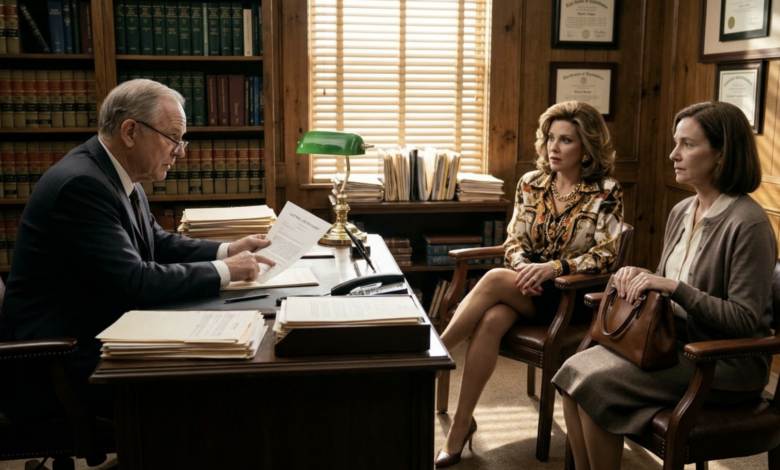
“Before I read the distribution of assets, I want everyone present to understand that Clayton was very deliberate about the language in this document. He also left instructions that certain letters and financial records be presented alongside the will.”
Tammy frowned.
“What letters?”
Mr. Haskins reached into the blue folder and removed a smaller envelope.
It was cream-colored.
My name was written across the front.
Marlene.
I recognized the handwriting immediately.
Clay’s handwriting had always been terrible. His capital letters leaned one direction, and his lowercase letters leaned another. When he wrote checks, he used so much pressure that the writing sometimes appeared on the next page.
I hadn’t seen his handwriting in years.
My stomach tightened.
“Is that for me?” I asked.
Mr. Haskins nodded.
“Clay specifically instructed me to give you this letter before proceeding with the remainder of the will.”
Tammy pushed her chair backward.
“Oh, come on. This is ridiculous.”
Her attorney touched her arm.
“Tammy, let him finish.”
She pulled her arm away.
“I don’t need to sit here and watch my dead husband’s ex-wife receive love letters.”
I looked at her.
For once, I didn’t feel the need to defend myself.
Mr. Haskins slid the envelope across the table.
I opened it carefully.
Inside was one sheet of lined paper.
There were only a few paragraphs.
I read the first sentence.
Then I read it again.
*Marlene, if you’re reading this, then I ran out of time to tell you what I should have told you years ago.*
My eyes began to sting.
I continued.
*You were the only person who ever knew what this business cost me. You kept the books when I had nothing. You stayed when I was working twelve-hour shifts and sleeping in a trailer. You knew every well, every loan, every mistake, and every dollar that came into that company.*
*I know I hurt you. I know what happened with Krystal destroyed something between us that I could never repair. I won’t ask you to forgive me. I don’t deserve that.*
*But there is something you need to know.*
I stopped.
The room was completely silent.
I looked up.
Tammy was watching me.
“What does it say?”
I folded the paper slightly.
“Something Clay wanted me to know.”
“Well, we can all read it, can’t we?”
“No,” Mr. Haskins said.
Tammy’s face hardened.
“Excuse me?”
“Clay’s personal letter to Marlene is not part of the public reading of the will. It is hers.”
Her lawyer leaned back.
Mr. Haskins continued.
“However, there are other documents that concern the estate.”
He pulled out another folder.
This one was thick.
Much thicker than the blue one.
“Clayton also instructed me to review the ownership structure of several assets before announcing the final distributions.”
Tammy smiled again, although it looked forced.
“Fine. Whatever it is, let’s get on with it. I have a meeting in Dallas tomorrow.”
Mr. Haskins looked directly at her.
“Mrs. Dobbs, before we discuss what you may inherit, we need to discuss what Clayton actually owned.”
That sentence changed everything.
Tammy sat up straight.
“What do you mean, what he actually owned?”
“Exactly what I said.”
“Clay had hundreds of millions of dollars.”
“Clayton had substantial assets. That does not mean every asset was personally owned by him.”
Her attorney opened his briefcase.
“Are you suggesting there are properties excluded from the estate?”
“I’m saying that Clayton’s business interests, personal holdings, trusts, and other arrangements must be examined separately.”
Tammy shook her head.
“This is ridiculous. I was his wife. I lived with him. I know what he owned.”
I almost smiled.
Because that was the first thing Tammy had said all morning that made me certain she didn’t know Clay nearly as well as she thought.
Clay had never been a man who discussed money casually.
Even when we were married, he didn’t tell me everything.
But he did tell me where the records were.
He taught me how to read a royalty statement before I was thirty.
He showed me how to recognize a bad lease, how to follow a payment through three different accounts, and how to tell when a company was hiding debt behind another company.
And there was one thing he had always insisted on.
Never confuse the name on the building with the name on the deed.
Mr. Haskins opened the thick folder.
“According to the records prepared and reviewed by independent financial counsel, Clayton established several separate entities over the years. Some were created before his divorce from Marlene. Others were created afterward.”
Tammy interrupted.
“Wait. Are you saying Marlene owns part of his oil company?”
“No. I’m saying that certain interests were transferred into separate legal structures, and some of those structures have beneficiaries and ownership provisions that predate your marriage.”
“That doesn’t make sense.”
“It will.”
Mr. Haskins turned another page.
“Clayton’s will provides that his personal property, remaining individually owned investments, and certain liquid assets will be distributed according to the following instructions.”
Tammy leaned forward.
Finally, she looked satisfied.
Mr. Haskins read.
“To my wife, Tammy Dobbs, I leave my personal residence, its furnishings, my vehicles, my personal jewelry collection, and the sum of two million dollars.”
Tammy blinked.
Then she laughed.
“Two million?”
Mr. Haskins didn’t respond.
“That’s a joke, right? Clay had hundreds of millions. Two million doesn’t even cover the house and the cars.”
“Those items are included separately.”
“Then what about the rest?”
Mr. Haskins looked down.
“The remaining individually owned assets will be distributed according to the provisions that follow.”
Tammy’s smile disappeared.
He continued.
“To my former wife, Marlene Dobbs, I leave the sum of twelve million dollars, free of any condition, along with the fully paid residence located on 82nd Street in Lubbock, Texas, which she currently owns.”
I stared at him.
I didn’t understand what I was hearing.
The house on 82nd Street was already mine from the divorce.
And twelve million dollars?
That was more money than I had ever imagined seeing in my bank account.
Tammy stood up.
“Absolutely not!”
Her chair scraped against the floor.
“That is insane. Why would he give her twelve million dollars?”
Mr. Haskins removed his glasses.
“Because he instructed me to.”
“He was sick! He wasn’t thinking clearly!”
“Clayton signed this document seven months before his stroke.”
“Then he was being manipulated!”
“By whom?”
Tammy opened her mouth.
Then she looked at me.
“By her!”
I was so surprised that I almost laughed.
“Tammy, I haven’t spoken to Clay in years.”
“You knew him better than anyone!”
“That doesn’t mean I was controlling him.”
Her attorney stood.
“Mr. Haskins, we reserve all rights to challenge this document and investigate the circumstances surrounding its execution.”
“Of course,” Mr. Haskins replied calmly. “You are entitled to do that.”
Tammy grabbed her purse.
“This isn’t over.”
She pointed at me.
“You think you’ve won something? You haven’t. I’ll make sure you don’t get a penny.”
I looked at my little sister.
The same girl who used to steal my clothes when we were teenagers.
The same girl who had laughed at me in the church fellowship hall.
The same girl who had once told me that I was lucky to have been married to a rich man, even though she knew exactly how hard I had worked during those years.
I finally spoke.
“Tammy, I didn’t come here to fight you.”
She scoffed.
“Of course you didn’t.”
“I came because I was invited.”
“And now you’re leaving with twelve million dollars.”
“I haven’t taken anything yet.”
She shook her head and stormed out.
Her attorney followed.
The door closed.
For a moment, Mr. Haskins and I sat in silence.
Then he reached into the folder and pulled out another document.
“Marlene, there’s something else.”
I looked at him.
“What?”
He took a slow breath.
“That twelve million dollars is not the most important thing Clay left you.”
I stared at him.
“Then what is?”
He turned the document toward me.
At the top was the name of an oil company I hadn’t heard in years.
Dobbs Energy Holdings.
Beneath it was a list of ownership interests.
I read the first few lines.
Then I stopped.
My name appeared again.
Not as a beneficiary.
Not as a former spouse.
As a trustee.
I looked at Mr. Haskins.
“I don’t understand.”
He folded his hands.
“Do you remember the original mineral leases you helped Clayton organize in 1994?”
“Of course.”
“Do you remember the company that purchased the first group of those leases?”
“West Ridge Petroleum.”
He nodded.
“That company was reorganized several times. Eventually, its remaining interests became part of a private holding structure. Clayton never sold every interest in those properties.”
I looked down at the paper.
“How much is it worth?”
Mr. Haskins hesitated.
Then he answered.
“Based on the most recent valuation, the trust controls assets valued at approximately sixty-eight million dollars.”
I couldn’t speak.
“Sixty-eight million?”
“Yes, ma’am.”
“Why am I listed as trustee?”
“Because Clayton appointed you several years ago, with your consent required for certain financial decisions. The appointment was never revoked.”
I shook my head.
“I never agreed to manage sixty-eight million dollars.”
“Clayton knew that. You were never expected to manage it alone. There is a professional trust administrator. Your responsibility is to protect the beneficiaries and oversee the decisions specified in the trust agreement.”
“Who are the beneficiaries?”
Mr. Haskins turned another page.
“That is where things become complicated.”
He pointed to three names.
One was mine.
One belonged to a small charitable foundation in Scurry County.
The third was a name I had never seen before.
“Who is this?” I asked.
Mr. Haskins looked toward the closed conference room door.
Then he lowered his voice.
“Her name is Rebecca Sloan.”
I frowned.
“Who is Rebecca Sloan?”
“She is twenty-six years old. She lives in Midland.”
I searched my memory.
Nothing.
Mr. Haskins continued.
“Clayton established an education fund for her when she was a child. He also arranged for her medical expenses and certain living costs to be paid through a separate account.”
I looked at him.
“Was she related to him?”
He didn’t answer immediately.
Instead, he opened another envelope.
This one had a handwritten note on it.
*To be opened only after Marlene has read the letter.*
My hands went cold.
Mr. Haskins slid it toward me.
“Clay wanted you to understand something before you saw this.”
“What?”
“He believed you were the only person who would look at the facts before deciding what to do.”
I opened the envelope.
Inside was a photograph.
A little girl stood beside Clay in front of a modest brick house.
She looked about seven or eight.
Clay had one hand on her shoulder.
He was smiling.
I turned the photograph over.
There were four words written on the back.
*My daughter, Rebecca Sloan.*
I stared at the handwriting.
Then I looked at Mr. Haskins.
“Clay had a daughter?”
“Yes.”
“With whom?”
“Her mother was a woman named Patricia Sloan. She passed away six years ago.”
I sat back.
The room seemed to grow smaller.
“Did Tammy know?”
Mr. Haskins looked down at the photograph.
“I cannot tell you what Tammy knew. But I can tell you that Clayton specifically instructed me not to contact Rebecca until after this meeting.”
“Why?”
“Because he wanted you to hear the truth first.”
I looked at the little girl again.
She had Clay’s eyes.
There was no denying it.
And suddenly I understood why he had wanted me in that room.
Not because he wanted to give me twelve million dollars.
Not because he wanted to embarrass Tammy.
He had left me something much bigger.
A responsibility.
Mr. Haskins closed the folder.
“There’s one more thing you should know, Marlene.”
I looked up.
“During the final months of Clayton’s life, he became concerned about certain withdrawals from his personal accounts. He asked me to review them.”
My heart began beating faster.
“Withdrawals?”
“Several transfers. Some were legitimate. Others were not properly documented.”
“How much money?”
He glanced at the paperwork.
“Approximately four million, six hundred thousand dollars.”
I slowly put the photograph down.
“Who made them?”
Mr. Haskins didn’t answer.
He simply turned the last page around.
There was a signature at the bottom.
I recognized it immediately.
It belonged to Tammy.
And beside her signature was a date.
Three weeks before Clay’s stroke.
I looked at Mr. Haskins.
“Does Tammy know you’ve found this?”
He shook his head.
“No. And I strongly advise you not to confront her until our financial investigators have completed their review.”
I stared at the signature.
My little sister had married a wealthy man.
She had laughed at me in church.
She had told everyone she was finally getting the life she deserved.
But now, sitting in that conference room in Lubbock, I began to wonder whether she had been planning something much longer than anyone realized.
Mr. Haskins placed one final document in front of me.
“Clay left you a specific instruction concerning Rebecca. He wanted you to meet her.”
I looked at the photograph one more time.
Then I asked the question that had been sitting in my mind.
“Does Rebecca know her father is dead?”
—
The legal proceedings continued for several months.
Tammy’s challenge to the will eventually failed.
The court accepted the validity of Clay’s final testament after reviewing the evidence.
The trust remained separate from the estate.
The twelve million dollars designated for me was distributed according to the will.
The house on 82nd Street remained mine, just as it had been since the divorce.
Tammy received the personal residence, vehicles, furnishings, jewelry, and the two million dollars specified in the will.
However, the questionable transfers were handled separately.
The investigation continued, and the parties involved were required to account for the funds.
I never attended another church service with Tammy.
I heard through Mrs. Peabody that people had started asking questions.
Some said Tammy was unlucky.
Others said she had made her own trouble.
I didn’t join those conversations.
I had no interest in turning my sister’s life into a public spectacle.
I had enough to deal with.
One afternoon, Rebecca came to my house.
She brought a small box.
“I found something in Dad’s storage unit,” she said.
She placed it on my kitchen table.
Inside were old photographs, a few baseball cards, a child’s drawing, and a small wooden bicycle.
I picked it up.
“What’s this?”
Rebecca smiled through her tears.
“He made it for me when I was little. I thought it was lost.”
I turned it over.
On the bottom, in Clay’s handwriting, were the words:
*For my little girl. Love, Dad.*
Rebecca sat down.
“I want to ask you something.”
“Anything.”
“Would you help me with the foundation?”
I looked at her.
“What foundation?”
She explained that she wanted to use part of the money Clay had left her to establish a scholarship program for students from working families in Scurry County.
She wanted to help children whose parents worked in oil fields, farms, feed stores, and other jobs that rarely made headlines.
Children whose families couldn’t afford college.
Children like her mother had once hoped she would become.
I smiled.
“I think your father would have liked that.”
She nodded.
“I also want to help people who need medical assistance. Especially families dealing with strokes and long-term rehabilitation.”
I thought about Clay lying in that hunting blind.
I thought about the friends who had been with him.
I thought about how quickly a person’s life could change.
“Then let’s do it,” I said.
And we did.
We called it the Clayton Dobbs Education and Family Assistance Fund.
Not because Clay had been perfect.
He hadn’t.
But because he had spent his final years trying to repair some of the damage he had caused.
The foundation began with five scholarships and a small medical assistance program.
Within a year, it was helping families across three West Texas counties.
I volunteered to review the financial records.
Rebecca handled the scholarship applications.
We worked together every Thursday afternoon.
Sometimes she brought lunch.
Sometimes I brought pie.
And slowly, without either of us planning it, she became part of my life.
Not as a replacement for anything.
Not as a reminder of Clay.
Just as Rebecca.
A young woman who had lost her father and was trying to make something good out of what remained.
Almost a year after the will reading, Tammy called me.
I almost didn’t answer.
But something made me pick up.
“Hello?”
“It’s me.”
“I know.”
She was quiet.
Then she said, “Can I come over?”
I looked out the kitchen window.
“Why?”
“I need to talk to you.”
I thought about saying no.
Instead, I told her she could come Saturday afternoon.
When she arrived, she looked different.
Her hair was pulled back.
She wore jeans and a simple blouse.
There were no sunglasses, no expensive jewelry, and no familiar smile.
She sat at my kitchen table.
For a while, she just stared at her hands.
Then she spoke.
“I lost the house.”
I didn’t know what to say.
She explained that the financial investigation and legal expenses had changed her circumstances.
The property was sold as part of a financial settlement, and she was no longer living the life she had expected.
I listened.
Then she said something I never thought I would hear.
“I thought Clay would make me happy.”
I looked at her.
“Did he?”
She shook her head.
“Not really.”
“Tammy…”
“I know what you’re going to say. Money doesn’t buy happiness.”
I didn’t say anything.
She continued.
“When he was alive, I was always worried about something. Who was calling him. What he was signing. Whether he was talking to Rebecca. Whether he was going to change the will.”
She looked up.
“I was so afraid of losing what I had that I never enjoyed any of it.”
I folded my hands.
“Why did you tell Rebecca those things?”
Her eyes filled.
“I was jealous.”
The word hung between us.
“I was jealous of you first. Then I was jealous of Rebecca. Clay talked about her all the time before we married. He had her picture in his office. He kept her birthday on his calendar.”
She wiped her cheek.
“I thought if I could get her out of his life, he would finally belong to me.”
I looked at my little sister.
“People aren’t possessions, Tammy.”
“I know that now.”
She started crying.
“I don’t expect you to forgive me.”
I waited.
“But I wanted to tell you I’m sorry.”
I looked down at the table.
There were so many things I could have said.
I could have reminded her about the church.
The ring photograph.
The four million dollars.
The years of insults.
But I realized that none of those things would change what had happened.
“Tammy, I can’t pretend none of it happened.”
She nodded.
“I understand.”
“And I can’t promise things will ever be the same.”
“I know.”
“But you’re my sister.”
She looked up.
For the first time in years, she looked like the little girl who used to sit on my bedroom floor and ask to borrow my crayons.
I reached across the table.
“I don’t want to spend the rest of my life hating you.”
She began to cry harder.
I didn’t hug her immediately.
Forgiveness wasn’t a switch I could turn on because someone had finally apologized.
It was something that would take time.
But I allowed her to sit there.
And for that afternoon, that was enough.
Two years passed.
The scholarship program grew.
We helped twenty-three students attend college or technical school.
One young man from Snyder became an engineer.
A girl whose father worked on drilling rigs received a nursing scholarship.
Another student used the assistance fund to help his mother pay for rehabilitation after a serious stroke.
Every time I reviewed the financial reports, I thought about Clay.
I wondered what he would have said if he could see what his daughter had built.
I imagined him sitting at the kitchen table, drinking coffee and complaining that we were spending too much money on office supplies.
Some things never change, even in memory.
One afternoon, Rebecca and I drove out to Scurry County.
We visited the first piece of land where Clay had struck oil in 1994.
The old equipment was gone.
The road was rough.
But the land was still there.
Rebecca stood beside me and looked across the property.
“Is this where everything started?”
I nodded.
“This is where your father went from a man with one good pair of boots to a man who could afford just about anything.”
She smiled.
“What was he like back then?”
I thought about it.
“He was stubborn. Hardworking. Terrible at saving money. He thought every problem could be solved with a bigger truck.”
Rebecca laughed.
I continued.
“But he was also generous. He helped people without telling anyone. He worked hard because he wanted to build something.”
“Do you miss him?”
I looked across the land.
“Sometimes.”
“Do you miss being married to him?”
I considered the question.
Then I shook my head.
“No, sweetheart. I miss the good parts. I don’t miss the hurt.”
Rebecca nodded.
We stood there for a few minutes.
Then she reached into her bag and pulled out a small envelope.
“I found this in Dad’s office. Mr. Haskins said I could give it to you.”
My name was written across the front.
Marlene.
I opened it.
Inside was one final note.
*Dear Marlene,*
*If you ever stand on this land again, I hope you remember the woman who sat at a kitchen table with a calculator and helped me believe that something could come from nothing.*
*I spent too many years chasing the next well, the next deal, and the next dollar.*
*I thought becoming rich would make me a better man.*
*It didn’t.*
*The best things I ever had were never for sale.*
*You were there when I had nothing. You knew the man before the money. And even though I ruined what we had, I never forgot what you did for me.*
*Please look after Rebecca if you can.*
*Not because I expect you to.*
*But because I know your heart.*
*And Marlene, don’t spend the rest of your life keeping accounts for other people’s mistakes.*
*You’ve earned the right to live your own life.*
*Clay.*
I folded the letter.
For a moment, I couldn’t speak.
Rebecca put her arm around me.
“Are you okay?”
I nodded.
“Yes.”
And I meant it.
Last Sunday, I went back to First Baptist.
It was the same church where Tammy had once stood in the fellowship hall with a plate of lemon bars and announced that she had married the rich version of my ex-husband.
The same church where people had watched me set down my coffee cup and walk away.
I sat in my usual place near the back.
Mrs. Peabody spotted me before the service started.
She walked over and squeezed my hand.
“Honey, it’s good to see you.”
“It’s good to see you too.”
She leaned closer.
“I heard about that scholarship program. My neighbor’s grandson got one of those awards.”
I smiled.
“He’s a good boy. He deserved it.”
Mrs. Peabody nodded.
Then she said something that made me laugh.
“You know, I always said that girl was going to get exactly what she earned.”
I looked at her.
“Mrs. Peabody, let’s just pray she learns something from it.”
She smiled.
“You’re a better woman than I am.”
I wasn’t sure about that.
I had simply learned that carrying bitterness was another way of letting someone else control your life.
After church, I drove to the little office where Rebecca worked.
She was waiting outside with two cups of coffee.
“One for you,” she said.
“Thank you.”
We sat on a bench beneath a large oak tree.
She told me about the next group of scholarship applications.
I told her about a bookkeeping client who had somehow managed to enter the same invoice three times.
We laughed.
For a moment, everything felt ordinary.
And ordinary had become something I treasured.
I was seventy years old.
I had a paid-off house.
A modest car.
A good pension.
A bank account that was more than comfortable.
And a young woman who called me when she needed advice, not because she needed money, but because she wanted to talk.
I had once thought my greatest achievement was helping a roughneck become an oil millionaire.
I was wrong.
My greatest achievement was learning that my worth had never depended on what a man owned, what a husband left behind, or what a younger sister wanted to take.
Clay left me twelve million dollars.
He left Rebecca a future.
He left a foundation that would help children whose families needed a chance.
But the most important thing he left was the opportunity for two women who had been hurt by the same man to find a reason to move forward.
As for Tammy, we were slowly rebuilding a relationship.
It wasn’t the relationship we had as children.
Some things cannot be restored exactly as they were.
But we spoke occasionally.
We had coffee once.
And I learned to forgive her without giving her the power to hurt me again.
I still keep books for a few small businesses.
I still check every invoice.
I still don’t trust a balance sheet until the numbers make sense.
And I still have that old casserole dish Tammy borrowed decades ago.
She brought it back last Christmas.
It was chipped on one side.
I told her it was fine.
Because after all those years, I finally understood something.
Money can buy houses, cars, land, and comfort.
It can buy a beautiful wedding ring and a seat at the head of an expensive table.
But it cannot buy loyalty.
It cannot buy a father’s love.
It cannot buy back lost years.
And it certainly cannot buy peace.
My sister married my ex-husband because she thought his fortune would make her life complete.
But when the money came, she discovered that being rich and being loved were two very different things.
I was invited to Clay’s attorney’s office because he wanted me to receive part of his estate.
I left that office with something much more valuable.
The truth.
And after thirty-eight years of keeping books for other people, I finally stopped measuring my own life by what anyone else had taken from me.
Because the richest person in the room isn’t always the one with the most money. Sometimes, it’s the person who can walk away with their dignity still intact.