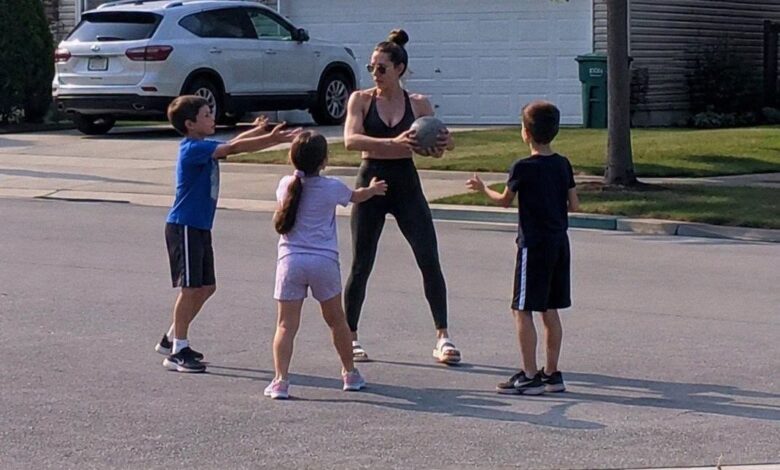
The Kids on Our Street Had Always Played Outside Then a New Neighbor Moved in and Demanded Quiet for Her Morning Yoga
The children on our cul de sac had played outside for years. Then Brooke moved in and decided that every morning from eight to nine should be completely quiet so she could practice yoga. Wanting an hour of calm was understandable. Telling neighborhood children that the public street belonged to her during that hour was not.
At first, the change was easy to miss. Bikes stayed in garages, chalk drawings disappeared, and children who usually gathered in the circle began playing elsewhere. My son eventually admitted that Brooke had told them she had already spoken with their parents and that they were no longer allowed near her home during her practice.
Other families heard the same story from their children. Brooke had not requested reasonable distance from her lawn. She had presented her preference as a rule supported by the adults. Her husband Walter, once a friendly presence who kept chalk on the porch, had become silent and withdrawn whenever the subject arose.
We decided to answer without screaming or trespassing. One Saturday morning, neighbors carried chairs, coffee, a plastic basketball hoop, bicycles, and a new bucket of sidewalk chalk into the cul de sac. At eight o’clock, 19 children and 14 adults were simply using the street the way we had for years.
Brooke stepped onto her porch in workout clothes with a yoga mat under one arm. She accused us of organizing harassment because we had chosen her practice time. I admitted that the timing was deliberate, but explained that standing peacefully on a public street was not harassment. We were demonstrating that she could ask for consideration without claiming ownership.
When Brooke denied telling the children they could not play, several parents confirmed that their children had received the same message. She said we were treating the street as though longtime residents owned it. I answered that nobody owned it, including us and including her.
Walter finally came outside. Brooke asked him to defend her, but instead he questioned whether she had told the children to leave. Mrs. Green had brought a new chalk bucket, and Walter picked up a yellow piece, crouched beside my daughter, and drew a crooked sun next to her purple toothed dinosaur.
Brooke treated his disagreement as humiliation. Walter calmly told her that she used that word whenever someone refused to do exactly what she wanted. He admitted taking his old chalk bucket inside because Brooke said the children made her anxious. Then he apologized to the neighborhood and stopped confusing support for his wife with surrendering every boundary.
The morning could easily have become a public shaming. No one needed to mock Brooke or make noise merely to upset her. We occupied the common space, allowed ordinary play, and refused the false rule. That distinction mattered because a reasonable boundary cannot be defended by becoming cruel to the person who crossed it.
Later, Brooke began therapy and tried what she called noise exposure. Her therapist had suggested that if normal neighborhood sounds felt threatening, forcing everyone else to eliminate them was not a lasting solution. One morning, my six year old asked whether Brooke could teach her a handstand. Brooke agreed, as long as they moved from concrete to grass.
Over the following month, the quiet hours sign disappeared. Brooke still practiced yoga, sometimes indoors and sometimes on the lawn. We moved children farther down the street when play became especially wild beside her house, not because she owned the hour but because neighbors should make reasonable efforts for one another. She stopped treating every sound as an attack.
The relationship never became perfectly warm. Dana remained cautious, and Brooke still disliked our long block meetings. Yet she began making specific requests instead of demands, and we could agree when a bicycle truly blocked the road. Walter no longer vanished whenever she was upset.
The chalk bucket remains on Walter’s porch, children still use the circle, and Brooke still practices yoga. Sometimes all three things happen at once. Living near other people means no one receives perfect silence or unlimited noise. The real improvement came when everyone accepted that consideration is shared, a coping strategy does not outrank other families’ normal lives, and love does not require one person to surrender every reasonable boundary