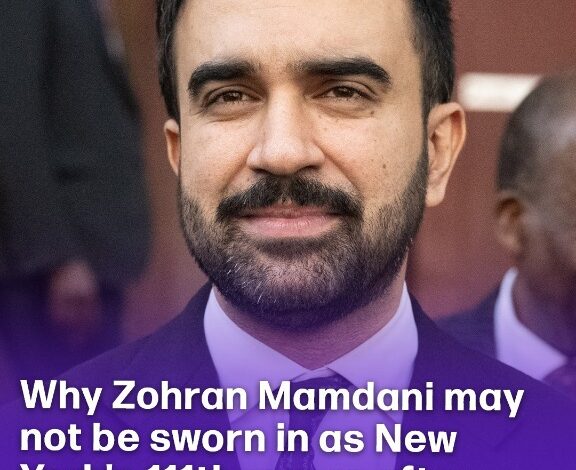
Why Zohran Mamdani may not be sworn in as New York 111th mayor after shocking detail emerges
Zohran Mamdani’s election stunned New York City—not because it was unexpected, but because of what it represented. At 34, he shattered several of the city’s political barriers at once, becoming the first Muslim mayor, the first mayor of South Asian heritage, and the first born on the African continent. His victory marked a cultural shift in a city defined by its diversity yet slow to elevate that diversity into top leadership. As he prepared for his January 2026 inauguration, the city buzzed with anticipation. But just as New Yorkers settled into celebrating the milestone, an odd historical wrinkle emerged—one that had nothing to do with politics and everything to do with a centuries-old accounting error.
Historian Paul Hortenstine had been deep in research, tracing the connections between early New York leaders and the transatlantic slave trade, when he uncovered an overlooked detail. Matthias Nicolls, the city’s sixth mayor, had served not one but two separate terms—one in 1672, the other in 1675. His second term had never been counted independently. The city had always treated his non-consecutive terms as a single entry, even though the office of mayor, much like the presidency, traditionally counts each term separately when numbering leaders. As a result, the official tally of mayors had been off by one for more than three centuries.
If Nicolls’s second term were counted correctly, every mayor after him would shift up a number. That meant the incoming “111th” mayor of New York City would technically be the 112th. Mamdani, without even taking office, had already become the center of an unexpected historical correction.
Hortenstine didn’t keep the discovery quiet. He contacted the mayor’s office, providing documentation and pointing out that the error seemed to trace back to a 17th-century archival record. The miscounting had simply been repeated without question through generations of recordkeepers, historians, and political ceremonies. It wasn’t the first time someone noticed, either. In 1989, historian Peter R. Christoph raised the same discrepancy, asking how nearly a hundred mayors could have been misnumbered. Yet nothing changed. The error became part of the city’s tradition by default, carried forward without scrutiny.
Now, with Mamdani poised to take office as a history-making figure, the oversight resurfaced with fresh urgency. The revelation sparked discussion among city officials, historians, and curious New Yorkers. Would the administration formally acknowledge the correction? Would the city renumber its entire historical list of mayors? Or would the tradition remain intact, the mistake preserved simply because it had survived so long already?
What made the situation even more intriguing was that the correction had no impact on Mamdani’s authority, role, or responsibilities. The city’s laws didn’t hinge on ceremonial numbering. His term wouldn’t change, his powers wouldn’t shrink, and his election wouldn’t be challenged. The issue existed purely in the symbolic space—part historical accuracy, part bureaucratic oddity, part storytelling quirk for future generations.
As word spread, New Yorkers reacted in typical New York fashion. Some found it amusing, a strangely fitting footnote for a city known for its chaotic layers of history. Others were surprised that such an error lasted so long, especially in a city where recordkeeping was usually meticulous. And some argued the correction should be made immediately, not for Mamdani’s sake but for the integrity of the city’s archives. A few even joked that the discovery added yet another “first” to his already groundbreaking election: the first mayor to inherit a numbering controversy dating back nearly 350 years.
Meanwhile, Mamdani moved forward with preparations for his administration. Press conferences focused not on the numbering but on the work ahead. Housing reform, transit improvements, public safety, economic recovery—these were the issues dominating the transition period. He spoke often about inclusivity, representation, and the future of a city that elected him not because of where he came from but because of where he promised to take it. The historical mix-up didn’t distract him; if anything, it became a lighthearted talking point in an otherwise weighty moment.
Behind the scenes, archivists and historians debated the merits of updating the official list. Some argued the correction was necessary, that accuracy in historical records mattered, even when it seemed trivial. Others believed altering a list that had stood for centuries might create more confusion than clarity. The city had built its identity around long, layered history—some flawed, some corrected, all woven together. Changing the numbering after 350 years could ripple through textbooks, plaques, ceremonies, and museum exhibits. The symbolic cost, they argued, outweighed the practical gain.
Still, the debate lingered, and Hortenstine pressed for recognition of the oversight. His motivation wasn’t political; it was rooted in the truth. To him, acknowledging the mistake wasn’t about undermining tradition but about honoring the accuracy of the historical record. Christoph’s research from 1989 had already tried to spark the conversation decades earlier. Now, with a new mayor stepping into office under the spotlight of historic significance, the moment had finally arrived for the city to reconsider the details it had long overlooked.
In the weeks leading up to the swearing-in, the story evolved from an obscure archival discovery into a quirky subplot in one of the most consequential mayoral transitions in modern New York history. Local news covered it with a mix of curiosity and irony. National outlets mentioned it as a footnote, highlighting how even in moments of sweeping political change, the smallest details can steal attention. New Yorkers debated whether the city should embrace the correction or leave the numbering as a relic of its imperfect past.
Through it all, Mamdani remained focused. Ceremony mattered, but leadership mattered more. Whether he was the 111th or 112th mayor had no bearing on the challenges waiting for him on day one. The city needed stability, vision, and bold action—none of which depended on how many predecessors he had in the official count.
Yet the timing of the discovery carried symbolic weight. It served as a reminder that history is never fully settled, never entirely complete. Records, like people, evolve. Mistakes surface. Moments are reinterpreted. And sometimes, the story of a city shifts not through grand political movements but because someone turned a page in a centuries-old ledger and noticed something everyone else had missed.
When Mamdani steps forward to take the oath, the debate over mayoral numbering may still be unresolved. But the city he is about to lead—the one that elected him, questioned its past, and argued passionately about the details—stands ready to watch a new chapter begin. The footnote may linger in articles and conversations, but the significance of his leadership rests in the years ahead, not in the number assigned to his place in the lineup.
And as New York prepares for its groundbreaking mayor, the centuries-old clerical error becomes part of the story—a reflection of a city constantly rewriting itself, even in the fine print.