Woman Noticed Her Husband’s Wedding Ring Was Missing at His Funeral – A Week Later, She Saw It on a Stranger’s Hand
At my husband’s funeral, I discovered that the wedding ring he’d worn for 23 years was missing. I thought someone had stolen it, but a week later, a chance encounter with a stranger left me questioning how well I’d really known the man I loved.
My husband’s wedding ring was missing at his funeral.
One week later, I saw it on a stranger’s hand.
For 23 years, Henry was my husband, my best friend, and the person who never left my side.
We lost two babies late in pregnancy.
After the second loss, I blamed myself for months.
I wondered whether I’d missed something or whether my body had failed our children.
Henry never blamed me.
He held me when I cried, sat beside me when I couldn’t speak, and never made me feel like less of a wife because we had no children.
Eventually, we found happiness again.
Our wedding rings were custom-made.
Henry’s had a gold leaf and two tiny stars, one for each baby we’d lost.
He never took it off.
Then a heart attack took him.
He was 51.
One morning, he was making coffee in our kitchen.
By lunchtime, I was sitting in a hospital waiting room, being told my husband was gone.
At his funeral, I leaned over his casket to touch his hand one last time.
His ring finger was bare.
I turned his hand over and checked beneath his cuff.
“Where’s his ring?” I asked.
My sister, Diane, put an arm around me.
“Marissa, honey…”
“Someone took his ring!”
I made the funeral director check twice.
I called the hospital and questioned the staff.
I even accused someone of stealing it.
Nobody had it.
Eventually, I convinced myself Henry must have lost it somewhere.
A week after the funeral, I forced myself to go grocery shopping.
I stood staring at the top shelf, where Henry’s favorite tea was just out of reach.
“Excuse me,” I said to a young man nearby. “Could you reach that tea for me?”
He stretched upward, and his sleeve slipped back.
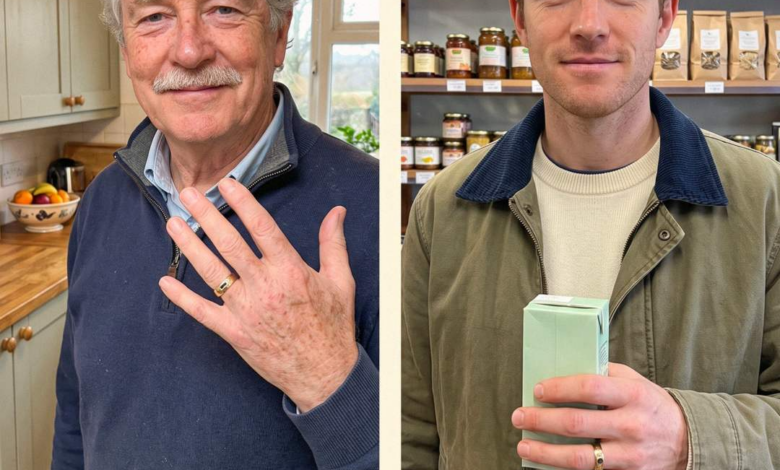
A gold leaf.
Two tiny stars.
A scratch beside the second one.
Henry had made that scratch while repairing our kitchen door.
“Where did you get that ring?”
The young man turned.
“Sorry?”
“That ring!” I grabbed his wrist. “It belonged to my husband. He just died!”
His face went pale.
“Your husband?”
“Henry. His name was Henry.”
The box of tea slipped from his hand.
“Are you Marissa?”
I released his wrist.
“How do you know my name?”
He stared at me, then at the ring.
“Henry gave this to me. What do you mean he’s dead?”
His eyes filled with tears.
“He can’t be dead. He was supposed to call me.”
I gripped my shopping cart.
“Who are you?”
“My name’s Patrick.”
He wiped his face with his sleeve.
“Henry was going to introduce us. He said he wanted us to be a family.”
I couldn’t understand what I was hearing.
“Family? What are you talking about?”
Patrick looked at the ring.
“Your husband asked me not to tell you until he could explain everything himself. He was scared you might not want me.”
The grocery store was not the right place for the conversation we were about to have.
I invited Patrick to a coffee shop across the street.
He looked about 18, with dark hair, worn sneakers, and the nervous expression of someone expecting to be told he’d done something wrong.
We sat opposite each other.
“Start from the beginning,” I said.
Patrick explained that he’d met Henry through weekend activities at our church.
Henry volunteered there every Saturday, organizing food deliveries, helping with repairs, and assisting young people who needed extra support.
I knew about the volunteering.
I just didn’t know about Patrick.
“I grew up in foster care,” Patrick said. “I turned 18 a few months ago.”
He’d moved into a rented room after leaving the system and was struggling to find steady work.
Henry helped him prepare a resume, drove him to interviews, and taught him how to repair his bicycle.
“At first, I thought he just felt sorry for me,” Patrick admitted.
“What changed?”
“He kept showing up.”
One Saturday, Patrick missed a church activity because he was sick.
Henry brought him soup and medicine.
Another time, Patrick mentioned that his room’s heater wasn’t working properly.
Henry helped him contact the landlord and made sure someone came to repair it.
“He never acted like I owed him anything,” Patrick said.
That sounded like my husband.
But something bothered me.
“Henry told me about plenty of people he helped. Why didn’t he mention you?”
Patrick hesitated.
“I asked him not to.”
That surprised me.
“Why?”
“Because I didn’t want people talking about me like I was some charity project.”
He explained that Henry had respected his request.
Their friendship gradually became something more personal, but Patrick still worried about being discussed by strangers.
“Then about a month ago, Henry started talking about family.”
My fingers tightened around my cup.
“What did he say?”
“He asked if I’d ever wanted to be adopted.”
I stared at him.
“He said adults can sometimes be adopted too. He’d been looking into it.”
“Henry wanted to adopt you?”
“He wanted to ask you first. He said it had to be something all three of us wanted.”
I sat back.
Henry and I had discussed adoption years earlier, after our second loss.
I’d been the one to bring it up.
But I wasn’t emotionally ready, and eventually we stopped discussing children altogether.
I’d assumed Henry felt the same way.
“Why would he think I’d agree?” I asked.
Patrick looked uncomfortable.
“He didn’t know if you would.”
Then he said something that hurt more than I expected.
“He told me you two had been happy together, but he wondered if you’d both stopped talking about having a family because you were afraid of hurting each other.”
I looked down.
Henry had been right.
“Why did he give you his wedding ring?” I asked.
Patrick rubbed his thumb over the gold leaf.
“Because I told him I didn’t believe him.”
He explained that he’d lived in five foster homes.
When he was 12, one family discussed adopting him.
He’d started calling them Mom and Dad before they decided they couldn’t handle raising him.
Another foster parent promised they’d stay in touch after he moved out.
They never did.
“So when Henry said he wanted me to be part of his family, I figured he’d change his mind too.”
“What did you tell him?”
“That people always leave eventually.”
Patrick stared at his hands.
“He said he couldn’t promise what you’d decide, but he could promise that he wasn’t going to abandon me.”
Then Henry removed his wedding ring.
“He told me he’d worn it for 23 years. He showed me the stars and explained about your babies.”
I swallowed.
“He said it was the most important thing he owned, and he wanted me to keep it until we could all sit down together.”
Patrick’s voice shook.
“He said, ‘I’m trusting you with something precious because I want you to know how serious I am.'”
I covered my mouth.
Henry had never removed that ring willingly in front of me.
Not once.
“Did he tell you when you were supposed to meet me?”
“That Sunday. He was going to call after talking to you.”
I closed my eyes.
That Sunday had been the day after Henry’s funeral.
Patrick had spent the previous week believing Henry was avoiding him.
“I called him four times,” he admitted. “I thought he’d changed his mind.”
“Patrick…”
“I was going to give the ring back.”
He looked at me.
“Then you told me he was dead.”
Tears rolled down his cheeks.
“I spent all that time being angry at him.”
I reached across the table.
“You didn’t know.”
He wiped his face.
“Can I ask you something?”
“Of course.”
“Did he ever mention wanting a son?”
I thought about Henry teaching our neighbor’s children to ride bicycles, helping with school projects, and volunteering at church.
He’d always loved being around children.
But after our losses, he’d stopped talking about becoming a father.
“I think he wanted to be a dad very much,” I answered.
Patrick nodded.
Then he removed the ring.
“I should give this back.”
He placed it between us.
I picked it up and ran my finger over the familiar scratch.
“Keep it,” I said.
He shook his head.
“It’s yours.”
“Henry gave it to you for a reason.”
Patrick stared at me.
“You really don’t mind?”
I thought about the two stars.
“No. But promise you’ll take care of it.”
He nodded and carefully slipped it back onto his finger.
That evening, I told Diane everything.
She listened quietly before asking, “How do you feel about Henry keeping this from you?”
“I don’t know.”
And I genuinely didn’t.
I loved that he’d cared about Patrick.
But I was hurt that he’d been considering something so important without telling me.
Diane reminded me that Henry had intended to introduce us.
“Maybe he just hadn’t figured out how to bring it up.”
“Maybe.”
But I couldn’t ask him anymore.
Two days later, I visited our church and spoke to the volunteer coordinator, Ruth.
She knew Patrick well.
When I mentioned Henry’s plans, she looked surprised.
“Henry talked to me about Patrick,” she said. “But not about adoption.”
“What did he say?”
“That Patrick needed someone who would stay involved in his life, even when things got difficult.”
Ruth told me Patrick had nearly stopped attending the weekend activities several months earlier.
He’d been offered a better-paying job in another town, but the employer canceled the position before he moved.
Patrick was embarrassed and angry.
He stopped answering calls.
“Henry kept checking on him,” Ruth said. “But Patrick wouldn’t let him visit for a while.”
That changed something for me.
I’d assumed Patrick trusted Henry because Henry was consistently kind.
Now I realized their relationship had already survived Patrick pushing him away.
“Did Henry ever complain?” I asked.
“Not once. He said Patrick had good reasons to be cautious.”
Before leaving, I asked Ruth whether she thought Patrick had other people he could depend on.
She shook her head.
“Not many.”
I drove home thinking about the difference between helping someone and becoming responsible for them.
Henry had been prepared for that responsibility.
Was I?
I called Patrick the following evening.
“Would you like to come over for dinner?”
He sounded startled.
“Why?”
“Because I’d like to get to know you.”
There was a pause.
“You don’t have to do that because of Henry.”
“I know.”
He arrived Friday carrying flowers.
“I wasn’t sure what to bring,” he admitted.
I made chicken soup, which Henry had apparently praised repeatedly.
During dinner, Patrick told me about his job at a hardware store and his plans to study heating and air conditioning repair.
He was funny, observant, and surprisingly stubborn.
When I offered him more soup, he refused three times before admitting he wanted another bowl.
After dinner, he noticed our kitchen door sticking.
“Henry told me about this door,” he said.
I laughed.
“He never managed to fix it properly.”
Patrick asked for the toolbox.
Twenty minutes later, the door closed smoothly.
He grinned.
“Guess he taught me something useful.”
Then his smile faded.
“I wish I could tell him.”
“So do I.”
Before leaving, Patrick asked whether I wanted him to come back the following week.
“I’d like that,” I said.
He looked relieved.
But the following Friday, he canceled an hour before dinner.
The week after that, he didn’t answer my invitation.
I began wondering whether he’d only agreed to visit because he felt obligated.
When I finally reached him, I asked directly.
“Patrick, do you actually want us to keep seeing each other?”
“Yeah.”
“Then what’s happening?”
He hesitated.
“I thought maybe you were just doing this because you felt sorry for me.”
I understood then that he was testing whether I’d disappear when he became inconvenient.
“I’m not asking you to replace Henry,” I told him. “And you don’t have to become my son just because he hoped you would.”
Patrick was silent.
“I’d still like to know you,” I added. “But it has to be your choice.”
After a moment, he said, “Can I come Friday?”
“Of course.”
Over the next few months, we built our own relationship.
Patrick helped me clear out Henry’s garage.
I helped him prepare for his community college entrance assessment.
Sometimes we disagreed.
One afternoon, Patrick invited me to see the room he rented.
I’d never been there.
It was small but clean, with a narrow bed, a desk, and two mismatched chairs.
On the desk sat a photograph of Henry and Patrick outside the church.
“Henry gave me that,” Patrick said.
I picked it up.
My husband was smiling, one arm around Patrick’s shoulders.
I noticed something immediately.
Henry wasn’t wearing his wedding ring.
Patrick saw where I was looking.
“That was taken the day he gave it to me.”
I studied the photograph.
Henry looked proud.
Not sad or uncertain.
Proud.
“Can I have a copy?” I asked.
Patrick smiled.
“Yeah. I was hoping you’d want one.”
That evening, I placed the photograph beside our wedding picture.
For the first time, I could see the family Henry had been hoping to bring together.
But I also understood that his hopes weren’t enough.
Patrick and I had to choose each other.
Three months after our meeting, Patrick came over to help me plant flowers.
We spent the afternoon working in the backyard.
Afterward, we sat on the porch drinking lemonade.
“Patrick, can I ask you something?”
“Sure.”
“Do you still want to be adopted?”
He looked at me.
“By you?”
I smiled.
“Yes, by me.”
He stared at the yard.
“I thought that was Henry’s idea.”
“It was. But I’ve been thinking about it myself.”
He didn’t answer.
“I don’t expect you to call me Mom. You don’t have to move in. And I don’t want you to feel like you owe me anything.”
“Then why?”
“Because I’ve come to care about you. I want to be there when you finish school, when you get your first apartment, and when things go wrong.”
My voice trembled.
“I want you to know you have someone you can count on.”
Patrick looked down at Henry’s ring.
“What if you change your mind?”
“I won’t stop caring about you because we have a bad day.”
He swallowed.
“People say that.”
“I know.”
I reached for his hand.
“I can’t prove what the next 20 years will look like. I can only tell you what I want and keep showing up.”
He was quiet for a long time.
Then he asked, “Would it be okay if I called you Mom someday?”
I started crying.
“Whenever you’re ready.”
He hugged me.
“I think I’d like to be adopted.”
We learned about adult adoption together and took our time making the arrangements.
Several months later, it became official.
Diane took our picture afterward, and Patrick insisted we go out for dinner to celebrate.
He still wore Henry’s ring.
When we got home, he handed me a small envelope.
Inside was a copy of the photograph of him and Henry outside the church.
On the back, he’d written, “He promised I wouldn’t be alone. You kept that promise.”
I hugged him.
Then I told him something I’d been wanting to say for months.
“Patrick, I didn’t adopt you because Henry asked me to.”
He looked at me.
“I adopted you because you’re my son.”
He smiled.
“Thanks, Mom.”
I still miss Henry every day.
I wish he’d lived long enough to introduce us himself.
I wish we’d had the chance to talk about his plans and make them together.
But I know now that he wasn’t trying to replace the children we’d lost.
He’d met a young man who needed a family, and he’d hoped we might become one.
The ring I thought someone had stolen from my husband’s body had actually been given away with love.
It still has the gold leaf, the two stars, and that little scratch beside the second one.
Only now, when I see it on Patrick’s hand, I don’t think about what disappeared at Henry’s funeral.
I think about the family that began before I even knew it existed.
But here is the real question: If you discovered that your late spouse had made a life-changing promise to someone you’d never met, would you feel obligated to honor it, or would you need to build your own connection before welcoming that person into your family?