My Husband and I Took in a Refugee for a Few Nights – One Morning, She Vanished and Left Something Under the Bed
Jenna expects their frightened guest to stay only a few nights. Instead, the girl quietly transforms their home while guarding a secret she refuses to name. Then one morning, she vanishes, leaving behind a note, an abandoned backpack, and a discovery Jenna never expected to make.
I used to think I was good at reading people.
At 40, I had spent enough years watching faces change during uncomfortable conversations, hearing the meaning behind pauses, and noticing when someone said “I’m fine” while looking anything but fine.
Then I met Milly.
My husband, Tristan, and I found the 18-year-old girl beneath a bridge in our city.
It was late afternoon, and the temperature had dropped faster than either of us expected. Tristan and I had been walking home after picking up groceries when he suddenly stopped.
“Jenna,” he said quietly. “Look over there.”
At first, I saw only concrete pillars, dark water, and damp piles of trash caught against the edge of the bridge.
Then something moved.
A girl was sitting against one of the pillars with her knees pulled tightly to her chest. Her clothes were thin, dirty, and completely wrong for the weather. Her face was pale, and her lips had begun to turn blue.
She looked freezing, hungry, and clearly terrified.
Tristan stepped forward, but the girl flinched so violently that he stopped at once.
“It’s okay,” he told her, raising both hands. “We’re not going to hurt you.”
She stared at us without answering.
I crouched several feet away. “My name is Jenna. This is my husband, Tristan. Do you understand me?”
Her eyes moved from me to Tristan and back again. After a moment, she gave a small nod.
I noticed the backpack then.
It was small, faded, and pressed tightly against her chest. She held it with both arms as though someone might tear it away if she loosened her grip for even a second.
“Are you alone?” I asked.
Another nod.
“Do you have somewhere safe to go?”
This time, she looked down.
That answer frightened me more than anything she could have said.
Tristan glanced at me, and I knew what he was thinking. We had a spare bedroom. We had food. We had heat. More importantly, we had no children living at home and no reason to walk away from someone who might not survive the night outside.
Still, bringing a stranger home was not a decision either of us took lightly.
“We can call a shelter,” Tristan offered gently. “Or the police, if you want.”
Her fingers tightened around the backpack.
“No police,” she whispered.
Those were the first words she said to us.
Her voice sounded raw, as if she had not spoken for days.
I exchanged another look with Tristan.
“Would you come home with us?” I asked. “Just for tonight. You can have a warm shower, something to eat, and a room with a lock.”
She studied my face for so long that my knees began to ache from crouching.
Finally, she asked, “Why?”
The question caught me off guard.
“Because you’re freezing,” I replied. “And because leaving you here would be wrong.”
She did not smile. She did not thank us. She simply stood, still clutching the backpack to her chest.
That was how Milly came into our lives.
She told us her name during the walk home, although I could not tell whether it was her real one. She also told us she had fled a country where it was no longer safe, but she refused to say which one.
Whenever Tristan asked even the gentlest question about her journey, her expression closed.
“What happened to your family?” he asked once.
Milly lowered her eyes. “I don’t want to talk about it.”
“That’s all right,” I said quickly.
Tristan nodded. “You don’t have to tell us anything.”
She looked relieved, but only for a moment. Fear returned to her face almost immediately, like a shadow that never left her for long.
At home, I gave her clean towels, a toothbrush, and some clothes I thought might fit.
She thanked me softly, then carried the backpack into the bathroom.
She carried that backpack everywhere, even to the bathroom, and barely spoke to us. The strangest thing was the way she constantly pressed it against her chest, tightening her grip whenever anyone came near.
The first time I reached toward it, I was only trying to move the strap away from a bowl of soup.
Milly jerked backward so fast that the chair legs scraped across the floor.
“Don’t touch it,” she snapped.
I froze.
Tristan stepped into the kitchen. “Everything okay?”
Milly looked from him to me, breathing hard.
“Yes,” I said. “I startled her.”
Her face softened with shame. “I’m sorry.”
“You don’t need to apologize,” I assured her. “No one will touch your things.”
After that, we kept our distance from the backpack.
She always seemed frightened, as though she were hiding something or expecting someone to find her.
A car door slamming outside made her jump. Footsteps in the hallway caused her to turn toward the front door.
Once, when someone knocked to deliver a package, she ran into the guest room and locked herself inside.
Still, something about Milly began to change during the mornings.
The first morning, I woke to the smell of cinnamon and butter.
When I entered the kitchen, she had already cleaned the house, washed the dishes, and prepared an incredible breakfast.
There were pancakes, eggs, sliced fruit, and hot coffee waiting on the table.
I stared at her. “Did you do all this?”
She nodded.
“You didn’t have to.”
“I wanted to.”
Tristan came in behind me and looked around. “You cleaned the living room too?”
Milly’s shoulders rose nervously. “Was that wrong?”
“No,” he said. “Not wrong. Just unexpected.”
She looked down at her hands. “I should help.”
“You are our guest,” I told her.
Her reply was barely audible. “Guests leave.”
The words stayed with me.
Every morning after that, I woke up to discover that she had already cleaned the house, washed the dishes, and prepared an incredible breakfast. We never asked her to do any of it, and we even gave her a little spending money to show our gratitude.
She resisted at first.
“I can’t take this,” she said when Tristan placed the folded bills beside her plate.
“You can,” he replied.
“I did not come here for money.”
“We know,” I said. “Buy whatever you need.”
She stared at the money for a long time before slipping it into her pocket.
During the day, she remained quiet, but little pieces of her personality began to show.
She liked sweet tea but hated milk.
She laughed once when Tristan burned toast, then covered her mouth as if laughter itself might be dangerous.
I started hoping she would trust us.
But every evening, she locked herself inside the guest room and refused to open the door, even when we knocked.
“Milly?” I called one night. “I left clean clothes outside.”
No answer.
“Are you all right?”
Still nothing.
Tristan touched my arm. “Give her space.”
“I know,” I whispered. “I just wish I knew what she’s afraid of.”
Then one morning, I woke up and couldn’t find her in the kitchen or living room.
The house felt strangely still.
“Milly?” I called.
There was no answer.
I checked the bathroom, then the back porch. Her shoes were gone. So was the coat we had given her.
I called out several times, but there was no answer.
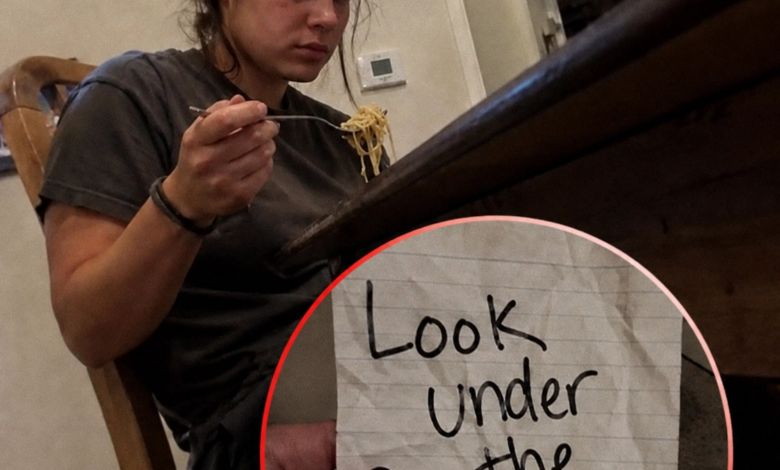
When I entered the guest room, she wasn’t there either, and only a note remained on the bed.
It read:
“Thank you.
I know that after you see what I left, you’ll want to find me. Don’t try. Look under the bed.”
With my heart pounding, I slowly bent down and looked underneath.
For a second, I saw nothing but darkness.
Then my eyes adjusted.
A large padded envelope had been pushed against the wall beneath the bed. Beside it sat Milly’s small backpack.
I stopped breathing.
She had never let that backpack out of her sight. She had carried it to the bathroom, held it while she ate, and slept with it pressed beside her. Seeing it abandoned felt wrong in a way I could not explain.
“Tristan!” I shouted.
He came running down the hallway. “What happened?”
I pointed beneath the bed.
His face tightened when he saw the bag. He crouched beside me and slowly pulled both items into the light.
“Do we open them?” I asked.
Tristan picked up the note again. “She told us to look.”
The zipper made a sharp sound in the silent room.
Inside the backpack were documents wrapped in plastic, several photographs, a cheap phone, and a small wooden box. There were also folded maps marked with routes across borders and cities I did not recognize.
Tristan lifted one of the photographs.
It showed Milly standing beside a woman who looked remarkably like her. The woman had one arm around Milly’s shoulders. A boy of about nine stood in front of them, smiling so widely that his eyes were nearly closed.
“They must be her family,” I murmured.
Tristan turned the picture over.
Three names had been written on the back.
Mila. Danica. Stefan.
“Milly’s real name might be Mila,” he said.
My stomach twisted. “And the others?”
“Her mother and brother, maybe.”
I opened the padded envelope.
A thick stack of cash slid into my lap.
I stared at it in disbelief.
There were more bills than I could quickly count, bundled together with rubber bands. Beneath them lay a letter written in careful, uneven English.
My hands trembled as I unfolded it.
“Read it out loud,” Tristan said softly.
I swallowed and began.
“Jenna and Tristan, I am sorry I lied about my name. My name is Mila, but my little brother called me Milly, so I used that because it made me feel less afraid.”
My voice faltered.
Tristan sat beside me on the floor.
I continued.
“My mother gave me this money before we were separated. She told me it was for a safe place, food, and a new life. I did not spend it because I kept thinking I could use it to find her and my brother.”
I pressed a hand to my mouth.
The letter went on.
“I was not hiding from the police because I had done something wrong. I was hiding from a man named Peter. He helped people cross borders, but later he demanded more money.
When families could not pay, he threatened them. He took their documents and told them they belonged to him until the debt was paid.”
Tristan’s expression hardened.
“That’s who she thought was coming for her,” he said.
I looked back at the letter.
“I escaped from him three days before you found me. I thought he would follow me. I thought he would hurt anyone who helped me.
That is why I locked the door. That is why I watched the windows. That is why I could not tell you where I came from.”
Tears blurred the words.
“I cleaned your home and made food because I did not know how else to repay kindness. Where I had been, kindness always had a price. I kept waiting for you to ask for something.”
I could barely continue.
Tristan took the letter from me, but I shook my head.
“No. I need to finish.”
The next lines hurt even more.
“You gave me money even though I had money hidden in my bag. I am ashamed of that. I did not use yours. It is in the wooden box. Please take it back.”
I reached for the box and opened it.
The bills Tristan had given her were folded neatly inside.
There was also a silver bracelet with a tiny blue stone.
“The bracelet belonged to my mother. Please keep it until I come back. I know I told you not to find me. I wrote that because I was afraid you would follow and be hurt.
I have gone to meet a woman who helps refugees report men like Peter. She says she may know where my mother and brother are.”
I stopped and looked at Tristan.
“She went alone.”
He was already reaching for the cheap phone. “Maybe there’s something on this.”
The phone was locked, but a number had been written on the bottom of the letter.
“Call this woman only if I do not contact you in two days,” I read. “Her name is Sabine. She knows my story.”
Tristan exhaled sharply. “Then we call now.”
“She specifically said two days.”
“Jenna, she’s 18.”
“And terrified,” I replied. “If we ignore what she asked, she may never trust us again.”
He stood and paced to the window.
“So we just wait?”
I hated the idea as much as he did, but I understood something then that I had failed to understand before. We had offered Milly shelter, but shelter was not the same as control. Helping her did not give us the right to make every choice for her.
“We wait until tonight,” I decided. “If she doesn’t contact us, we call.”
Tristan looked ready to argue, then slowly nodded.
Those hours were among the longest of my life.
Every passing car made me look outside.
Every vibration from my phone sent my heart racing.
At 8:17 p.m., an unknown number appeared on the screen.
I answered at once.
“Hello?”
There was a pause, followed by a shaky breath.
“Jenna?”
“Milly?”
Tristan rushed toward me.
She began crying.
“I’m safe,” she managed. “Sabine is with me.”
I closed my eyes. “You scared us half to death.”
“I know. I’m sorry.”
“Did you find your family?”
Another pause followed.
“My brother,” she whispered. “They found Stefan.”
My knees nearly gave way. Tristan caught my arm and guided me to the couch.
“And your mother?” I asked.
“They are still looking.”
Milly’s voice broke, but underneath the grief, I heard something new. Hope.
“Come home,” I told her.
“I left the money.”
“I don’t care about the money.”
“I lied to you.”
“You were trying to survive.”
She cried harder.
Tristan leaned toward the phone. “Milly, the room is still yours.”
For a long moment, she said nothing.
Then she whispered, “Can Stefan come too?”
Three days later, they arrived together.
Stefan was smaller than he looked in the photograph. He stayed close to Milly, and she kept one hand on his shoulder as if she feared he might disappear again.
When she saw the bracelet on my wrist, her eyes filled with tears.
“You kept it,” she said.
“I told myself I was only holding it for you.”
Milly stepped forward and hugged me.
It was the first time she had touched me without fear.
Months later, Sabine helped locate their mother in a temporary shelter across the border. The reunion took time, paperwork, and more patience than any of us knew we had, but it happened.
Milly eventually told me the truth about everything.
She also stopped locking the guest room door.
The backpack remained in her closet, but she no longer carried it from room to room.
Sometimes, when I woke early, I still found her in the kitchen making breakfast. The difference was that she no longer did it because she felt indebted.
She did it because our home had become hers.
And every time she laughed with Stefan at the table, I remembered the terrified girl beneath the bridge and understood how much courage it had taken for her to trust us at all.
So here is the real question: When someone who has known only fear finally risks trusting you, do you protect yourself from the danger following them, or open your home and heart enough to help them believe that kindness can exist without a price?