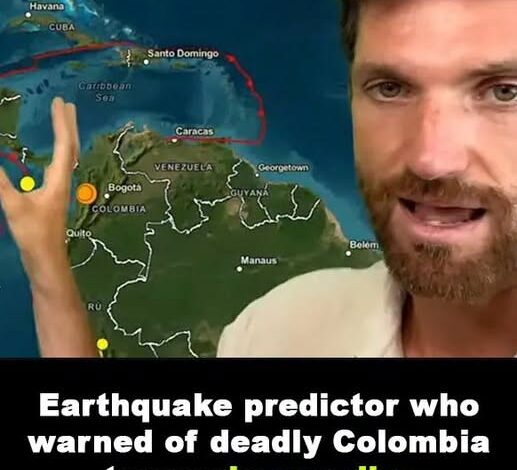
Earthquake Expert Who Warned Before Deadly Colombia Quake Says California Is Super Overdue For Major Event
A geophysicist who said he had warned about major seismic activity before a powerful earthquake in Colombia later turned his attention to California, describing the state as “super overdue” for a major event. His remarks spread quickly because they connected recent earthquakes in South America with California’s long-standing fear of the “Big One.”
The commentator, identified in the source as Burns, pointed to a magnitude 7.4 earthquake in Colombia and earlier activity in Venezuela. He suggested that historical patterns across the Americas justified watching California closely during the following six months to one year. He emphasized Southern California but said increased activity elsewhere made him reluctant to exclude the rest of the state.
Burns also acknowledged an essential limitation: earthquake forecasting is not an exact science. That admission should remain central to any account of his warning. Scientists can estimate long-term probabilities and identify dangerous faults, but they cannot reliably predict the precise date, location, and magnitude of an earthquake.
California unquestionably faces serious seismic risk. The San Andreas Fault system and many other active faults cross heavily populated regions. Geologists know from fault movement, paleoseismic records, and past earthquakes that damaging events will occur again. “Overdue,” however, is an informal description, not a countdown.
Faults do not follow a human calendar. If the average interval between major ruptures is a certain number of years, that does not mean an earthquake must happen immediately after the average has passed. Recurrence intervals vary, and each fault segment behaves within a complex regional system.
The idea that a large earthquake thousands of miles away can automatically trigger California’s next major rupture also requires caution. Powerful earthquakes can send seismic waves around the world and sometimes influence small changes or remote tremors. That does not provide a dependable method for predicting a major California earthquake months later.
The source referenced work by seismologist Dr. Lucy Jones modeling a magnitude 7.8 earthquake on the southern San Andreas Fault. Such scenarios are valuable for preparation. They examine how prolonged shaking could damage buildings, roads, water lines, electricity, communications, hospitals, and emergency services across a wide area.
A scenario is not a prediction. Its purpose is to show what could happen so governments, utilities, businesses, and families can reduce losses before an earthquake occurs. The difference matters because a dramatic forecast can create panic, while a scientifically grounded scenario encourages practical action.
Californians do not need a viral deadline to prepare. Heavy furniture and water heaters can be secured, emergency supplies stored, family communication plans established, and earthquake alerts enabled. People should know to drop, cover, and hold on during shaking, then check for injuries, fire, gas leaks, and structural hazards afterward.
Households should consider water, medication, flashlights, batteries, sturdy shoes, food, and copies of important documents. Businesses and schools need drills and continuity plans. Older buildings may require retrofitting, especially structures known to perform poorly during strong shaking.
Statements from one commentator should be compared with information from the U.S. Geological Survey, state geological authorities, and established seismologists. A person may correctly emphasize that California has substantial risk while overstating the ability to connect distant earthquakes or define a short window.
The responsible conclusion is neither dismissal nor panic. California will experience damaging earthquakes in the future, and preparation is justified today. But no credible evidence in the source established that a major event was certain within six months or one year. The real warning is permanent: people living in earthquake country should prepare before the ground moves, not because someone has predicted a date, but because the long-term hazard is real. Earthquake readiness should become routine rather than a temporary reaction to a frightening video. The safest household is the one that prepared while no prediction was trending and maintained those supplies as part of ordinary life.