My Mom Cooked Meals for a Homeless Man Who Lived Behind Our House for 20 Years – The Day After Her Passing, He Took My Hands in His and Said Something That Changed My Life
The day after my mother’s funeral, the man who had lived behind our house for most of my life was gone.
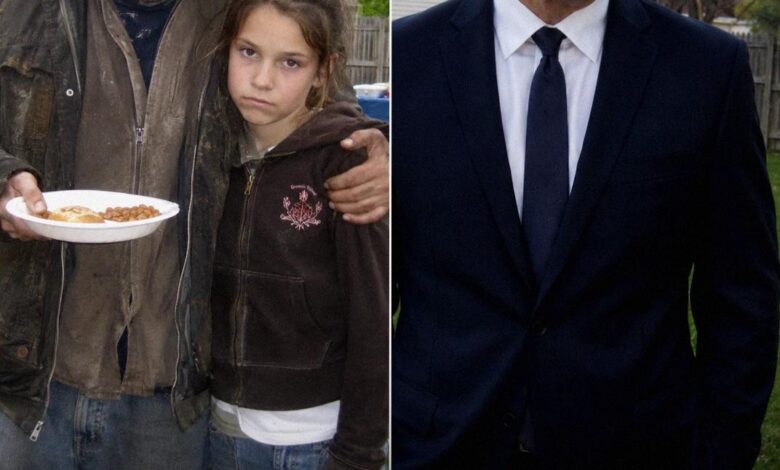
For twenty years, Victor had slept in a shelter made of tarps, scrap wood, old blankets, and whatever kindness my mother could sneak past the world. He lived just beyond the fence of our little rental house, close enough that I could see the smoke from his coffee can stove in the mornings My mother fed him every single day.
And for most of my life, I hated him for it.
Not because he was cruel. Victor was never cruel to me. He was quiet, careful, and always seemed to fold himself smaller whenever I came near, as if he knew his presence bothered me.
But we were poor too.
That was the part no one seemed to understand.
Our lights were cut off twice one winter. My sneakers had duct tape over the toes. My mother watered down soup and pretended she liked it thin.
Still, every afternoon, she packed three meals.
One for me.
One for herself.
And one for Victor.
The third meal always went into the cleanest plastic container we had.
When I was eleven, I finally said what had been burning inside me.
“He eats better than I do.”
Mom stood at the stove, stirring chicken soup.
“Fiona,” she said quietly, “don’t start.”
“Why not? It’s true. We barely have enough, but Victor gets food like he’s family.”
The spoon slipped from her hand and clattered into the sink.
She turned toward me, her face suddenly pale.
“Don’t say his name like that.”
“Like what?”
“Like he’s nothing.”
I folded my arms, hungry and angry in the way only a hurt child can be.
“He’s just some man behind our house.”
Mom’s voice changed.
“No,” she said. “He isn’t just some man.”
For one second, I thought she might finally explain.
Instead, she shoved the warm container into my hands.
“Take him his food.”
I stared at her.
“Maybe if you stopped feeding strangers, we wouldn’t live like this.”
Her palm struck the counter so hard I jumped.
“Don’t you ever say that again. You have no idea what that man gave up.”
“Gave up for who? You?”
Her eyes filled with something I didn’t understand.
Then she turned away.
“Take him his food, Fiona. This conversation is over.”
So I did.
Victor sat near the fence that day, rubbing his hands together against the cold.
“Your mom make soup?” he asked softly.
“Chicken.”
He smiled, just a little.
“That’s her best one.”
“You don’t even know her.”
The smile disappeared.
“I know her soup,” he said.
I hated him more for saying that.
Years passed.
I moved out eventually, and Mom and I fought less because I stopped asking questions. But Victor stayed. He stayed through storms, winters, heat waves, and every season of my resentment.
Sometimes I noticed things I couldn’t explain.
A loose porch step fixed overnight.
Firewood stacked by the back door after a storm.
A pair of secondhand boots appearing beside my backpack after mine split open in high school.
“Where did these come from?” I asked Mom once.
“Church donation,” she answered too quickly.
I looked out the kitchen window.
Victor was brushing snow from the steps.
I still didn’t understand.
Then cancer came and made my mother small.
Stephanie, the woman who once carried grocery bags in both hands and opened doors with her elbows, became thin enough that I could see every bone in her wrist.
Two weeks before she died, I sat beside her hospital bed while she picked at the blanket.
“Fiona.”
“I’m here.”
“You have to promise me something.”
“Mom, rest.”
“No.” Her fingers closed around my wrist. “Victor.”
My stomach tightened.
“Not this again.”
“Promise me you’ll feed him.”
“Why?” I whispered. “Why him? Why always him?”
Her eyes filled.
“I never put him before you.”
“It felt like you did.”
“I know,” she said, her voice breaking. “And I’m sorry.”
“Then tell me why.”
Her gaze drifted toward the hospital room door, as if someone might be listening.
“If Mark comes around after I’m gone, don’t let him touch the blue box.”
I blinked.
“Uncle Mark? What does he have to do with Victor?”
Her grip tightened.
“He’ll erase him completely.”
“Erase who?”
“Just promise me.”
I wanted to demand answers.
But she looked so frightened, so fragile, and I was still her daughter.
“I promise.”
A tear slid down her cheek.
“He was my safe place,” she whispered.
A few days later, she was gone.
After the funeral, people filled her little house with sandwiches, casseroles, and soft voices.
Uncle Mark stood near the hallway, already opening boxes.
“What are you doing?” I asked.
He smiled the smooth, patient smile he always used when he wanted me to feel unreasonable.
“Helping.”
“By going through her things?”
“Your mother kept too much, Fiona. Old papers. Broken dishes. Things that only made her sad.”
“I’ll decide what stays.”
His smile thinned.
“You’re grieving. This isn’t the time to make emotional choices.”
I looked past him toward the back window.
Victor’s shelter sat behind the fence, half hidden by weeds.
“Funny,” I said. “Mom told me almost the same thing about you.”
Mark’s hand froze on a cardboard box.
“What did Stephanie say?”
“That if you came around, I shouldn’t let you touch the blue box.”
For one second, his face changed.
Then he laughed softly.
“She was sick.”
“She was scared.”
“Of me?”
“You tell me.”
His eyes flicked toward the relatives in the living room.
Then he leaned closer.
“Leave old pain buried, Fiona.”
The next morning, I made beef stew because it was the only meal I knew I couldn’t ruin. I put it in one of Mom’s plastic containers and drove back to her house.
But Victor’s shelter was empty.
The blanket was folded neatly.
The coffee cans were gone.
Even the firewood had been stacked in a perfect line.
“Victor?” I called.
“Fiona.”
I turned.
Victor stood near the back steps wearing a clean dark coat. Beside him was a black SUV I didn’t recognize.
He looked different without his tangled beard and layers of worn clothing.
Older.
Tired.
Almost dignified.
Mrs. Bell, Mom’s longtime neighbor, stepped out from the driver’s seat.
“It’s borrowed from my nephew,” she said before I could ask. “Victor wanted to visit your mother’s grave without Mark causing trouble.”
Then I saw what Victor was holding.
A small silver locket.
My mother’s locket.
The one she claimed she lost when I was eight.
“Where did you get that?” I asked.
Victor’s thumb moved over the dented edge.
“Stephanie gave it to me.”
“That locket was lost.”
“No,” he said quietly. “She told you it was.”
My chest tightened.
“Why would my mother give you her locket?”
“Because I gave it to her first.”
I stared at him.
“When?”
“When she was little. Maybe ten. Maybe younger.”
He opened the locket.
Inside was a faded photograph of two children sitting on porch steps. A little girl with my mother’s eyes. A boy with his arm wrapped protectively around her shoulders.
On the back, scratched in childish handwriting, were three words.
My safe place.
“That’s Mom,” I whispered.
Victor nodded.
“And the boy is you?”
“Yes.”
I stepped back.
“No. Mom only had one brother.”
“Mark was the youngest,” Victor said.
“You’re lying.”
“I wish I were.”
“If you were her brother,” I said, my voice rising, “why did she make you live outside?”
Victor flinched.
Mrs. Bell answered for him.
“Because Mark scared her.”
I turned.
“Scared her how?”
“He told Stephanie people would call her unfit if she let Victor near you. She was poor, single, and terrified.”
Victor closed the locket carefully.
“She let me stay close. That was all she thought she could risk.”
My mother’s hospital words slammed back into me.
The blue box.
I ran inside.
I tore through Mom’s closet until I found it hidden beneath old blankets.
My name was written across the lid.
Inside were photographs, letters, and envelopes.
The first photo showed Mom as a little girl beside Victor. Her knees were scraped. His lip was split.
On the back, in Mom’s handwriting, were the words:
Victor walked me home again.
Then I found the letter addressed to me.
Fiona,
If you are reading this, then I wasn’t brave enough to tell you while I was alive.
Victor was my brother before he was anything else.
He packed my lunch, walked me to school, and gave me the good blanket when there was only one.
Once, when we were children, he took our mother’s bracelet and tried to sell it. Not for candy. For blankets. The pipes had frozen, and we were freezing.
They never forgave him.
Not Mark.
Not our parents.
Mark called him a thief for the rest of his life, even after Victor had only been trying to keep us warm.
Then Victor got sick, and the family punished him for becoming the person they had already decided he was.
Mark said Victor was dangerous. He said I was too poor to understand risk. When you were little, he told me that if I let Victor near you, people would question whether I was fit to be your mother.
I believed he could take you from me.
So I made the worst bargain of my life.
I kept Victor alive, but I let you believe he was a stranger.
Please don’t let Mark put him outside again.
Love,
Mom
By the time I finished reading, I could barely breathe.
All those years.
All those meals.
All that resentment.
I thought Mom had chosen Victor over me.
But she had been trying to protect both of us in the only broken way fear allowed.
When I returned to the house, Mark was already there.
And the blue box was in his hands.
“Put that down,” I said.
He gave me that soft smile again.
“Fiona, you’re upset. Let me handle this.”
“No,” I said. “You’ve handled enough.”
Victor stepped in behind me.
Mark’s face hardened.
“Get him out.”
I moved in front of Victor.
“His name is Victor. He’s Mom’s brother.”
Aunt Linda gasped from the living room.
“But you said he died, Mark.”
Mark snapped, “Because that was easier.”
“Easier for who?” I asked.
He looked around, searching for support.
I held up my mother’s letter.
“She wrote everything down. You threatened her. You used her poverty against her. You made her believe loving her own brother could cost her daughter.”
“I protected this family,” Mark said.
“No,” I replied. “You protected the version where Victor didn’t exist.”
Victor’s voice shook, but he stood tall.
“I chose Stephanie when you chose appearances.”
Mark grabbed his coat.
“You’ll regret this, Fiona. He’ll drain the life out of you the way he drained hers.”
“I already regret too much,” I said. “But not this.”
Aunt Linda stepped between Mark and the hallway table.
“Leave the box,” she said.
His eyes narrowed.
“Linda.”
“No,” she said, her voice trembling. “You told us he was dead.”
The room changed then.
No one looked confused anymore.
They looked ashamed.
Judging.
Mark dropped the box, yanked open the door, and left.
For a long moment, nobody moved.
Then I turned to Victor.
“Uncle Victor,” I said softly. “Come sit down.”
He looked at me as though he had waited twenty years to hear those words.
I set two bowls of soup on Mom’s chipped kitchen table.
Victor stopped at the doorway.
“I can eat outside.”
“No,” I said. “You don’t eat outside anymore.”
His eyes filled.
“Tonight, you’re staying here. Tomorrow, we’ll figure out the rest together.”
He sat slowly, holding Mom’s locket between his hands.
For the first time in twenty years, Victor’s meal did not leave through the back door.
It stayed on the table.
Where family belonged.